Collegiate GPA Calculator
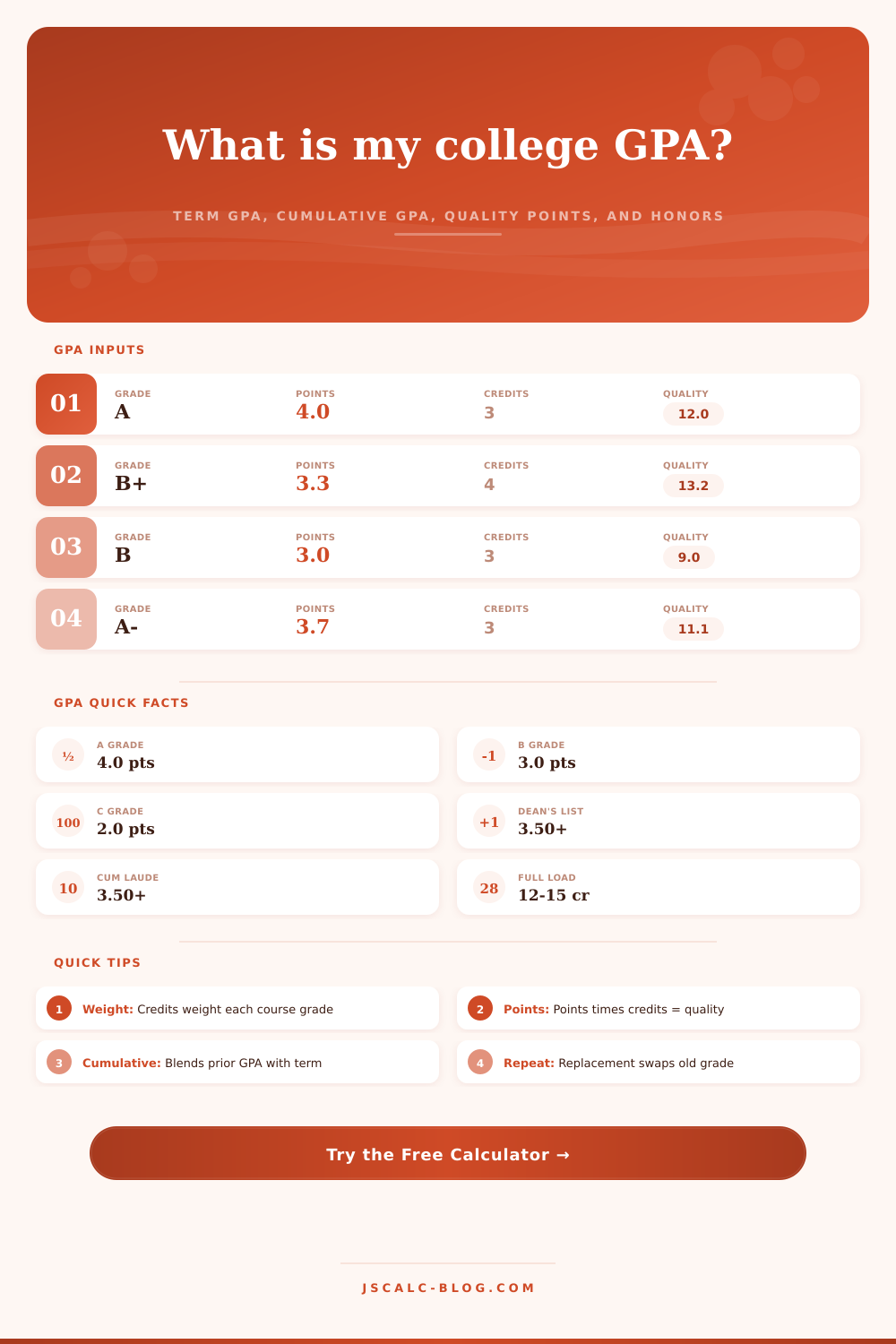
Enter each course grade and credit hours to compute your term GPA and blended cumulative GPA, total quality points, credit load, and Latin honors band on the standard 4.0 or plus/minus grade scale.
🎓Real Semester Presets
📚This Term's Courses
⚙Scale, Prior Record & Target
Switching updates every grade dropdown above.
Only used when grade replacement is On.
🔢Formula Snapshot
📄Per-Course Quality Points
| Course | Grade | Points | Credits | Quality Points |
|---|---|---|---|---|
| Enter courses above to see the per-course breakdown. | ||||
📊Letter Grade to Grade Points
| Letter | Plus/Minus Points | Standard 4.0 Points | Meaning |
|---|---|---|---|
| A | 4.0 | 4.0 | Excellent |
| A- | 3.7 | 4.0 | Near excellent |
| B+ | 3.3 | 3.0 | Very good |
| B | 3.0 | 3.0 | Good |
| B- | 2.7 | 3.0 | Above average |
| C+ | 2.3 | 2.0 | Slightly above avg |
| C | 2.0 | 2.0 | Average |
| C- | 1.7 | 2.0 | Below average |
| D+ | 1.3 | 1.0 | Weak pass |
| D | 1.0 | 1.0 | Minimum pass |
| D- | 0.7 | 1.0 | Lowest pass |
| F | 0.0 | 0.0 | Failing |
🗂GPA Classification & Latin Honors
| GPA Band | Classification | Latin Honors | Sample Standing | Notes |
|---|---|---|---|---|
| 3.90 – 4.00 | Highest distinction | Summa Cum Laude | Top 1-5% | Often thesis or GPA cutoff |
| 3.70 – 3.89 | High distinction | Magna Cum Laude | Top 10% | Strong honors eligibility |
| 3.50 – 3.69 | Distinction | Cum Laude | Top 25% | Common Dean's List floor |
| 3.00 – 3.49 | Good standing | None | Solid | Meets most major GPA rules |
| 2.50 – 2.99 | Satisfactory | None | Average | Watch competitive programs |
| 2.00 – 2.49 | Minimum good standing | None | At risk | 2.0 is a common floor |
| 1.00 – 1.99 | Academic probation | None | Warning | Improvement plan likely |
| 0.00 – 0.99 | Subject to dismissal | None | Critical | Consult an advisor now |
📐Credit Load Reference
| Load Type | Credits / Term | Status | Typical Use |
|---|---|---|---|
| Part-time | 1 – 11 | Reduced | Working or returning students |
| Full-time | 12 – 15 | Standard | Most aid and housing rules |
| On-track (4-yr) | 15 – 16 | Recommended | 120 credits in eight terms |
| Heavy overload | 17 – 21 | Overload | May need dean approval |
🧮Full Formula Breakdown
💡Practical GPA Tips
The grade point average is a strange phenomenon for most students: something we’re able to observe but can actualy influence through smart semester planning. We take a test and see a B in Chemistry and feel as though the rug’s been pulled from beneath us, one poor test will forever ruin our chances academically (or so it seems). Nothing could be further from the truth. Nothing could be more mechanical.
Your GPA is nothing more than an average weighted by class load. It doesn’t evaluate you as a person and it doesn’t assess your future prospects. It only considers how many quality points you earned compared to number of credit hours in which you tried to earn them. Knowing this makes all the difference in terms off planning your semesters.
How to Manage Your GPA
After you enter in your credits and grades, this calculator does all of math for you. No need to do any calculations by hand; now you’re free to think about strategy instead.
Weight is key: A 4-credit engineering course pulls your average significantly harder than a 1-credit elective seminar. If your cumulative score is hovering around the red zone, you should of make it your top priority to protect your grade in these big-hitter courses. An A -> B slide in a 4-credit class are worse than a C -> D drop in a 1-credit lab. Easy leverage.
Additionally, most students don’t realize cumulative average stabilizes as time goes on. As a freshman, with only 30ish credits, a solid semester could raise your GPA by a whole point, or knock it down by a whole point. By junior year, with 90+ credits racked up, that same showing doesn’t even move the needle much at all. That is because total number of credits makes it harder to change your average.
Do you have a lower GPA? If you’re in your second year now and want to graduate with honors standing, sorry; you can’t correct it in just one semester. It’ll take several semesters of nearly perfect grades before you pull the average high enough to clear those thresholds: with honors or high honors, etc. Use the calculator below to plug in your current GPA and credit hours, and it will show you how many perfect term you would need to achieve a specific GPA goal.
Cum laude and summa cum laude are bandings typically used by schools to indicate that a student has distinguished themselves in some way, but they’re not hard-and-fast indicators of high intelligence; they’re simply administrative conventions. Cum laude may mean something like a 3.5 (or higher) at one college, whereas summa might mean nearly perfect, 3.9 or better, with no blemishes. There’s such diversity among universities. Some will give honors to the top ten percent, others use fixed cut-off numbers regardless of a student’s class ranking. Understanding how your particular school defines those lines is important: Do you want to push for that additional decimal place? Or is it enough to know you’re in good standing? The chart on the page lists out common banding so you can check how you’re tracking toward average standards.
Grade replacement policy is another detail to consider. Certain universities will let you retake courses you did poorly on or fail and have them replaced altogether in your overall calculation. They’ll erase your mark from the equation. Others require they averages both attempts. That could mean the difference between staying in good standing or being put on academic probation. Using this option (if available) with core pre-reqs can turn your path around if your school permits it, otherwise, you’re stuck lugging weight of past grades forever.
But a GPA is ultimately only a number. And while it can opens certain doors, like competitive internships or graduate admission, it doesn’t necessarily reflect problem solving, curiosity, or resilience. The takeaway? Use the calculator for what it’s good at (managing the numbers easly) and apply yourself to learning the material so thoroughly that the grades tend to take care of themselves. Change how you look at it, and what used to cause anxiety becomes something you can easly measure.