Sales Tax Calculator
Add sales tax to a subtotal, reverse-extract the tax hidden inside a grand total, or solve for the combined rate. Handles state plus local add-ons, discounts before tax, per-item splits, and rounding.
🎯Real State Rate Presets
📝Sale Details
Picking a state auto-fills the base tax rate. You can still edit it.
In reverse mode this is treated as the grand total that includes tax.
Used only in find-rate mode with the subtotal above.
Exempt sets the applied tax to zero for a quick compare.
🔢Formula Snapshot
📊US State Sales Tax Rates
| State | State Base | Avg Local | Combined | Notes |
|---|---|---|---|---|
| California | 7.25% | 1.60% | 8.85% | Highest state base rate |
| Texas | 6.25% | 1.95% | 8.20% | Local capped at 2.00% |
| New York | 4.00% | 4.53% | 8.53% | NYC combined 8.875% |
| Florida | 6.00% | 1.00% | 7.00% | County surtax varies |
| Illinois | 6.25% | 2.60% | 8.85% | Chicago hits 10.25% |
| Tennessee | 7.00% | 2.55% | 9.55% | Among highest combined |
| Colorado | 2.90% | 4.90% | 7.80% | Lowest state base |
| Washington | 6.50% | 2.90% | 9.40% | No state income tax |
| Pennsylvania | 6.00% | 0.34% | 6.34% | Clothing exempt |
| Oregon | 0.00% | 0.00% | 0.00% | No statewide sales tax |
🗂Rate Comparison Grid
| Region | Base | Local | Combined | Tax on $100 | Total $100 |
|---|---|---|---|---|---|
| Oregon | 0.00% | 0.00% | 0.00% | $0.00 | $100.00 |
| Colorado (Denver) | 2.90% | 5.91% | 8.81% | $8.81 | $108.81 |
| Florida (Miami) | 6.00% | 1.00% | 7.00% | $7.00 | $107.00 |
| Texas (Houston) | 6.25% | 2.00% | 8.25% | $8.25 | $108.25 |
| California (LA) | 7.25% | 2.25% | 9.50% | $9.50 | $109.50 |
| New York (NYC) | 4.00% | 4.875% | 8.875% | $8.88 | $108.88 |
| Tennessee (Memphis) | 7.00% | 2.75% | 9.75% | $9.75 | $109.75 |
| Illinois (Chicago) | 6.25% | 4.00% | 10.25% | $10.25 | $110.25 |
💲Quick Rate × $100 Lookup
| Combined Rate | Tax on $50 | Tax on $100 | Tax on $250 | Tax on $1,000 |
|---|---|---|---|---|
| 4.00% | $2.00 | $4.00 | $10.00 | $40.00 |
| 6.00% | $3.00 | $6.00 | $15.00 | $60.00 |
| 7.25% | $3.63 | $7.25 | $18.13 | $72.50 |
| 8.25% | $4.13 | $8.25 | $20.63 | $82.50 |
| 8.875% | $4.44 | $8.88 | $22.19 | $88.75 |
| 9.55% | $4.78 | $9.55 | $23.88 | $95.50 |
| 10.25% | $5.13 | $10.25 | $25.63 | $102.50 |
⚙Full Formula Breakdown
📋Taxable vs Exempt Categories
| Category | Common Treatment | Why It Varies | Watch For |
|---|---|---|---|
| Groceries | Often exempt or reduced | Many states waive food tax | Prepared food is taxable |
| Prescriptions | Usually exempt | Medical necessity rules | OTC meds may be taxed |
| Clothing | Mixed by state | PA and NJ exempt apparel | NY exempts under $110 |
| Digital goods | Increasingly taxable | Newer state statutes | Streaming and software |
| Services | Often untaxed | Goods-focused tax base | Some states tax services |
| Shipping | Depends on state | Taxable if bundled | Separate line can help |
💡Practical Sales Tax Tips
The price on the register doesn’t match the sticker price. There’s a little jolt of surprise that happens.
And it all adds up, the sales tax isn’t always a single flat percent these days. It’s got a base rate from the state plus typically another layer of extra tax at the city or county level. Depending where you live, overall rate can be wildly different. Without learning to break it down for yourself, it gets difficult to calculate cost.
How to Calculate Sales Tax Easily
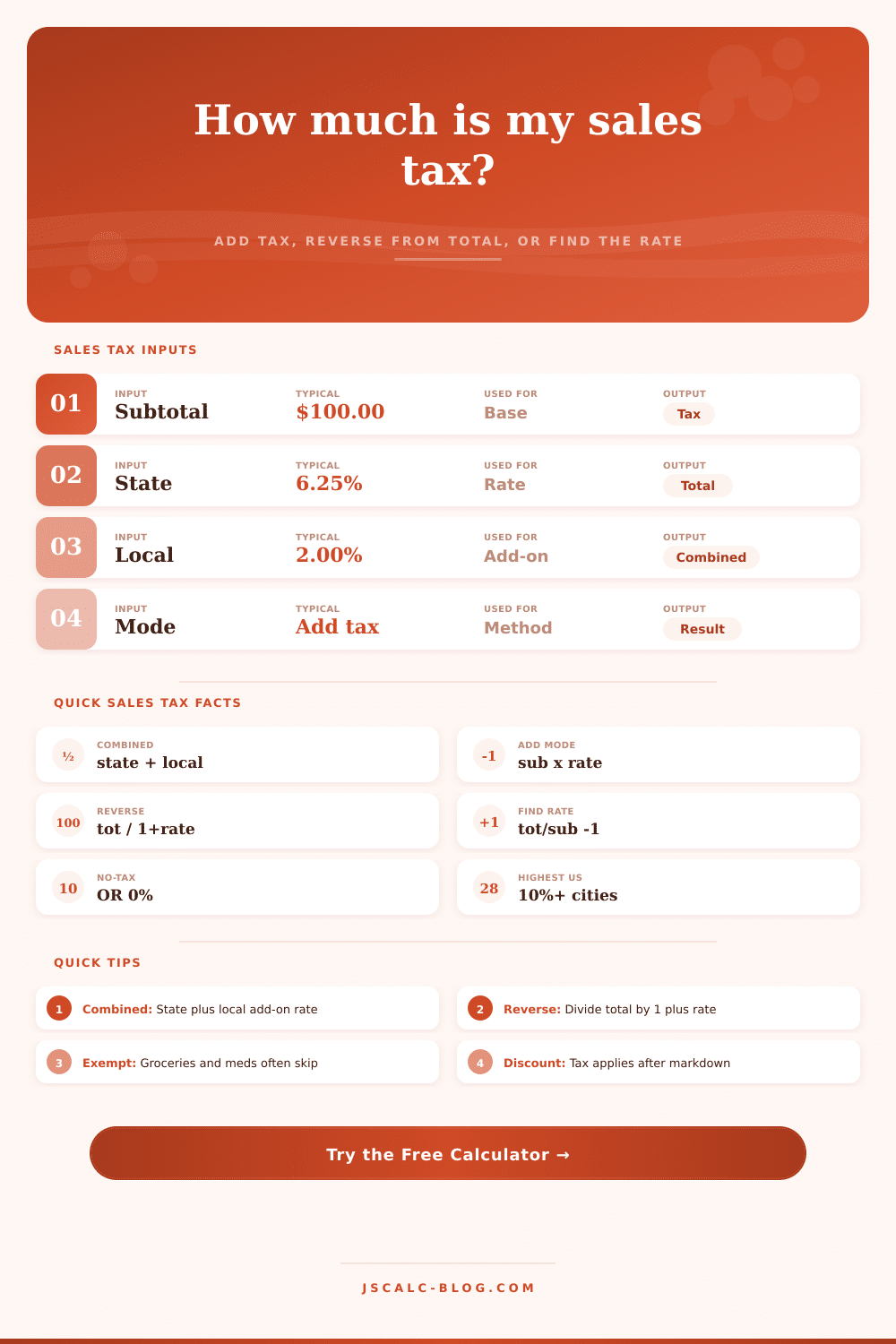
By plugging in your subtotal and location, calculator takes care of all the math for you. Because it’s built to deal with three different scenarios, it saves you from having to guess at how these layers of rates interacts. For example, most users will use it to add tax to a price that they already know, but if you want to calculate the pre-tax cost, then you can use reverse mode.
In this situation, you divide the total on your receipt by 1 + the tax rate. The reason why people who attempt to do this in their head usually gets it wrong is because the tax was applied to original price, so subtracting the percentage from the total doesn’t work.
Knowing why rates vary from one state line to another helps. For example, some states don’t collect an income tax at all (such as Tennessee or Florida) so they depends more on sales tax. Some states has a low state-based rate but permit local governments to tack on substantial surcharges. If you’re curious about how Chicago stacks up against Portland, for instance, you’ll find this information laid out in reference table.
There’s not a wild reason behind the variation. It’s the result of political choices and the budget priorities of each area (which impacts your wallet). Knowing whether you are subject to the state rate vs. The combined local rate will help avoid surprise when you shop online or cross a state line.
There’s also another level of complexity that catches people by surprise: discounts. When there’s a sale and you use a coupon to bring down the price, sales tax gets based off final amount. So if you purchase something for $100 that has 20% off, you don’t pay tax on $100. You pay tax on what you paid: the $80 discounted price. That means using your coupon really saves you money on tax too. A little thing, sure, but when you’re stretching a budget it counts.
These aren’t the only items subject to the rules, however. Certain purchases, typically groceries and prescription drugs, get tax breaks. Clothing is another matter; its treatment vary greatly from state-to-state. While some exclude clothing from sales altogether, others treat clothes as just another item. Newer categories of digital goods have emerged as another area where governments is seeking to impose taxes (because software downloads and streaming services count as taxable transactions in today’s economy).
If you wish to see what your purchase price would look like with no tax, there’s a switch that toggles that option on the calculator. You can use this comparison to measure the true cost of tax policy on everyday expenses.
There’s also the matter of rounding, which sounds small but can add up: most retailers round to nearest penny when charging, although some may round up or have different rules for multi-item carts. You can tweak that setting within the tool if you’re looking at something where accuracy matters (like a business purchase). But for people just shopping around casually, default rounding tends to work well enough.
It’s just that you want to understand how much is in your bank account and in your hand as you walk out the door. It makes sense out of a confusing receipt. It helps you understand what happened. No longer do you feel taken advantage of… Bamboozled! They use sneaky fees. You get to know the math behind it all and this is empowering whether you’re saving up for something big or simply wondering where your hard-earned moolah is being spent.
It puts that checkout jolt back in its place and allows you to get on with planning for tomorrow. You should of seen how complicated tax can be. Everything seems more naturaly once you know the maths.