Extra Credit Impact Calculator
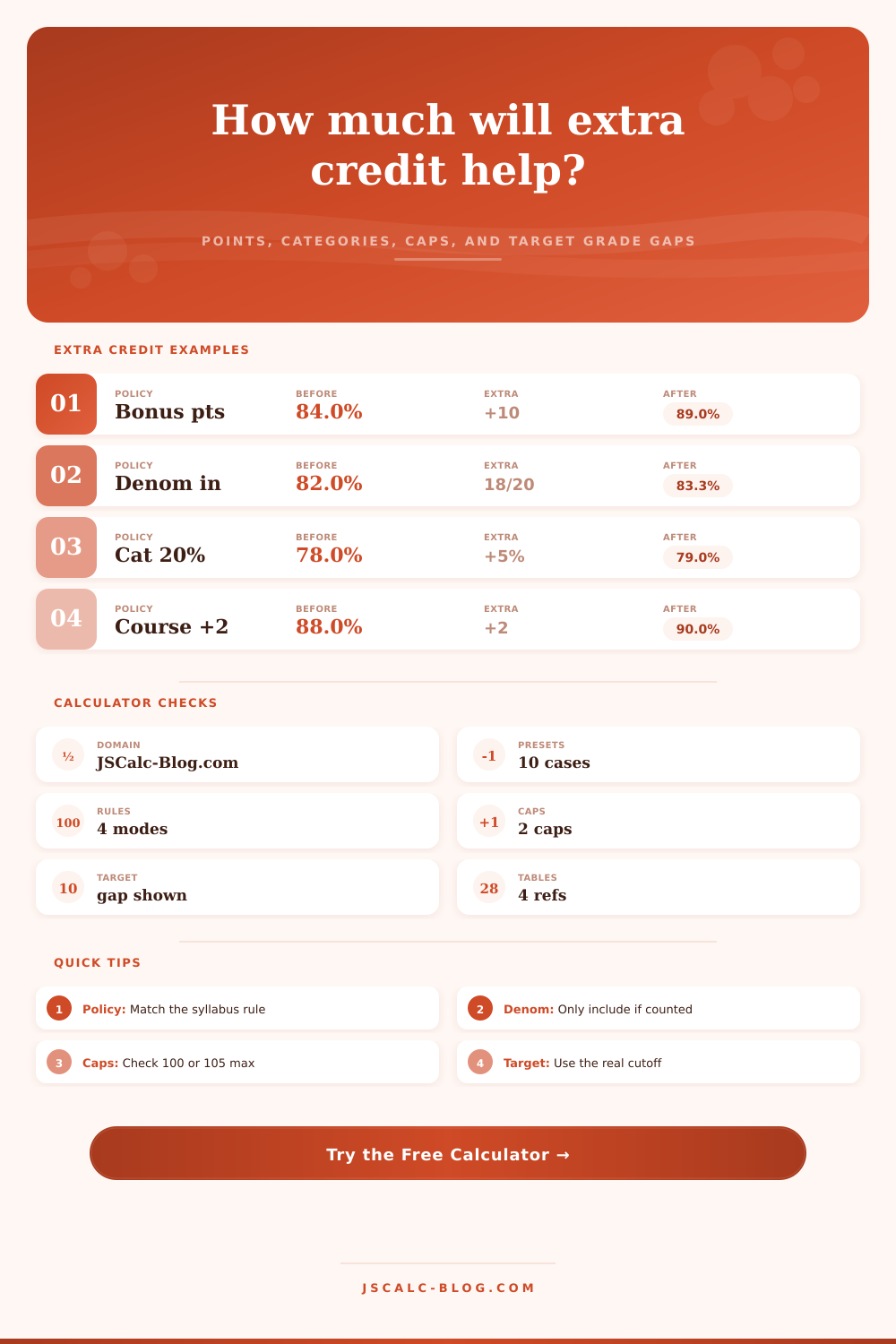
Estimate how extra credit changes a points grade, a weighted category, or the final course percentage using denominator rules, caps, and target grade gaps.
Each preset fills the grading policy, current points, extra credit rule, caps, and target cutoff. You can edit every field after loading.
Extra credit impact
Enter your numbers and calculate to see the exact grade change.
Results will appear here after calculation.
| Policy | Formula | Denominator | Best use | Common mistake |
|---|---|---|---|---|
| Bonus points | (earned + extra) / possible | Excluded | Optional bonus quiz or attendance points | Adding possible points when the syllabus says bonus-only |
| Included assignment | (earned + extra) / (possible + extra possible) | Included | An extra task scored like a normal assignment | Treating a low extra-credit score as pure bonus |
| Category percent | category percent + bonus percent points | Not points based | Syllabus says "add 3 points to homework average" | Multiplying the bonus by the category weight twice |
| Course percent | final grade + bonus percent points | Not points based | Syllabus says "add 1 point to final grade" | Putting course-wide bonus into one small category |
| Category cap | min(raw category, cap) | Depends on policy | Grades that cannot exceed 100, 105, or 110 | Counting bonus points above a stated maximum |
| Final cap | min(raw final, course cap) | After weighting | Transcript gradebooks with max final percentage | Reporting 102% when final grades are capped at 100% |
| Scenario | Current setup | Extra credit rule | Category result | Final grade effect | Target note |
|---|---|---|---|---|---|
| Bonus quiz | 420 / 500 in a 30% category | +15 numerator-only points | 84.0% to 87.0% | +0.9 final points | Helps most when the category is heavily weighted |
| Included task | 205 / 250 in homework | 18 / 20 added to numerator and denominator | 82.0% to 82.6% | Small lift because denominator grows | Still useful, but not a pure bonus |
| Category boost | 76% project category | +5 percentage points to category | 76.0% to 81.0% | +1.25 if category weight is 25% | Do not divide by points possible |
| Course bump | 88% final course grade | +2 final percentage points | Category unchanged | 88.0% to 90.0% | Can exactly cross a letter cutoff |
| Hard cap | 98 / 100 before extra | +10 bonus points, cap at 100% | 108.0% raw, 100.0% capped | Only +2 points can count | Cap loss matters near 100% |
| Low weight category | 80% in a 5% participation category | +10 category percentage points | 90.0% category | Only +0.5 final points | Weight limits the final effect |
| Starting gap to target | Category weight | Needed category lift | Bonus-points meaning | Interpretation |
|---|---|---|---|---|
| 1 final point | 10% | 10 category points | 10 points per 100 possible | A small final gap is large inside a small category |
| 1 final point | 25% | 4 category points | 20 points per 500 possible | Medium category weights move the final grade faster |
| 2 final points | 40% | 5 category points | 25 points per 500 possible | High-weight categories make extra credit more powerful |
| 3 final points | 100% | 3 total course points | 30 points per 1000 possible | Total-points courses have direct point-to-percent math |
| Past cap | Any | Cannot count above cap | Extra beyond cap is lost | Targets above the cap are impossible without policy change |
| Already met | Any | 0 needed | Extra improves margin only | Still useful when the grade can fall later |
| Cutoff target | Typical percent | Gap check | Cap concern | Use in calculator |
|---|---|---|---|---|
| Pass / D | 60% | Target minus final after extra | Rarely cap-limited | Set target to 60 |
| C range | 70% | Often reachable with small course bumps | Usually none | Set target to 70 |
| B range | 80% | Watch category weight and denominator | Caps matter if category already high | Set target to 80 |
| A range | 90% | Needs more lift when other categories are low | 100% final cap can stop overage | Set target to 90 |
| A+ / honors | 97% to 100% | Extra credit may be mostly cap-limited | Check 100, 105, or 110 max | Use exact syllabus cutoff |
| Custom school scale | Varies | Use the posted gradebook cutoff | Teacher policy controls | Enter the exact target |
Your final percentage is hovering right under line of what’s required. It’s 88.9%. And it needs to be 90.0%, which means an A.
Panic? Maybe. Before losing sleep over this one, however, take another look in your gradebook (online). Most students don’t realize that there’s a big distinction between included assignments and bonus points.
How to Calculate Your Grade Correctly
To make things easy on yourself, use the calculator above to run numbers. But even more important than the number that comes back is understanding how these inputs works together.
One trap: Assuming extra credit always helps. You read in syllabus: “You can earn extra points on this quiz.” So you figure those extra points merely add to your score. Wrong!
This is a trap because that quiz might also increase the number of possible points. The other thing going on is the denominator problem. Adding points to bottom of fraction dilutes effect of what’s on the top. Getting a perfect score on some extra-credit work will boost your average, but getting a lousy score will drag it down, by more then you anticipate.
People often do not understand because they see phrase “extra credit” and imagine it means free points. It only means free points if denominator remains static.
So what bucket are you in? Some buckets take a bonus point off of the total possible. Others put it in running total. This is why the tool allow you to toggle policies… It breaks out numerator and denominator so you can see raw truth.
Add ten points to a bucket with a fixed denominator and the lift is clean. Add ten points to two buckets (both possible and earned) and the lift is muted. The math doesn’t lie when it comes to the dilution effect.
Then there’s the problem with caps. A lot of grade books will max out categories at 100%, or maybe even 105%. Let’s say you’ve got an assignment that’s currently worth 98% of the possible category score, and you add 10 bonus points. You don’t end up with 108%. You reach the wall. Your extra goes poof!
That stinks, because it feels as if you’ve done all this work and the system won’t let you have it. These caps is checked automatically by calculator. It will explain how many of your extra points count toward your total grade, and which ones was wasted because of policy rules.
There’s no arguing with a cap. But you can be aware of one in advance. It’s about the weights, not size of the points. A huge bonus in a small category may not even affect your overall grade at all.
For example, if a class is 5% participation, it takes a perfect score for that category to barely change your grade at all. Focus your efforts where heavy lifting is done. Where does it count? Major projects and exams is weighted most heavily, so additional credit goes farther here.
This is shown on the page in the reference table which plots the interaction between bonus points and category weight. This is a simple trade off: high weight = big impact; low weight = needs big change to effect overall average.
The more you’re trying to chase, the more it hurts. Every point matter less when there’s not much room left between grades. As you inch toward the top, the returns decreases with each percentage point.
It’s huge to move your grade from 89 to 90. It’s impossible to move your grade from 97 to 98. That’s what happens on a linear grading scale. The more you get up there, the tougher the math. Linearly smaller gains require exponentially greater effort.
So don’t guess; calculate. Plug it into the calculator and read the rule about extra credit from your syllabus. Is there a limit? What’s its weight relative to the rest?
It strips away your anxiety because now you have data instead of hoping. Now you’ll know immediately if you’re filling a void or bridging a gap between grades. See numbers and let the stress melt away.
Do the work, or take the grade. Either way, you’ll know what makes sense. And that is worth more than points.