Lumber Calculator For Project
Enter one piece length and quantity for a woodworking or building project to get total board feet, linear feet, how many 8, 10, 12, or 16 ft boards to buy after cut optimization, and estimated cost.
🪵Real Project Presets
📝Project Cut Details
Just a label for your result summary.
Finished length you need per cut piece.
Length available at the store to buy.
Dollar amount per board foot, linear foot, or board.
Blade width lost per cut, affects cuts per stock.
Cut mode packs pieces into each stock length.
🔢Board Foot Formula Snapshot
📏Nominal vs Actual Lumber Sizes
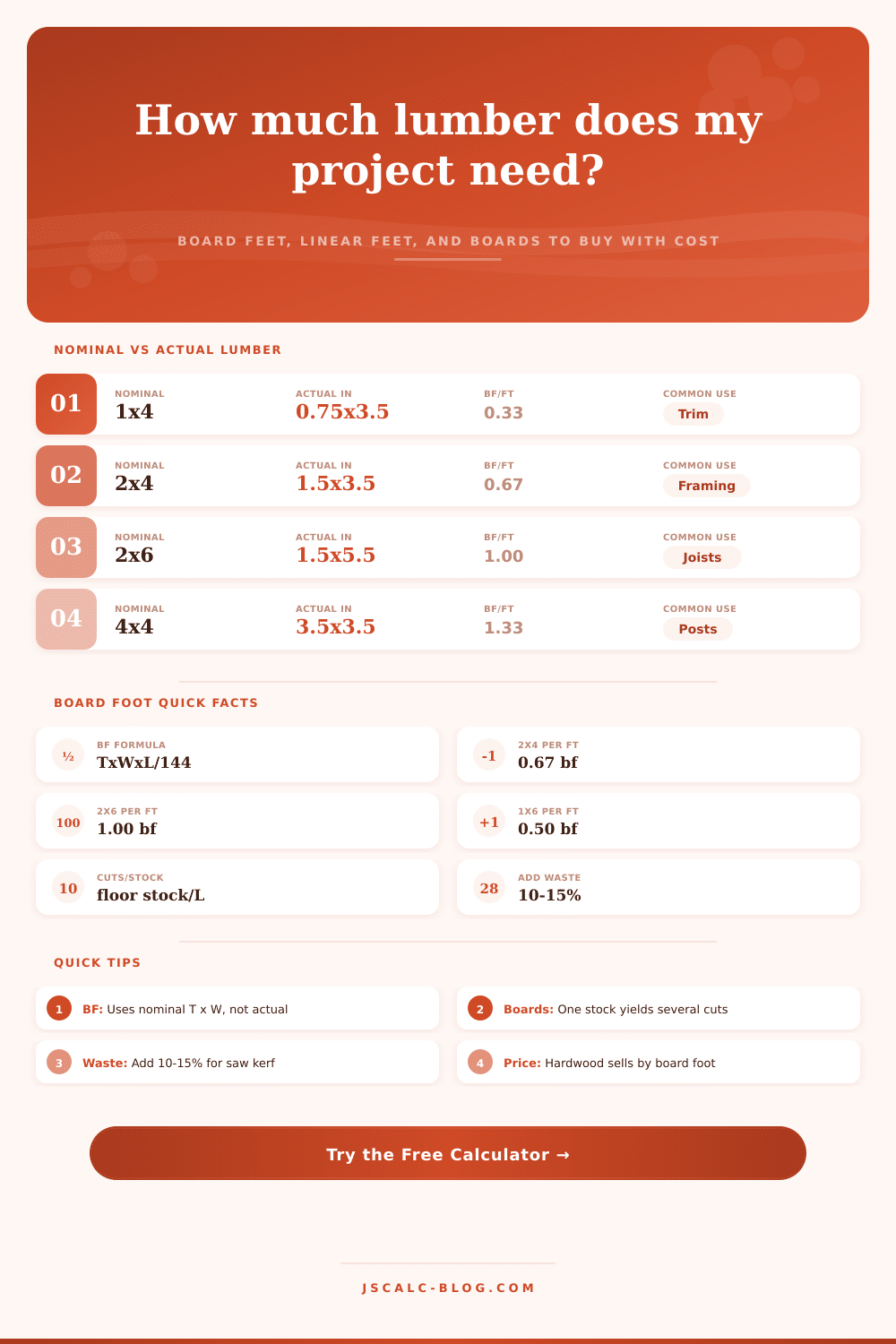
| Nominal | Actual Thickness | Actual Width | Board Feet Per Foot | Typical Project Use |
|---|---|---|---|---|
| 1x4 | 0.75 in | 3.5 in | 0.33 bf/ft | Trim, baseboard, slats |
| 1x6 | 0.75 in | 5.5 in | 0.50 bf/ft | Fence pickets, shelving |
| 1x8 | 0.75 in | 7.25 in | 0.67 bf/ft | Bookshelves, wide shelves |
| 2x4 | 1.5 in | 3.5 in | 0.67 bf/ft | Wall studs, framing |
| 2x6 | 1.5 in | 5.5 in | 1.00 bf/ft | Deck boards, joists |
| 2x8 | 1.5 in | 7.25 in | 1.33 bf/ft | Floor joists, headers |
| 2x10 | 1.5 in | 9.25 in | 1.67 bf/ft | Rim joists, raised beds |
| 4x4 | 3.5 in | 3.5 in | 1.33 bf/ft | Posts, workbench legs |
Board feet uses the NOMINAL thickness and width (2 × 4), not the smaller actual planed size. That is the industry convention lumberyards price by.
📦Boards Needed By Stock Length
| Piece Length | 8 ft Stock | 10 ft Stock | 12 ft Stock | 16 ft Stock | Cuts Per 12 ft |
|---|---|---|---|---|---|
| 2 ft pieces | 4 / board | 5 / board | 6 / board | 8 / board | 6 cuts |
| 3 ft pieces | 2 / board | 3 / board | 4 / board | 5 / board | 4 cuts |
| 4 ft pieces | 2 / board | 2 / board | 3 / board | 4 / board | 3 cuts |
| 6 ft pieces | 1 / board | 1 / board | 2 / board | 2 / board | 2 cuts |
| 8 ft pieces | 1 / board | 1 / board | 1 / board | 2 / board | 1 cut |
| 10 ft pieces | buy 12 ft | 1 / board | 1 / board | 1 / board | 1 cut |
| 12 ft pieces | buy 12 ft | buy 12 ft | 1 / board | 1 / board | 1 cut |
Cuts per stock = floor(stock length / piece length). Longer stock wastes less on short pieces but is harder to transport.
💲Price Reference By Species
| Species / Grade | Sold By | Typical Per BF | Typical Per LF | Best For |
|---|---|---|---|---|
| SPF framing | Per board | $0.55 - $0.90 | $0.90 - $1.60 | Studs, plates, framing |
| Pressure treated | Per board | $1.00 - $1.80 | $1.60 - $3.00 | Decks, ground contact |
| Whitewood pine | Per board | $0.80 - $1.50 | $1.20 - $2.20 | Shelves, DIY builds |
| Cedar | Per board foot | $3.00 - $6.00 | $2.50 - $5.00 | Fencing, outdoor trim |
| Red oak | Per board foot | $4.00 - $8.00 | – | Furniture, hardwood shelves |
| Walnut | Per board foot | $9.00 - $15.00 | – | Fine woodworking, tops |
Ranges are general estimates and vary by region and market. Hardwoods are almost always priced per board foot.
🗂Lumber Comparison Grid
| Nominal Size | Actual Size (in) | BF Per Foot | Common Stock Length | Typical Use |
|---|---|---|---|---|
| 1x4 | 0.75 × 3.5 | 0.33 | 8 to 12 ft | Trim and slats |
| 1x6 | 0.75 × 5.5 | 0.50 | 6 to 16 ft | Fence pickets |
| 1x8 | 0.75 × 7.25 | 0.67 | 8 to 12 ft | Shelving boards |
| 2x4 | 1.5 × 3.5 | 0.67 | 8 to 16 ft | Framing and studs |
| 2x6 | 1.5 × 5.5 | 1.00 | 8 to 20 ft | Decking and joists |
| 2x8 | 1.5 × 7.25 | 1.33 | 8 to 20 ft | Joists and headers |
| 2x10 | 1.5 × 9.25 | 1.67 | 8 to 20 ft | Beds and rim joists |
| 4x4 | 3.5 × 3.5 | 1.33 | 8 to 16 ft | Posts and legs |
⚙Full Calculation Breakdown
📋Reference Values
| Item | Common Entry | How It Is Used | Effect On Result |
|---|---|---|---|
| Waste factor | 10% to 15% | Multiplies board feet up | Raises BF and per-foot cost |
| Saw kerf | 0.125 in blade | Subtracted per cut | May drop one cut per stock |
| Stock length | 8, 12, or 16 ft | Sets cuts per board | Longer stock, fewer boards |
| Price basis | BF, LF, or each | Chooses cost formula | Switches how cost is found |
| Piece length | 2 ft to 16 ft | Divides into stock | Sets yield per board |
💡Practical Lumber Tips
The problem is that when you calculate how many boards you will need, it’s under ideal circumstances. In real life those ideal circumstances don’t happen. Boards isn’t perfectly straight; there will be hidden knots; you’ll fudge some cuts. Every time you fire up your saw blade, it eats away an important eighth of an inch of your board. And by the time you’re standing at Home Depot hoping for one last cut out of a pile of scraps, it’s easy to underestimate all the waste. This tool take care of the dirty math for you. You will have no more guesswork. Just go buy what you need.
The trick is to know the difference between actual and nominal size. So if you order a two by four, you don’t recieve a board that’s two inches by four inches. It’ll be more like a 1-1/2 inch by 3-1/2 inch. The planer will shave it down, but you still pay for and recieve the amount of original rough dimensions. That makes an enormous difference when working with pricy timber or hardwoods: they are sold by the board foot, not merely a linear measurement, but a volume measurement. Calculate accordingly and you’ll be in for a shock at the end. The lumberyard invoices you in nominal dimensions; that’s why the calculator use them for these conversions.
Why You Need Extra Wood
Also consider stock lengths: Dimensional lumber come in set lengths from most retailers (eight, ten, twelve, sixteen feet). So if you have a project requiring 30 pieces at five feet each, then multiply five times thirty and you get one hundred fifty linear feet of lumber. You can’t just go buy one hundred fifty continuous feet of something and hack it apart, you’ll lose huge swaths to offcuts. So what’s the maximum amount of five-foot piece that will fit into a single, normal sized twelve-foot board? Two plus two feet leftover. And maybe there isn’t enough left over for anything else, so now you’ve bought more then you needed because of wasted bits which wind their way onto the pyre. This optimization logic calculates smallest number of whole boards you need to buy to reach your required total, while still leaving room for those pesky scraps.
The amount of waste also depends greatly on what tools you have and how skilled you are. A track saw will result in almost no waste (just a whisper), whereas a circular saw wielded by a newbie can results in an additional quarter inch wasted on every cut. For most framing applications, a ten to fifteen percent waste setting is typically fine as small differences aren’t critical. If you’re fitting pieces together tightly like in a bookshelf or when trimming out a room, then precision becomes important. One bad cut to a board and it’s trash. It is better to err slightly high than go back to the store. That second trip costs time, money, and the momentum of the project.
Then there are those hardwoods… There’s no standard price-per-board-foot for them as they is sold by volume and graded. And yes, that nice wide slab of walnut is going to cost more then that knotty narrow piece of oak. To account for that fact, the calculator also gives you the option to select the pricing basis. Input the price per board foot and it will scale up the cost to match amount of wood needed. No surprises when you realize that your deck boards aren’t realy at the same price point as your nice pine shelves after all.
Planning is the most cost-effective part of building. It’s tough enough to do some manual labor without worrying about having your weekend project interrupted by material shortages. When you know precisely what number of full boards to purchase (accounting for defects and saw kerf), you can shop confidently. You go to the store with a working list. The math has been completed. All you’ve got left to do now is cut up some wood.