Lumber Linear Foot Calculator
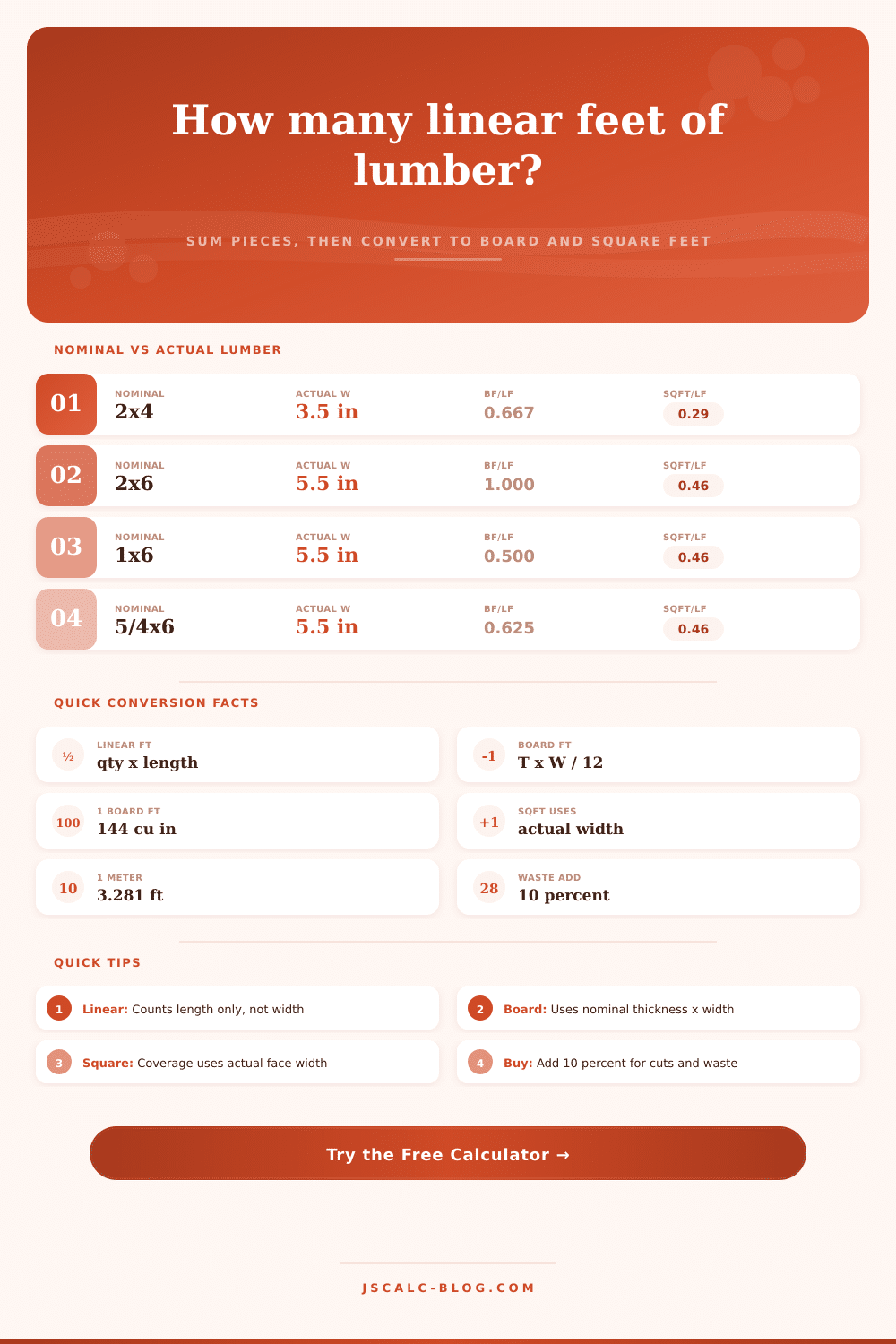
Add up the total linear feet from a piece list of quantity and length, then convert those linear feet to board feet and square feet using the nominal and actual dimensions of common lumber sizes.
📌Real Project Presets
📐Lumber & Piece List
Nominal thickness and width drive the board-foot math; actual face width drives coverage.
Used only when size is set to Custom.
Coverage width for custom size (usually less than nominal).
Wall or floor face width to cover; leave 0 to skip. Uses the unit above.
🔢Formula Snapshot
📋Piece List Breakdown
| Row | Quantity | Length | Linear Feet | Board Feet | Square Feet |
|---|---|---|---|---|---|
| Enter quantities and lengths above to see each row. | |||||
📏Nominal vs Actual Sizes
| Nominal | Actual Thickness | Actual Width | Common Use |
|---|---|---|---|
| 1x4 | 0.75 in | 3.5 in | Trim, casing, fence pickets |
| 1x6 | 0.75 in | 5.5 in | Fence boards, shelving |
| 1x8 | 0.75 in | 7.25 in | Shiplap, fascia, siding |
| 5/4x6 | 1.0 in | 5.5 in | Deck boards, stair treads |
| 2x4 | 1.5 in | 3.5 in | Wall framing, studs |
| 2x6 | 1.5 in | 5.5 in | Rafters, joists, walls |
| 2x8 | 1.5 in | 7.25 in | Joists, pergola beams |
| 4x4 | 3.5 in | 3.5 in | Posts, pergola legs |
🗂Linear-to-Board-Foot Comparison
| Nominal Size | Nominal T×W | Actual Width | BF per Linear Ft | SqFt per Linear Ft | LF per 100 BF |
|---|---|---|---|---|---|
| 1x4 | 1 × 4 in | 3.5 in | 0.333 | 0.292 | 300 ft |
| 1x6 | 1 × 6 in | 5.5 in | 0.500 | 0.458 | 200 ft |
| 1x8 | 1 × 8 in | 7.25 in | 0.667 | 0.604 | 150 ft |
| 5/4x6 | 1.25 × 6 in | 5.5 in | 0.625 | 0.458 | 160 ft |
| 2x4 | 2 × 4 in | 3.5 in | 0.667 | 0.292 | 150 ft |
| 2x6 | 2 × 6 in | 5.5 in | 1.000 | 0.458 | 100 ft |
| 2x8 | 2 × 8 in | 7.25 in | 1.333 | 0.604 | 75 ft |
| 2x10 | 2 × 10 in | 9.25 in | 1.667 | 0.771 | 60 ft |
| 2x12 | 2 × 12 in | 11.25 in | 2.000 | 0.938 | 50 ft |
| 4x4 | 4 × 4 in | 3.5 in | 1.333 | 0.292 | 75 ft |
📐Coverage & Common Lengths
| Board Width | Actual Face | Rows per Foot | LF per 100 SqFt |
|---|---|---|---|
| 1x4 face | 3.5 in | 3.43 | 343 ft |
| 1x6 face | 5.5 in | 2.18 | 218 ft |
| 1x8 face | 7.25 in | 1.66 | 166 ft |
| Flooring 3.25 | 3.25 in | 3.69 | 369 ft |
| Flooring 5.0 | 5.0 in | 2.40 | 240 ft |
| Stock Length | In Feet | In Meters | Typical Buy |
|---|---|---|---|
| 8 ft | 8 ft | 2.44 m | Studs, short trim |
| 10 ft | 10 ft | 3.05 m | Fence rails, siding |
| 12 ft | 12 ft | 3.66 m | Deck boards, joists |
| 16 ft | 16 ft | 4.88 m | Long deck, fascia |
| 20 ft | 20 ft | 6.10 m | Beams, long runs |
⚙Full Formula Breakdown
💡Practical Lumber Tips
This is a lumber calculator. You’re in the lumber aisle with a pile of two by fours in your arms that seem to weigh more than their appearance suggests. The price tag shows the cost per board foot, but how do you know if you are paying for empty space or enough wood to build a wall for your new shed?
The trouble you’re having translating what you measured linearly (on a tape) into volume-based units the store is using for pricing is exactly why people pick up this calculator before reaching for their wallet. The tool accepts lengths and quantities you have, adds them all up, and converts the result into both square footage and board feet according to the nominal size you chose.
How to Use This Lumber Calculator
If it’s linear feet, well, linear feet are easy; no width to consider at all. Eight-foot long boards will always be eighty linear feet regardless of their width, thin strips or fat beams. That number is fine if you’re trying to estimate how much material will fit in your truck bed but it doesn’t tell you how much area it covers or the actual volume.
That’s where we get down to business, transforming our linear feet into something called board feet. One board foot equals a cubic foot of wood, stretched out thinly enough to be just an inch thick. But lumber is rarely nominally one-inch thick, so you have some math to do: multiply the total linear footage times the width times the nominal thickness then divide by 12. Once you choose the right profile (which is dropped down on a menu), the calculator will convert measurements for you.
This is important. Most people assume they are using actual dimensions when they do this calculation. The nominal size is bigger than the thing you’re touching so they order too little. In fact, a “two by four” is one and a half inches by three and a half inches, but it sells as a two by four in volume units. Knowing that helps avoid mid-project panic about having to return to hardware store.
It also helps you calculate square footage using actual width. This is important for projects like decking or siding when you need to know how much material is required to cover specific surface area. Surface area is measured in square feet, not volume. If you’re installing shiplap or deck boards, what you want is amount of wall/floor covered (surface area), not the label size.
For example, a 1 by 6 board may have a “nominal” label width of six inches but actualy has a dressed face width of five and a half inches. So that board take up only five and a half inches of space for every foot of its length. The calculator knows this and makes up for it, ensuring you don’t run out near the end of a row or leave gaps.
It also accounts for waste. Applying a percentage margin to your total ensures you buy enough. In construction, adding ten percent for waste is standard practice. Something goes wrong. A knot ruins a piece, or you make bad cuts. You might also need off-cuts that aren’t long enough for something else. Having some leeway means you’ll be able to complete the project without scrambling around for more stuff. If you’re using tricky angles or expensive hardwoods, which create more waste, you can adjust this margin within the interface. Better to waste a couple of extra feet than run out halfway through your project.
A series of reference tables is on the page too that allow for a quick lookup of popular sizes. You can see what profile equals how much in terms of 100 board feet, which is useful when planning a budget. Certain profiles like twenty by tens, for example, cost more per linear foot than others. Knowing the conversion rate will help you plan accordingly. The tables also contain actual dimensions, a good reminder that lumber contracts during milling. Actual is physical; Nominal is a classification system.
The biggest mistake with DIY estimates is mixing up these units. We’re used to thinking in terms of linear feet, so if my linear estimate comes to 50, I believe that means I’ll need 50 board feet. However, you get less board feet per foot when you use thin stuff. That’s why the calculator has all three outputs displayed side by side, it makes it clear that your 80 linear feet of two by fours actualy amount to around 53 board feet, which sounds different and will make a difference on receipt.
Prevention is cheaper (and less frustrating) than a cure. Measure, enter your numbers in the rows below, and let mathematics decide whether it’s about volume or length. Then you have an accurate shopping list and know exactly what you’re getting. No longer will a piece be cut off because you guessed wrong on the math… And no longer will you waste cuts in the shop when ordering too much because you guessed right but were confused by the quirks of lumber milling and grading. Those are minutes well spent for peace of mind.