Lumber Cut List Calculator
Enter your required cut pieces and a stock board length, then var a first-fit-decreasing packer tell you how many boards to buy, the cut layout for each board, and the offcut waste.
📌Real Project Presets
📏Stock & Blade Settings
Length of one board you buy, in the unit above.
Material lost per cut. Typical table saw is 0.125 in.
Squaring cut removed from each board before packing.
🪵Required Cut Pieces
Enter each unique piece length and how many you need (up to 8 rows).
🔢Packing Snapshot
📊Pieces Per Board Comparison
| Cut Length | Per 8 ft (96″) | Per 10 ft (120″) | Per 12 ft (144″) | Waste in 8 ft |
|---|---|---|---|---|
| 12 in | 8 pieces | 10 pieces | 12 pieces | 0″ (0.0%) |
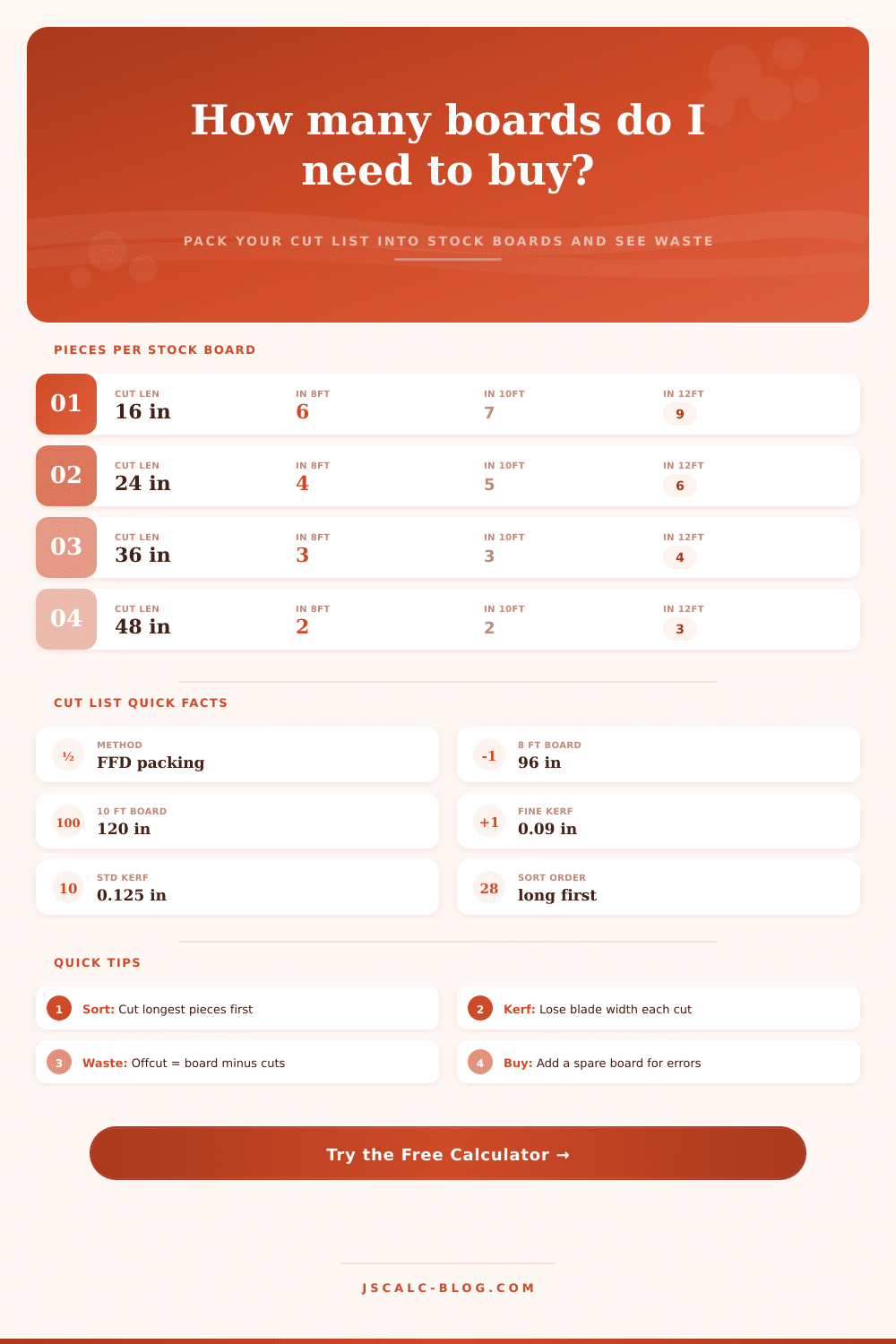
| 16 in | 6 pieces | 7 pieces | 9 pieces | 0″ (0.0%) |
| 18 in | 5 pieces | 6 pieces | 8 pieces | 6″ (6.3%) |
| 24 in | 4 pieces | 5 pieces | 6 pieces | 0″ (0.0%) |
| 30 in | 3 pieces | 4 pieces | 4 pieces | 6″ (6.3%) |
| 36 in | 2 pieces | 3 pieces | 4 pieces | 24″ (25.0%) |
| 40 in | 2 pieces | 3 pieces | 3 pieces | 16″ (16.7%) |
| 48 in | 2 pieces | 2 pieces | 3 pieces | 0″ (0.0%) |
Whole pieces per board at zero kerf. Waste column shows leftover offcut for the 8 ft board.
🛒Common Stock Lengths
| Nominal | Inches | Millimeters | Typical Use |
|---|---|---|---|
| 6 ft | 72 in | 1829 mm | Short trim, pickets |
| 8 ft | 96 in | 2438 mm | Studs, framing, shelves |
| 10 ft | 120 in | 3048 mm | Plates, longer rails |
| 12 ft | 144 in | 3658 mm | Deck boards, joists |
| 16 ft | 192 in | 4877 mm | Long runs, fascia |
🪚Kerf by Blade Type
| Blade / Saw | Kerf (in) | Kerf (mm) | Notes |
|---|---|---|---|
| Thin-kerf circular | 0.091 in | 2.3 mm | Less waste, less rigid |
| Standard table saw | 0.125 in | 3.2 mm | Most common full kerf |
| Miter / chop saw | 0.118 in | 3.0 mm | Clean crosscuts |
| Band saw | 0.035 in | 0.9 mm | Minimal loss per cut |
| Hand saw | 0.040 in | 1.0 mm | Varies with tooth set |
⚙How The Packer Works
📋Reference & Board-Foot Note
| Term | Meaning | How It Is Used | Effect On Result |
|---|---|---|---|
| Kerf | Blade cut width | Added per interior cut | More kerf = fewer per board |
| Offcut | Leftover board end | Board minus all cuts | Counts toward waste |
| Linear feet | Total length bought | Boards × stock length | Purchase quantity |
| Yield | Used vs bought | 100% minus waste % | Higher is more efficient |
| Board foot | Volume, not length | Thick × wide × long ÷ 144 | For pricing, not cut count |
This tool packs by length only. A board foot measures volume (1 in × 12 in × 12 in), so use it for pricing rather than counting linear cuts.
💡Practical Cutting Tips
There’s wasted space between a pile of wood on the ground and the shape you see in your mind. Unless you plan ahead before cutting anything, there’s some potential for waste. We’re all guilty of picking up an eight-foot board, cutting it down to size and throwing away the remaining bit, never giving it another thought. This continues until we find ourselves with three extra boards purchased because we didn’t check the numbers.
The problem solver I built above solve this issue by fitting your required number of pieces into the longest available lengths of wood (a first fit decreasing algorithm) to minimize scraps. Not only does it save you some sanity, it saves you a few dollars too.
How to Save Wood and Money
The kerf is the width of the blade itself which is the narrow strip of wood that turns into sawdust with each pass. With a typical table saw blade this can be as much as a quarter inch. So if you’re cutting ten pieces off a board, that’s now two and a half inches of air. That is two and a half inches of material you didn’t get to use because you were making a cut. Now maybe you think quarter inch isn’t worth worrying about. But when you’re doing multiple boards, and multiple cuts, it adds up quickly. By entering your exact kerf width (the tool lets you enter this), the packing logic take into account this loss instead of expecting perfect geometric fits. It is a small thing, but it matters when you are trying to make two pieces out of a board that seems to be just barely too short.
One other thing people tend to overlook is end trim. New lumber from yard is rarely perfectly square at both ends. More likely, you’ll need to cut off about an eighth of an inch at each end in order to have nice, parallel faces on which to make your joints. So before you’ve even measured your first piece, you’re down another half inch of waste. Add this as a trim allowance to the calculator and it won’t offer up two pieces on a single board where realisticly only one might fit. It’s that sort of attention to detail that keeps you from having that “oh crap” moment at day’s end when you realize that last piece doesn’t quite make it because you didn’t take into account the fact that you needed to square things up.
This approach also packs from longest to shortest, which seems backwards (why not start with the easiest fit?), but the reason is that long pieces are rigid constraints. Once you stuff boards full of the short scraps, you frequently end up with odd-shaped gaps that won’t hold any of the longer cuts. Starting with the long pieces allow the algorithm to pack in all the small ones more effectivey into whatever space is left over. It’s called first-fit decreasing, which is the standard heuristic for tackling bin packing problems. You don’t have to know about computer science to enjoy the outcome: fewer boards bought, less trash dumped in the dumpster.
On the other hand, there’s also the practical issue of purchasing lumber. Standard lengths are sold at lumber yards: eight footers, ten footers, maybe even twelve- or sixteen-footers. So say you need lots of thirty-inch long cuts. An eight footer sounds perfect, right? Three fit in there with a little leftover, while a ten footer fits four. That one extra foot of board make a huge difference in the percentage of waste versus yield. The cut length comparison charts I include on that page show this; you will see much less waste by using a ten-foot board instead of an eight-foot board. Sometimes spending a few dollars more per board for their longer version ends up costing less money because you’re not buying as many total. Precision cuts cost money, but so do wasted boards. Get a calculator and get the math right.
Always buy an extra board if you could of afforded it. Blades dull, wood moves, measurements will drift. You can calculate the possible minimum of perfectly executed cuts with a calculator, but this isn’t real life. That spare board is your insurance policy. It keeps you from breaking through to the next board if the angle is off by 1/8″ or something goes wrong. It costs less than the $10+ you would spend at lunchtime going back to the store because you cut it all up. Plan for perfection in the math, but plan for imperfection in the shop. The tool gets you close enough that you’re not guessing, which lets you go walk in yard and know just how many boards to buy, minus one board for good measure.