Logs to Lumber Calculator
Estimate the board-foot lumber yield of a saw log from its small-end diameter and length using the three standard log rules: Doyle, Scribner, and International 1/4-inch. Compare all three side by side and scale to any number of logs.
🪵Real Log Presets
📏Log Measurements
Metric entries convert to inches and feet before applying the log rules.
Measure the small end of the log, bark excluded.
Merchantable length between trim cuts.
Adds taper back so mid-log diameter is used in the rules.
Applied to the featured rule as an actual sawn-yield estimate.
🔢Log Rule Symbols
⚖Diameter vs Rule Comparison Grid (at 12 ft)
| Diameter (in) | Doyle (bf) | Scribner (bf) | Intl 1/4 (bf) | Doyle vs Intl |
|---|---|---|---|---|
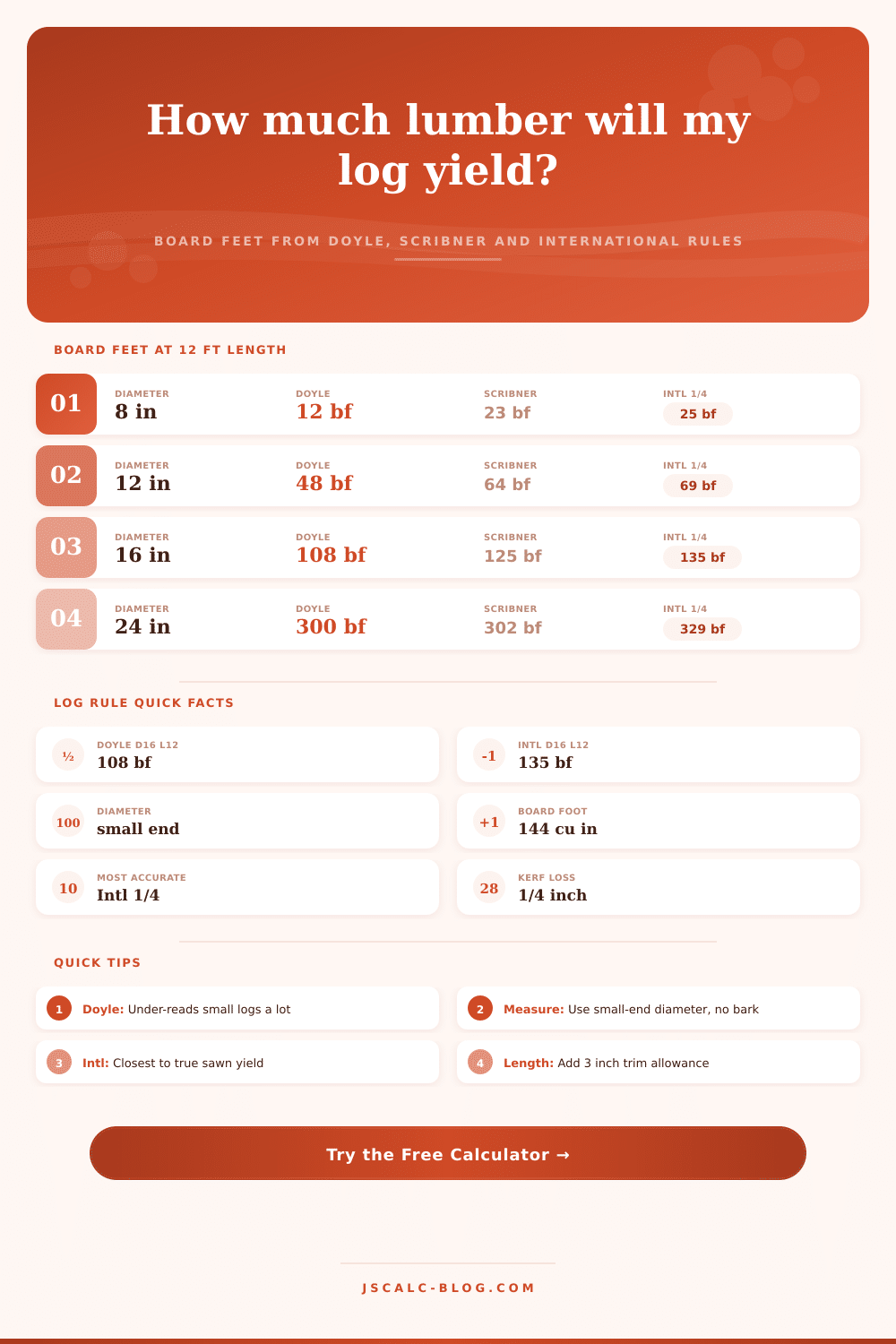
| 8 | 12 | 23 | 25 | −52% |
| 10 | 27 | 41 | 45 | −40% |
| 12 | 48 | 64 | 69 | −30% |
| 14 | 75 | 92 | 100 | −25% |
| 16 | 108 | 125 | 135 | −20% |
| 18 | 147 | 162 | 176 | −16% |
| 20 | 192 | 204 | 221 | −13% |
| 24 | 300 | 302 | 329 | −9% |
| 28 | 432 | 420 | 458 | −6% |
| 30 | 507 | 485 | 530 | −4% |
🌳Doyle Board Feet by Diameter and Length
| Diameter (in) | 8 ft | 10 ft | 12 ft | 16 ft |
|---|---|---|---|---|
| 8 | 8 | 10 | 12 | 16 |
| 10 | 18 | 23 | 27 | 36 |
| 12 | 32 | 40 | 48 | 64 |
| 14 | 50 | 63 | 75 | 100 |
| 16 | 72 | 90 | 108 | 144 |
| 20 | 128 | 160 | 192 | 256 |
| 24 | 200 | 250 | 300 | 400 |
📐Log Rule Formulas
📊Log Rule Comparison
| Rule | Basis | Kerf Assumed | Small Logs | Best Use |
|---|---|---|---|---|
| Doyle | Formula, 4in slab | Large, implied | Under-reads a lot | Big hardwood logs, US trade |
| Scribner | Board diagrams | 1/4 inch | Moderate under-read | Western US, softwoods |
| Intl 1/4 | Formula, taper | 1/4 inch | Most accurate | Research, true yield check |
| Intl 1/8 | Formula, taper | 1/8 inch | Highest yield | Thin-kerf band mills |
📋Board-Foot Basics and Log Grades
| Item | Definition | Typical Value | Notes |
|---|---|---|---|
| Board foot | Volume of lumber | 144 cu in | 12in × 12in × 1in nominal |
| Grade 1 log | Best veneer/saw log | 16in+ dia | Clear, straight, few defects |
| Grade 2 log | Standard saw log | 12 to 16in | Minor knots and sweep |
| Grade 3 log | Low-grade / pallet | Under 12in | Knots, crook, stain okay |
| Cull / firewood | Not merchantable | Under 8in | Rot or heavy defect |
| Green weight | Fresh-cut mass | 4 to 6 lb/bf | Varies with species moisture |
💡Practical Yield Tips
When people drag a big old oak out of their yard expecting to fill up three racks of lumber, they’re often disappointed. By the time the sawyer’s done with it, he have just enough boards to make a dozen pallets and a single chair. The log is heavy; it looks like it should hold plenty. But as the blade begins to bite, what you’ve got on paper is almost never what you get in hand. That gap, the difference between perception and reality, is what the logs to lumber calculator closes.
By changing length and diameter to board footage according to long-established industry standards, it bridge the space between those raw woods in the forest and those usable lumber boards in the mill. Enter your dimensions, and let it do the math for you; eliminating guesswork that typically results in some very expensive miscalculations.
How to Calculate Log Yield Correctly
International one-quarter inch is another log rule (along with Doyle and Scribner) and it arrives at a different conclusion because it assumes a very thin saw blade width of just a quarter of an inch. But it arrives at a different conclusion because it makes a diffrent assumption about waste. The older and more commonly used Doyle rule is fairly simple, and that’s what makes it famous, on small logs it’s notoriously conservative. Before we calculate the final amount, it subtracts a large slab allowance. So if you’ve got a twelve-inch log, Doyle assumes you’ll lose a bunch of material to edging and kerf from the saw. Fair enough for some rough grading, but if you’re selling to a mill that does a precise scale cut, it can leave money on the table.
Then there’s Scribner Decimal C. That’s a compromise between Doyle and reality. It is based off real drawings of how boards might fit within a log circle. This takes into account practicalities, like the fact that rectangles has to fit into rounds. So it’s not as extreme than Doyle, while still leaving some wood off the table.
The International one-quarter rule is perhaps closest to reality (and certainly the most generous) since it presumes your saw blade is actualy only a quarter-inch wide. In other words, more of that wood becomes lumber, instead of shavings and dust. If you compare the numbers on the chart on this page, you’ll notice that Doyle will show fifty-percent fewer board feet for small-diameter log than does International. At twenty-four inches or so, they get closer and closer, though even then it makes a difference when you’re scaling a timber sale entirely.
Half the battle is getting your first measurement correct. The inside bark dimension of the log at the small end is what you want to measure. Including bark will artificially inflate your estimated yield; bark doesn’t make for good lumber. Because some logs taper quite a bit from end-to-end, the calculator has an option where you can account for taper and the math will reflect average diameter instead of simply the smallest point. That’s important because a heavily tapered log will have less consistent board lengths which in turn impacts price as well as grade.
Next, how long do you want to cut? For a lot of construction uses a twelve foot log is standard, but if you’re cutting longer blanks for furniture pieces or shorter beams, entering a different length here directly impact total volume. Knowing this output will help you plan projects more realisticly and will also help you get a better price when negotiating.
Don’t freak out if the Doyle number seems absurdly low in comparison with what you expected. Chances are, it’s simply erring on the side of caution. The International column gives you a more hopeful, more real-world idea of how much might actually emerge from the saw if the mill does its job right. Keep in mind that green lumber weighs much more than dry lumber, which will help you estimate transportation costs as well. These figure serve as a sanity check before you even make your first cut, whether you’re planning a timber harvest or simply cleaning up some land.
The truth is that trees are limited resources with economic factors as well as real-world physical limitations. If you have a 12-inch diameter tree, there’s no way around it, no way to alter its size, but you can influence what you get from it. When you begin making decisions from yield data instead of a rough guess, you’ll compare the rules one to the other side-by-side. This changes your thinking from “it’s still a lot of tree” (which might be a dissapearance) to “this is what I’m getting.” It’s still a big log, but you know how much is actualy yours. And that makes it more of a plan than a disappointment.