Dimensional Lumber Weight Calculator
Pick a nominal size such as 2x4 or 2x6, add length and quantity, then choose species and moisture to estimate per-board weight, total weight, board feet, and volume from the true cross-section.
📌Real Lumber Presets
📝Board Inputs
Common stud length is 92-5/8 in, about 7.72 ft.
Green adds roughly 30–50%; treated is heaviest until it dries.
Used when species is set to custom. Base is at 19% MC.
🔢Weight Formula Snapshot
🪵Species Density Reference
| Species | Density at 19% MC | Kiln-Dry Est. | Typical Use |
|---|---|---|---|
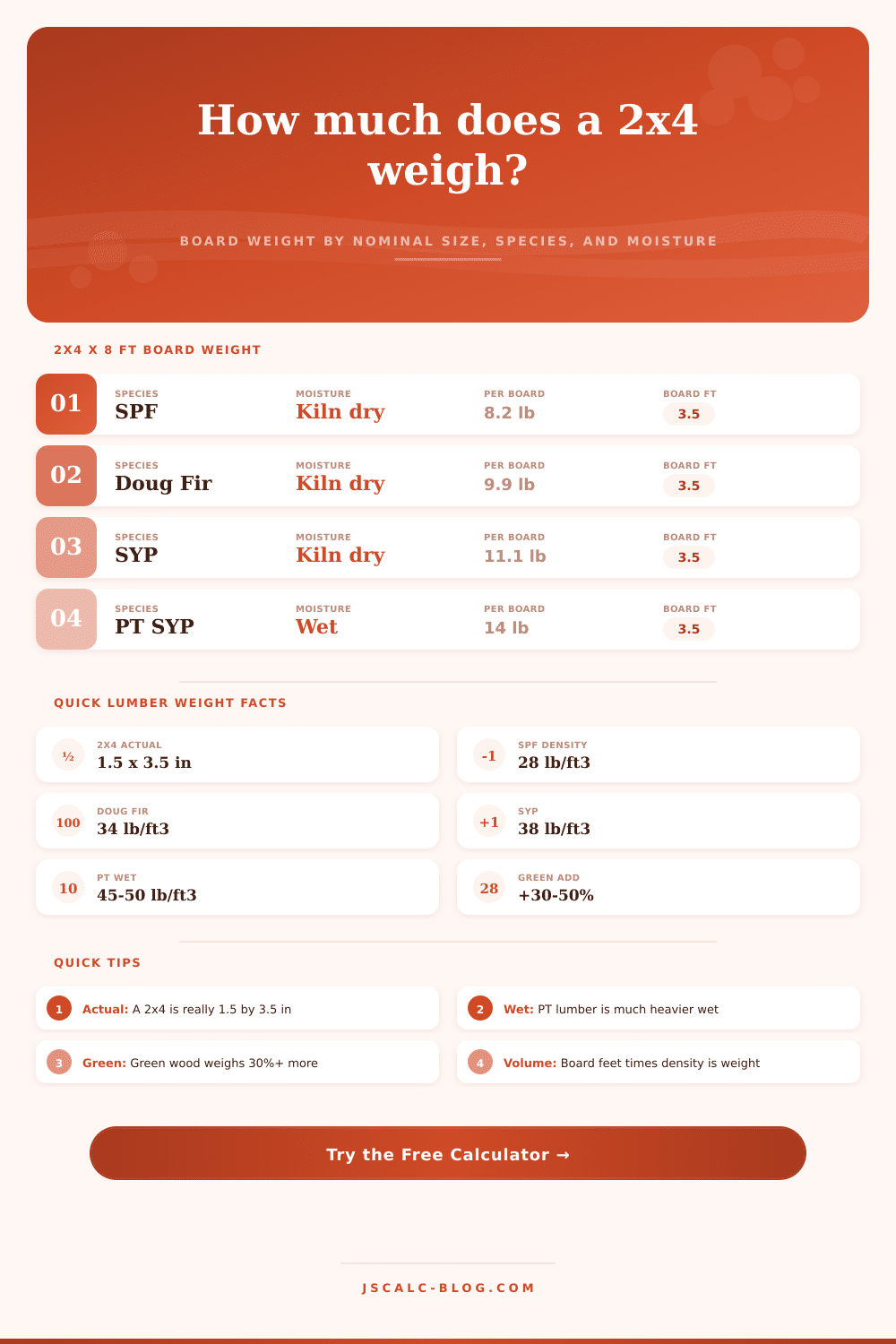
| SPF (spruce-pine-fir) | 28 lb/ft³ | ~26 lb/ft³ | Wall studs, framing |
| Hem-Fir | 30 lb/ft³ | ~28 lb/ft³ | Framing, plates |
| Douglas Fir-Larch | 34 lb/ft³ | ~32 lb/ft³ | Beams, joists, rafters |
| Southern Yellow Pine | 38 lb/ft³ | ~36 lb/ft³ | Joists, decking, trusses |
| Redwood | 28 lb/ft³ | ~26 lb/ft³ | Decks, outdoor trim |
| Western Red Cedar | 23 lb/ft³ | ~22 lb/ft³ | Fencing, siding |
| Pressure-Treated SYP | 48 lb/ft³ (wet) | ~38 lb/ft³ dried | Ground-contact, posts |
📏Nominal vs Actual Size
| Nominal | Actual Thickness | Actual Width | Board Feet per Ft |
|---|---|---|---|
| 1x6 | 0.75 in | 5.5 in | 0.34 bf |
| 2x4 | 1.5 in | 3.5 in | 0.44 bf |
| 2x6 | 1.5 in | 5.5 in | 0.69 bf |
| 2x8 | 1.5 in | 7.25 in | 0.91 bf |
| 2x10 | 1.5 in | 9.25 in | 1.16 bf |
| 2x12 | 1.5 in | 11.25 in | 1.41 bf |
| 4x4 | 3.5 in | 3.5 in | 1.02 bf |
💧Moisture Effect on Weight
| Condition | Approx. MC | Weight Factor | 2x4x8 SPF Example |
|---|---|---|---|
| Kiln-dried (KD) | ~12% | 0.93 × | ~7.6 lb |
| Surfaced dry S-DRY | ~19% | 1.00 × | ~8.2 lb |
| Green / fresh sawn | > 30% | 1.35 × | ~11.0 lb |
| Pressure-treated (wet) | Water added | PT density | ~13–14 lb |
🗂Weight per Foot Comparison (lb/ft)
| Nominal Size | SPF | Hem-Fir | Doug Fir | SYP | PT Wet |
|---|---|---|---|---|---|
| 1x6 | 0.80 | 0.86 | 0.97 | 1.09 | 1.38 |
| 2x4 | 1.02 | 1.09 | 1.24 | 1.39 | 1.75 |
| 2x6 | 1.60 | 1.72 | 1.95 | 2.18 | 2.75 |
| 2x8 | 2.11 | 2.27 | 2.57 | 2.87 | 3.63 |
| 2x10 | 2.70 | 2.89 | 3.28 | 3.66 | 4.63 |
| 2x12 | 3.28 | 3.52 | 3.98 | 4.45 | 5.63 |
| 4x4 | 2.38 | 2.55 | 2.89 | 3.23 | 4.08 |
⚙Full Formula Breakdown
💡Practical Lumber Weight Tips
There’s a certain level of surprise that happens at the lumber yard as you watch your pickup truck teeter back on its wheels. You thought you were getting some light pieces of pine for bathroom wall studs, but then it smacks into the tailgate hard. That disconnect between what you expected versus what is weighing down your project is why most DIY projects fall flat before they even get started. It’s because we simply don’t understand exactly what dimension lumber is after it come off the mill.
Plug in the species and size, and let the calculator do the math. No more guesswork, no more underestimating or overloading. Nominal sizes aren’t real numbers. A two by four isn’t really two inches by four inches. They’ve planed it down to be one and a half by three and a half. Why does that matter? Because when you multiply those numbers by length and quantity, they adds up fast. Those real dimensions matter; physics is built around them. And you want to know its real cross-section for your trailer, not what some marketing guy call it on the pile. Can your trailer hold the load or not?
How to Calculate Lumber Weight
It matters which species you buy. For example, spruce-pine-fir studs feel light enough to swing casually, but Southern Yellow Pine will be heavier than higher density. Southern Yellow Pine is denser, so it will be heavier. And then there’s pressure-wood which comes pre-soaked in chemicals and pre-weighed down from being wet. A freshly treated 2×4 may well be twice as heavy as one that has been dried out.
The weight changes how the material act. It affects your back and changes how you handle it. People frequently overlook moisture content as a variable. Wood is a sponge, and green lumber contain a lot of water. A gallon of water weighs about eight pounds, which can add a lot of weight to your load. If the wood is green, surfaced dry, or even kiln-dried, the calculator will account for that in its density calculation. Why? Because it’s going to be shipped wet, which affects weight. Understanding that joists will shed some weight while seasoning means you can plan your header loads accordingly and not exceed your axle limits.
Cost is based off a measure of volume (board feet) rather than weight, but understanding the math will give you a sense for overall mass. Species density and actualy volume are connected; knowing the one gives you a good idea about the other. The table below provides a reference for how density changes as moisture conditions change. Don’t worry about committing all those coefficients to memory; just know that green wood increases the base weight by thirty percent or more so you can add a safety margin.
Also consider adding a waste factor: If you’re cutting boards on-site, for example, offcuts end up in the dumpster, but you still need to carry those offcut to the dumpster. Without going overweight or busting your budget, a 10% buffer accommodates mistakes. And it’s easy to tweak with the interface, translating abstract percentages into concrete pounds.
And lastly, doing this over and over again makes it different work. A few boards seem doable. Fifty is draining. Know your numbers. Estimate the overall weight of the project. This helps you plan how to move everything and decide when to get help or rent a hand truck. This is less of a safety issue, more of a logistics issue. These are estimates of what moving these things will feel like.
If done correctly they allow building to go according to plan. If not…well, then you’re in the parking lot struggling under the load.