Logarithm Addition Calculator
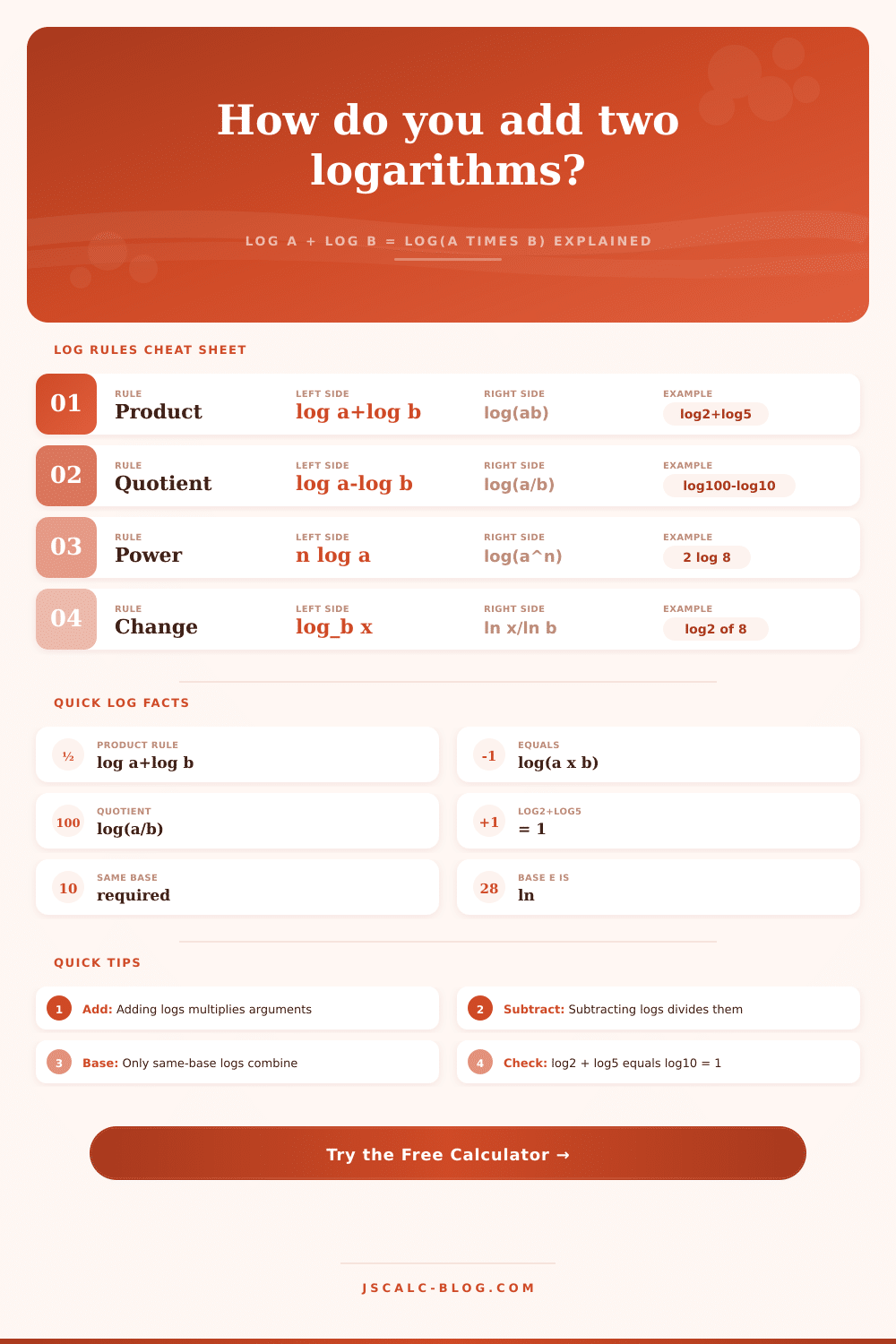
Add or subtract two logarithms of the same base and watch the product and quotient rules in action: log a + log b = log(ab), and log a – log b = log(a/b). See the combined argument, each individual log value, and the full rule breakdown.
🎯Log Rule Presets
📝Logarithm Inputs
Must be greater than 0. This is the argument of log(a).
Must be greater than 0. This is the argument of log(c).
Used only when base is set to Custom. Must be > 0 and not 1.
n log a = log(a^n). Leave at 1 for no power. Applies to a only.
🔢The Three Core Log Rules
🗂Log Rules Summary
| Rule Name | Expanded Form | Combined Form | Worked Example |
|---|---|---|---|
| Product rule | logₘ(a) + logₘ(c) | logₘ(a × c) | log 2 + log 5 = log 10 = 1 |
| Quotient rule | logₘ(a) – logₘ(c) | logₘ(a / c) | log 100 – log 10 = log 10 = 1 |
| Power rule | n × logₘ(a) | logₘ(a^n) | 2 × log 8 = log 64 ≈ 1.8062 |
| Change of base | logₘ(x) | ln(x) / ln(b) | log₂ 8 = ln 8 / ln 2 = 3 |
| Log of 1 | logₘ(1) | 0 | log 1 = 0 for any base |
| Log of base | logₘ(b) | 1 | log₁₀ 10 = 1, ln e = 1 |
📊Common Log Sums (Base 10)
| Value a | Value c | log a | log c | log a + log c | Product a × c |
|---|---|---|---|---|---|
| 2 | 5 | 0.3010 | 0.6990 | 1.0000 | 10 |
| 3 | 4 | 0.4771 | 0.6021 | 1.0792 | 12 |
| 4 | 25 | 0.6021 | 1.3979 | 2.0000 | 100 |
| 6 | 6 | 0.7782 | 0.7782 | 1.5563 | 36 |
| 5 | 20 | 0.6990 | 1.3010 | 2.0000 | 100 |
| 8 | 125 | 0.9031 | 2.0969 | 3.0000 | 1,000 |
| 7 | 3 | 0.8451 | 0.4771 | 1.3222 | 21 |
| 2.5 | 4 | 0.3979 | 0.6021 | 1.0000 | 10 |
🔄Base Conversions & Identities
| Notation | Base | ln Equivalent | logₘ(1) | logₘ(base) |
|---|---|---|---|---|
| log or log₁₀ | 10 | ln x / ln 10 | 0 | 1 |
| ln | e ≈ 2.71828 | ln x (itself) | 0 | 1 |
| lb or log₂ | 2 | ln x / ln 2 | 0 | 1 |
| log₅ | 5 | ln x / ln 5 | 0 | 1 |
| log₃ | 3 | ln x / ln 3 | 0 | 1 |
| log₁₆ | 16 | ln x / ln 16 | 0 | 1 |
⚙Full Rule Breakdown
💡Practical Log Tips
Logarithms are typicaly scary and students memorize them without ever understanding how they work. Think about it this way: a logarithm is simply a translation from multiplying to adding. This calculator handles the mechanics of that translation for you, allowing you to focus on logic rather than arithmetic drudgery.
That’s the central concept: The product rule tells us that we can takes the log of any product by simply adding the log of each factor separately. So log a + log b = log (a times b). That’s what you are looking at when you encounter log a + log b. It is combining two number into a single argument.
How Logarithms Work
Why does it work? It works if you know how the tool do the math. We use the log of something when we want to add things; we use the log of something else when we want to divide things. Before there were electronic calculators, it allowed you to do a complex multiply using simple addition.
Finally, realize what you are putting into calculator. In order to add two logs together, they must be written in same system of measurement (base). This means that both must use base 2, or base 10, or whatever other base you choose for the logarithm’s base. Typically in growth modeling and in calculus classes, students learns about natural logs with base e or commonly used logs with base 10. However, if you simply added a base 2 log with a base 10 log, you would violated the laws of algebra. The software will force you not to make this mistake.
That said, if your numbers aren’t expressed in same base, then you need to express one number in terms off another by using change-of-base formula. Another powerful idea is called power rule, which lets you take the exponent out of logarithm but as a multiplier. Rather than compute log(a squared) you do two times log(a). There’s a field for that exponent on the calculator. You should of play with it to get a sense for how powers influence the overall sum.
In physics and engineering, exponential growth/decay are frequent and this is something you’ll need. Change that exponent value and you’ll see how small differences in the exponent affects the total result. It demonstrates how much a logarithmic scale react to multiplicative factors.
Even if it isn’t obvious right away, there are many real-world uses. Logarithms is used on the decibel scale to measure sound, and also on the Richter scale for earthquake measurement. In those contexts, adding two log values can be thought of as combining two intensities (like energy levels), something you can’t necessarily get with linear addition. Doubling the amount of power from a sound source doesn’t mean it’s twice as loud; it adds a certain logarithmic value. This sort of thinking avoid mistakes in disciplines like seismology or audio engineering.
For example, the tables makes it easy to look up common pairings like log 5 + log 2 = 1, since multiplying them together give 10. If you can master these rules, you will have a solid mental model for understanding exponential relationships, and numbers in general. You’ll never lose track of zeros or misplace decimal points in manual calculations. That’s what the calculator is for: removing the struggle so that you get to keep the knowledge.
Next time you come across a problem with combined intensities (or multiplicative growth), keep in mind that addition is often simply multiplication disguised as such. You should understand why it works.