Inverse Factorial Calculator
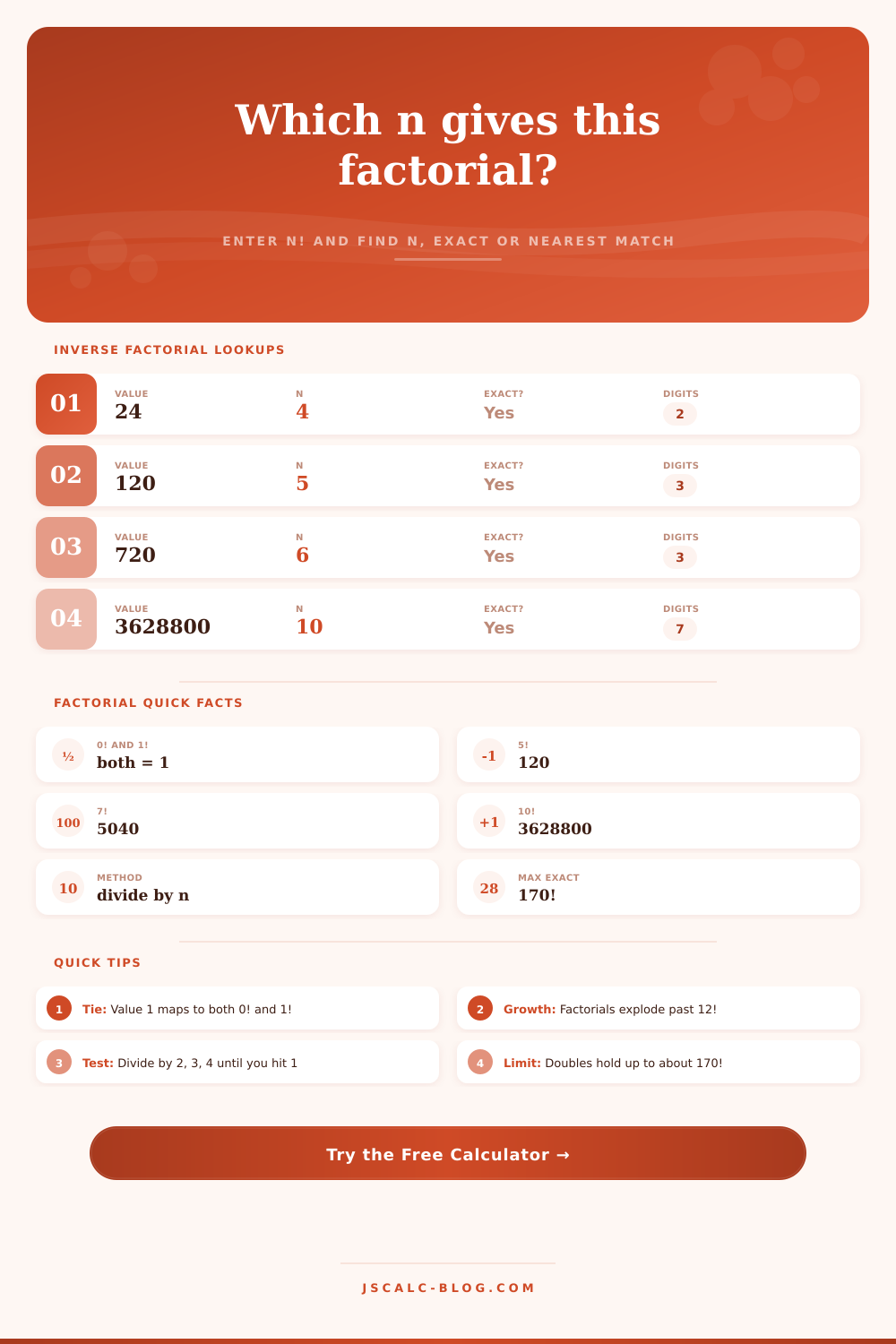
Enter a factorial value and find which whole number n produced it. If the value is not a factorial, the tool reports the nearest n below and above and shows every division step.
🎯Real Inverse Factorial Presets
📝Inverse Factorial Inputs
Enter the number you believe equals some n factorial.
Used only when mode is forward check.
Accept a factorial within this percent of V as a match.
🔠How The Method Works
📉Successive Division Steps
| Step | Divide By | Running Value | Reached 1? |
|---|---|---|---|
| Enter a value above to see the division walk-through. | |||
📋Factorials 0! to 15!
| n | n! | Digits | Ratio To Previous |
|---|---|---|---|
| 0 | 1 | 1 | – |
| 1 | 1 | 1 | ×1 |
| 2 | 2 | 1 | ×2 |
| 3 | 6 | 1 | ×3 |
| 4 | 24 | 2 | ×4 |
| 5 | 120 | 3 | ×5 |
| 6 | 720 | 3 | ×6 |
| 7 | 5,040 | 4 | ×7 |
| 8 | 40,320 | 5 | ×8 |
| 9 | 362,880 | 6 | ×9 |
| 10 | 3,628,800 | 7 | ×10 |
| 11 | 39,916,800 | 8 | ×11 |
| 12 | 479,001,600 | 9 | ×12 |
| 13 | 6,227,020,800 | 10 | ×13 |
| 14 | 87,178,291,200 | 11 | ×14 |
| 15 | 1,307,674,368,000 | 13 | ×15 |
🗂Comparison Grid: Growth And Ratios
| n | n! | Digits | Multiplier | Approx Value | Is Factorial |
|---|---|---|---|---|---|
| 4 | 24 | 2 | ×4 | 2.4e1 | Yes |
| 5 | 120 | 3 | ×5 | 1.2e2 | Yes |
| 6 | 720 | 3 | ×6 | 7.2e2 | Yes |
| 7 | 5,040 | 4 | ×7 | 5.0e3 | Yes |
| 8 | 40,320 | 5 | ×8 | 4.0e4 | Yes |
| 10 | 3,628,800 | 7 | ×10 | 3.6e6 | Yes |
| 13 | 6,227,020,800 | 10 | ×13 | 6.2e9 | Yes |
| 20 | ~2.4e18 | 19 | ×20 | 2.4e18 | Yes |
| 25 | ~1.6e25 | 26 | ×25 | 1.6e25 | Yes |
| – | 100 | 3 | – | 1.0e2 | No |
✅Is It A Factorial? Examples
| Value | Factorial? | Inverse n | Sits Between |
|---|---|---|---|
| 1 | Yes | 0 and 1 | tie at 0! and 1! |
| 2 | Yes | 2 | exact 2! |
| 24 | Yes | 4 | exact 4! |
| 100 | No | none | 4! (24) and 5! (120) |
| 720 | Yes | 6 | exact 6! |
| 5,000 | No | none | 6! (720) and 7! (5040) |
| 3,628,800 | Yes | 10 | exact 10! |
| 500,000,000 | No | none | 12! and 13! |
📐Digit Counts By n
| n | Digits In n! | Milestone | Notes |
|---|---|---|---|
| 5 | 3 | first 3-digit | 120 |
| 8 | 5 | crosses 10,000 | 40,320 |
| 10 | 7 | over one million | 3,628,800 |
| 15 | 13 | over one trillion | 1.3e12 |
| 20 | 19 | near 1e18 | 2.4e18 |
| 25 | 26 | past 1e25 | 1.6e25 |
| 50 | 65 | huge integer | 3.0e64 |
| 100 | 158 | 158 digits | 9.3e157 |
| 170 | 307 | double limit | 7.3e306 |
⚙Full Method Breakdown
💡Inverse Factorial Tips
Factorials are something you probably already know how to do: take any whole number and multiply it by all integer below it, up to number 1. For example, five factorial (5!) is equal to 120. This arithmetic are simple enough in the forward direction. In reverse? Not so much. That’s a whole other problem, finding the input for given output. And that’s where an inverse factorial calculator come into play. It will start with that big answer and work its way back to starting value.
Factorials are crazy number: they get way too big very quickly, which is why this is the stumbling point for most folks. Four factorial is 24; five factorial is 120, an increase of just one multiplication step, but a five-fold increase in size. Ten factorial are a seven-digit number. At fifteen factorial, it cross into trillions. Factorials explode, which makes it unlikely that any randomly generated number can be an exact factorial. Instead, its likely to be somewhere in the gap between factorials making the tool useful for locating precisely where the gaps is.
What Is an Inverse Factorial Calculator?
How does this work? It’s simple enough. Type something in and hit “1/x” (the inverse button) and engine will try dividing the number by each subsequent number until it find one that collapses nicely into one. That means it has discoverd n. Otherwise, if it can’t divide all the way through without leaving a remainder then the answer will provide the next whole numbers on either side of actual value. This is handy for when you’re doing things like estimations that need to be close but don’t necessarily has to be precise.
One tricky edge case occurs when one factorial equals one and zero factorial also equals one. If someone enters in one for input then correct answer is actualy one AND zero. It’s an unclear mathematical tie and the calculator notes this by flagging answer as such. After the initial step however, things get straightforward. The next factorial will always be different than the last, which is why we can solve the inverse question. Otherwise, how could you tell which input was right?
In probability theory and combinatorics, however, the reverse operation are needed: if you have a count of all possible permutations of a set but not the set’s size itself, you work backwards to arrive at the size. And it’s a pleasing method for confirming your own mental math. What do you think seven hundred twenty is as a factorial? Six, maybe? Correct! But how did you guess that? With no reference, its a natural response. The tool verifies it, step by step. It splits off two, then three, and on and on until it gets to one. Those steps makes it easy to understand.
Also note the limits: One-hundred-seventy factorial is approximately where standard computing precision fails. At that point, the number grows too large to be stored precisely in standard data types. The calculator respects this ceiling to prevent errors. Above that, you’re basically asking for infinite on a finite screen. Keep your input values in reasonably sane bounds and you’ll get good results.
These are tables that I have thrown up on page to be a sort of cheat sheet. You see the numbers and how many digits they produce so you get an idea of what the order of magnitude is. And as you notice it grow rapidly. Five factorial is three digits, ten factorial is seven, twenty factorial is nineteen. Notice how quickly the number of digits accumulates. It’s a visual tool to see if your input is remotely within range before you compute this function. This will save you time and give you a better sense of just how rapidely things ramp up.
Inverse factorials are all about perspective, about recognizing scale. Our minds was designed for dealing with small numbers, so we have trouble comprehending large ones. This kind of tool help us bridge that distance. It helps us translate some abstract size into a concrete index. A huge number shrinks it until it fits in your hand. Reverse an operation, reverse the world, that’s the magic.