Factorial Notation Calculator
Compute n! as the product n × (n−1) × ... × 2 × 1, view the full expansion string, digit count, and scientific notation, plus optional double factorial n!! support.
🎯Factorial Presets
📝Factorial Inputs
0! is defined as 1. Enter any non-negative integer.
🔢Notation Snapshot
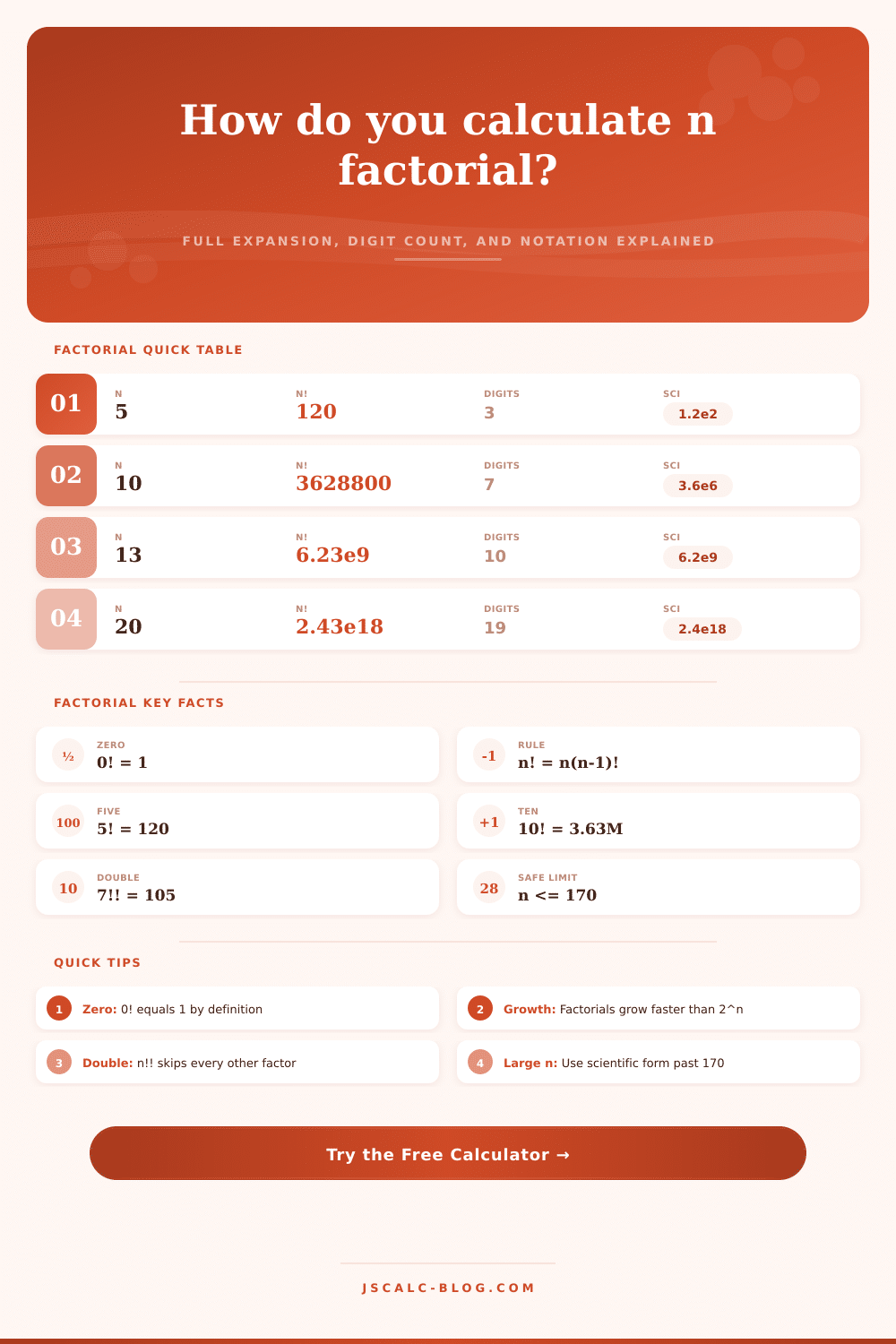
📋Factorials 0! Through 20!
| n | n! (exact) | Digits | Scientific |
|---|---|---|---|
| 0 | 1 | 1 | 1.00 × 10⁰ |
| 1 | 1 | 1 | 1.00 × 10⁰ |
| 2 | 2 | 1 | 2.00 × 10⁰ |
| 3 | 6 | 1 | 6.00 × 10⁰ |
| 4 | 24 | 2 | 2.40 × 10¹ |
| 5 | 120 | 3 | 1.20 × 10² |
| 6 | 720 | 3 | 7.20 × 10² |
| 7 | 5,040 | 4 | 5.04 × 10³ |
| 8 | 40,320 | 5 | 4.03 × 10⁴ |
| 9 | 362,880 | 6 | 3.63 × 10⁵ |
| 10 | 3,628,800 | 7 | 3.63 × 10⁶ |
| 11 | 39,916,800 | 8 | 3.99 × 10⁷ |
| 12 | 479,001,600 | 9 | 4.79 × 10⁸ |
| 13 | 6,227,020,800 | 10 | 6.23 × 10⁹ |
| 15 | 1,307,674,368,000 | 13 | 1.31 × 10¹² |
| 17 | 355,687,428,096,000 | 15 | 3.56 × 10¹⁴ |
| 20 | 2,432,902,008,176,640,000 | 19 | 2.43 × 10¹⁸ |
🗂Factorial Comparison Grid
| n | n! | Digits | Scientific | Ratio n!/(n−1)! |
|---|---|---|---|---|
| 1 | 1 | 1 | 1.00 × 10⁰ | ×1 |
| 5 | 120 | 3 | 1.20 × 10² | ×5 |
| 10 | 3,628,800 | 7 | 3.63 × 10⁶ | ×10 |
| 13 | 6,227,020,800 | 10 | 6.23 × 10⁹ | ×13 |
| 20 | 2.43 × 10¹⁸ | 19 | 2.43 × 10¹⁸ | ×20 |
| 25 | 1.55 × 10²⁵ | 26 | 1.55 × 10²⁵ | ×25 |
| 50 | 3.04 × 10⁶⁴ | 65 | 3.04 × 10⁶⁴ | ×50 |
| 70 | 1.20 × 10¹⁰⁰ | 101 | 1.20 × 10¹⁰⁰ | ×70 |
| 100 | 9.33 × 10¹⁵⁷ | 158 | 9.33 × 10¹⁵⁷ | ×100 |
| 170 | 7.26 × 10³°⁶ | 307 | 7.26 × 10³°⁶ | ×170 |
📐Notation Meaning
| Symbol | Name | Definition | Example |
|---|---|---|---|
| n! | Factorial | n × (n−1) × ... × 1 | 4! = 24 |
| 0! | Zero factorial | Empty product equals 1 | 0! = 1 |
| n!! | Double factorial | Skip every other factor | 6!! = 48 |
| n! = n(n−1)! | Recurrence | Each factorial builds on the last | 5! = 5 × 4! |
| × 10^k | Scientific | Mantissa times power of ten | 120 = 1.2 × 10² |
🧮Where Factorials Are Used
| Use | Formula | Role of Factorial | Example |
|---|---|---|---|
| Permutations | n! / (n−r)! | Counts ordered arrangements | P(5,2) = 20 |
| Combinations | n! / (r!(n−r)!) | Counts unordered choices | C(5,2) = 10 |
| Full orderings | n! | Ways to arrange n items | 4! = 24 orders |
| Taylor series | x^k / k! | Divides each series term | e = Σ 1/k! |
| Probability | varies | Sits in binomial counts | Coin flips |
⚙How The Factorial Is Computed
💡Factorial Notation Tips
In math, there’s something called an exclamation point. It look straightforward, and does big things. It doesn’t shout! Instead, when used with a number, it multiplies every whole number less than or equal to it, all the way back to one. Enter a five, then the exclamation point, and what you ask for is five times four times three times two times one. That equals 120.
That’s not so big that you can hardly remember it. Try using twelve instead. Suddenlly, the answer is almost half a billion. That’s much bigger than your brain can realy grasp, at least intuitively.
What is a Factorial?
Multiplication Tables don’t have to be boring, they’re also factorials, which is all about exponential growth in numbers. This is because it simply multiplies them all together, but calculation is quite difficult so we’ve made this calculator for you to avoid keeping your own mistakes under control. Simply enter an integer and you’ll see all of the numbers multiplied together.
This will help demonstrate exactly how exponentially large answer becomes. You’ll get to witness each term added and when sum reaches end of what can be written down. Beyond that point, you start seeing scientific notation and counts of how many digits are present in the number. After 20th factorial, for example, the number has 19 digits. This is quite hard to write out, prone to typing errors, and a boring way to do it.
The scientific notation will compress it down to something more usable: $2.43 \times 10^{18}$ That’s much easier on the eye and lets us know just how big the number is, without drowning in zeros. Engineers use this to help approximate how many possible arrangement there are; students use this to double-check their work in combinatorics. It’s always good to know if you’ve got a result that will fit inside a normal variable or if you’re going to have to start using special precision libreries.
The interface will switch automatically to show numbers that is getting too large for normal display. It’s got support for the lesser-used double factorial as well. Double factorials are like factorials except that instead of stepping down by one each time, you skip every other number. The 7 double factorial is seven times five times three times one. There is no multiplication at all from six through two. That makes the end result much smaller then a regular factorial.
In some probability distributions and physics equations this is important because only odd/even numbers contributes to the product. Many people are surprised to learn that factorials increase more rapidy than exponential functions. While exponential functions multiply by some constant base, each factorial increases the multiplier at each step, adding even greater force to previous product. The result is that factorials grows faster.
That’s why we define zero factorial to be 1, not zero. This becomes the empty product, establishing a starting point from which all other calculations can work correctly within their recursive formula. Otherwise they would of instantly collapse to nothing after first step if zero were the answer.
All this gives us the opportunity to connect the abstract symbol to some sort of concrete understanding. For example, we can see that 10! (ten factorial) has seven digits, and 100! (one hundred factorial) has hundreds of digits, and so on, and you begin to understand how big space of possibilities must be. That’s why brute force cryptanalysis works. There are enough combinations that we could test each one in turn, but the amount grow so rapidly that it would take longer then a human lifespan to finish.
There are also technical limitations when it comes to calculating factorials. Unless you use special software or program, your standard computer system will only be able to hold an exact value up to roughly factorial 170. Anything beyond that, and your precision goes out of whack. You can see this marked very clearly on the calculator.
Mathematically, we know there’s infinite expansion, but computationally speaking, there’s a limit to what our tools can do. That isn’t to say that simply knowing how to calculate inside those lines is less valuable than knowing where they are. As long as number remains manageable, the symbol is still in play.