Light Speed Converter
Express any speed as a fraction and percentage of the speed of light c, read off beta and the Lorentz factor, and find how long light needs to cross a chosen distance.
🚀Real Speed Presets
⚙Speed & Distance Inputs
Enter the moving speed in the unit chosen at right.
Used for the light-travel time card and breakdown.
Sea-level dry air is about 343 m/s; only used for Mach input.
🔢Speed of Light Snapshot
📈Fraction of c → Speed
| Fraction | Percent c | km/s | km/h | mph |
|---|---|---|---|---|
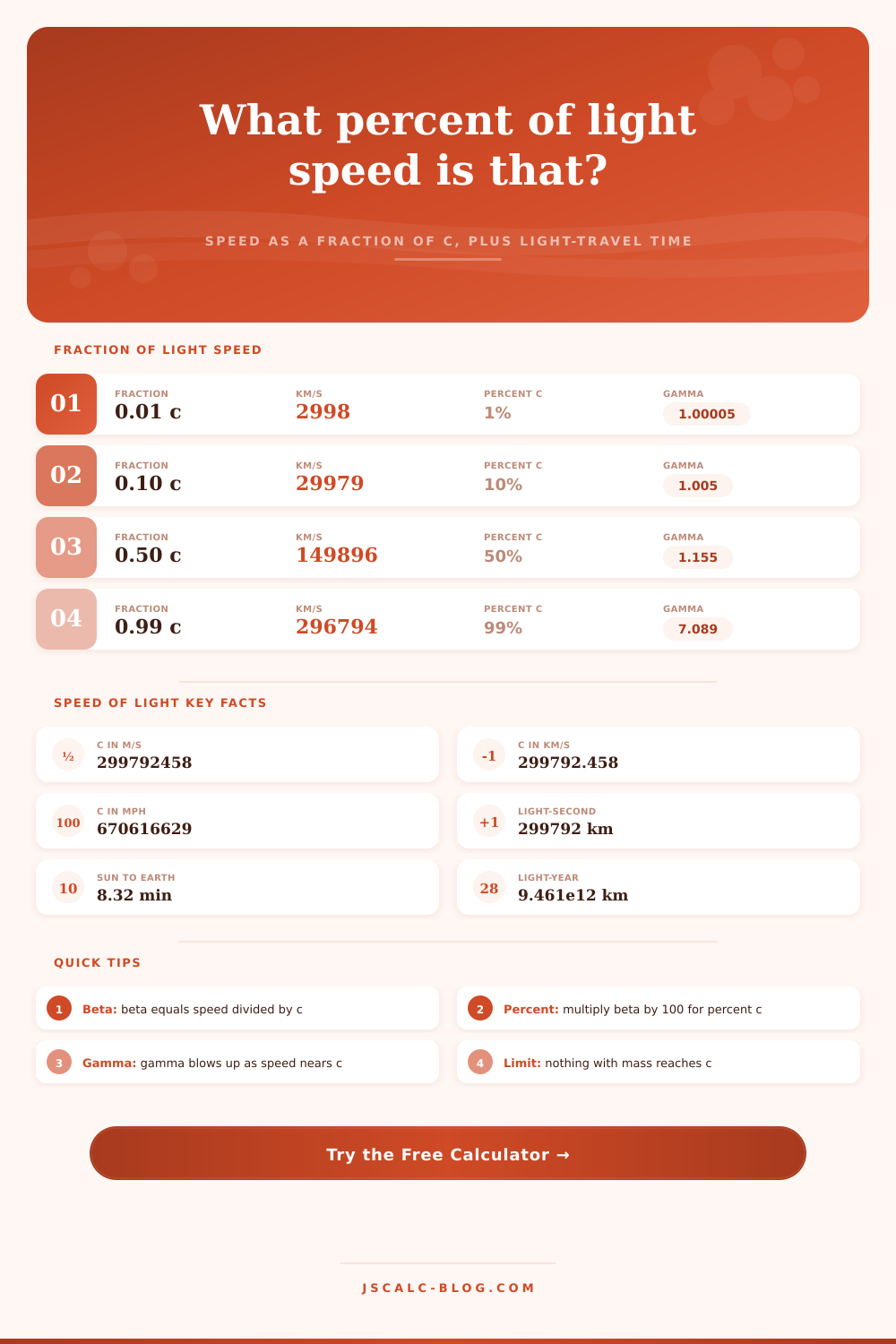
| 0.01 c | 1% | 2,997.9 | 10,792,528 | 6,706,166 |
| 0.05 c | 5% | 14,989.6 | 53,962,642 | 33,530,831 |
| 0.10 c | 10% | 29,979.2 | 107,925,285 | 67,061,663 |
| 0.25 c | 25% | 74,948.1 | 269,813,212 | 167,654,157 |
| 0.50 c | 50% | 149,896.2 | 539,626,424 | 335,308,315 |
| 0.75 c | 75% | 224,844.3 | 809,439,637 | 502,962,472 |
| 0.90 c | 90% | 269,813.2 | 971,327,564 | 603,554,966 |
| 0.99 c | 99% | 296,794.5 | 1,068,460,320 | 663,910,463 |
🪐Light-Travel Time From the Sun
| Body | Avg Distance | Light Time (s) | Light Time |
|---|---|---|---|
| Mercury | 57.9M km | 193 s | 3.22 min |
| Venus | 108.2M km | 361 s | 6.02 min |
| Earth | 149.6M km (1 AU) | 499 s | 8.32 min |
| Mars | 227.9M km | 760 s | 12.67 min |
| Jupiter | 778.5M km | 2,597 s | 43.28 min |
| Saturn | 1,432M km | 4,777 s | 79.61 min |
| Uranus | 2,867M km | 9,563 s | 2.66 hr |
| Neptune | 4,515M km | 15,060 s | 4.18 hr |
🌌Cosmic Distances In Light-Years
| Object | Distance (ly) | Distance (km) | Note |
|---|---|---|---|
| The Moon | 0.0000000406 | 384,400 | 1.28 light-seconds |
| The Sun | 0.0000158 | 149.6M | 8.32 light-minutes |
| Proxima Centauri | 4.24 | 4.01e13 | Nearest star |
| Alpha Centauri A | 4.37 | 4.13e13 | Bright neighbor |
| Sirius | 8.60 | 8.14e13 | Brightest night star |
| Betelgeuse | 642 | 6.07e15 | Red supergiant |
| Galactic center | 26,000 | 2.46e17 | Milky Way core |
| Andromeda Galaxy | 2,500,000 | 2.37e19 | Nearest big galaxy |
📊Percent c vs Speed & Gamma
| Percent c | Beta | m/s | km/s | mph | Gamma |
|---|---|---|---|---|---|
| 1% | 0.01 | 2,997,925 | 2,997.9 | 6,706,166 | 1.00005 |
| 5% | 0.05 | 14,989,623 | 14,989.6 | 33,530,831 | 1.00125 |
| 10% | 0.10 | 29,979,246 | 29,979.2 | 67,061,663 | 1.00504 |
| 25% | 0.25 | 74,948,115 | 74,948.1 | 167,654,157 | 1.03280 |
| 50% | 0.50 | 149,896,229 | 149,896.2 | 335,308,315 | 1.15470 |
| 75% | 0.75 | 224,844,344 | 224,844.3 | 502,962,472 | 1.51186 |
| 90% | 0.90 | 269,813,212 | 269,813.2 | 603,554,966 | 2.29416 |
| 99% | 0.99 | 296,794,533 | 296,794.5 | 663,910,463 | 7.08881 |
| 99.9% | 0.999 | 299,492,666 | 299,492.7 | 669,946,013 | 22.36627 |
🧮How The Math Works
📋Reference Speeds vs Light
| Mover | Speed | In m/s | Percent of c |
|---|---|---|---|
| Speed of sound | 343 m/s | 343 | 0.000000114% |
| Cruising jet | 250 m/s | 250 | 0.0000000834% |
| ISS orbit | 7.66 km/s | 7,660 | 0.00256% |
| New Horizons | 16.26 km/s | 16,260 | 0.00542% |
| Voyager 1 | 17 km/s | 17,000 | 0.00567% |
| Parker Solar Probe | 191 km/s | 191,000 | 0.0637% |
| Half light speed | 149,896 km/s | 149,896,229 | 50% |
💡Relativity Tips
There’s no getting around it: The universe have a speed limit, and it doesn’t budge. While there are ways to increase acceleration of car, adding more power, light won’t haggle with you. In a vacuum, it travels at approximately 300,000 kilometers per second, which is such a big number that your brain can’t even wrap its head around it without assistance.
Thankfullly, there’s this calculator, which translates those abstractions into something your mind can understand. Plug in whatever velocity you want and see how it stacks up against this cosmic ceiling. The speed of light.
Why Light Speed Is So Hard to Beat
The thing about light speed, most folks think it’s just really fast. But the interesting bit is how closely you’re approaching that limit. Classical physics hold up pretty good at everyday speeds. Velocities can be added easly. But when you start approaching ten percent of c, Newtonian mechanics starts to fall apart.
That’s why I like beta. Beta is your velocity over the speed of light. It’s a fraction telling you what portion of the cosmic budget you’re consuming. The calculator will spit out that number immediately and eliminate any unit confusion. Why? Because the faster someone go, the more their body will consume to do so.
When traveling at near light speeds, the energy cost doesn’t grow with velocity. The tables of reference has that ratio. As you accelerate past the point where you can walk out to get coffee, increasing your speed by twice as much won’t require twice as much energy. It’ll shoot up.
That’s represented by the Lorentz factor (or gamma). At one percent of light speed, gamma is barely above one and isn’t going to give you much time dilation or mass increase; it’s just slightly higher than one. You could travel in that sort of spaceship at that speed and feel little different then being home on Earth.
If you hit ninety-nine percent though, it explodes to nearly seven. Time will slow drastically for the person inside the ship compared to somebody watching them from outside. And I mean this literally. Not metaphorically. It’s real.
It also accounts for light travel time distances, putting all of those big numbers in human-scale context. It is better to think of space not as empty distance, but as latency. At any moment during the day, if you’re looking up toward the middle of sky around noon, you’re actualy seeing something eight and a half minutes old. And, you can plug in your own distance from nearby Proxima Centauri, the closest star; it will tell you how long it takes light to get there.
It converts distance in kilometers into seconds, minutes, and years of light-travel time, putting the size of galaxy into perspective. The problem with how everyone views these conversions is they think if something’s fast here on Earth, it must be fast by cosmic standards. Even though the Parker Solar Probe broke the record for speed around the sun, its speed was still only a fraction of a percent of c. Statistically, your car driving down the freeway are zero.
Understanding this hierarchy help avoid frustration over why we’re not even close to traveling through space. Requiring energy scales as the square of velocity. It takes huge amounts of input to get tiny gains. The presets provides a way to see how far we have come from understanding cosmic physics with our own engineering.
When I click the Voyager one preset, the speed look incredible for such an old probe, but it’s slow compared to the speed of light. The calculator shows it immediately. There’s no need to divide anything by 299,792,458 in your head. The machine does the math so you can focus on what the result means.
Speeds convert to a percentage of c and it’s humbling. It brings home that the vacuum of space is ruled by limitations none of us can overcome. As beta nears one the Lorentz factor increase steeply and tells us that 100 percent requires infinite energy. Mass cannot achieve such velocity; not at all.
We remain stuck on the left side of the graph staring up at stars whose light was emitted millennia ago. The calculator spits out the numbers, but its perspective lingers. You should of used it sooner.