LED Resistor Calculator
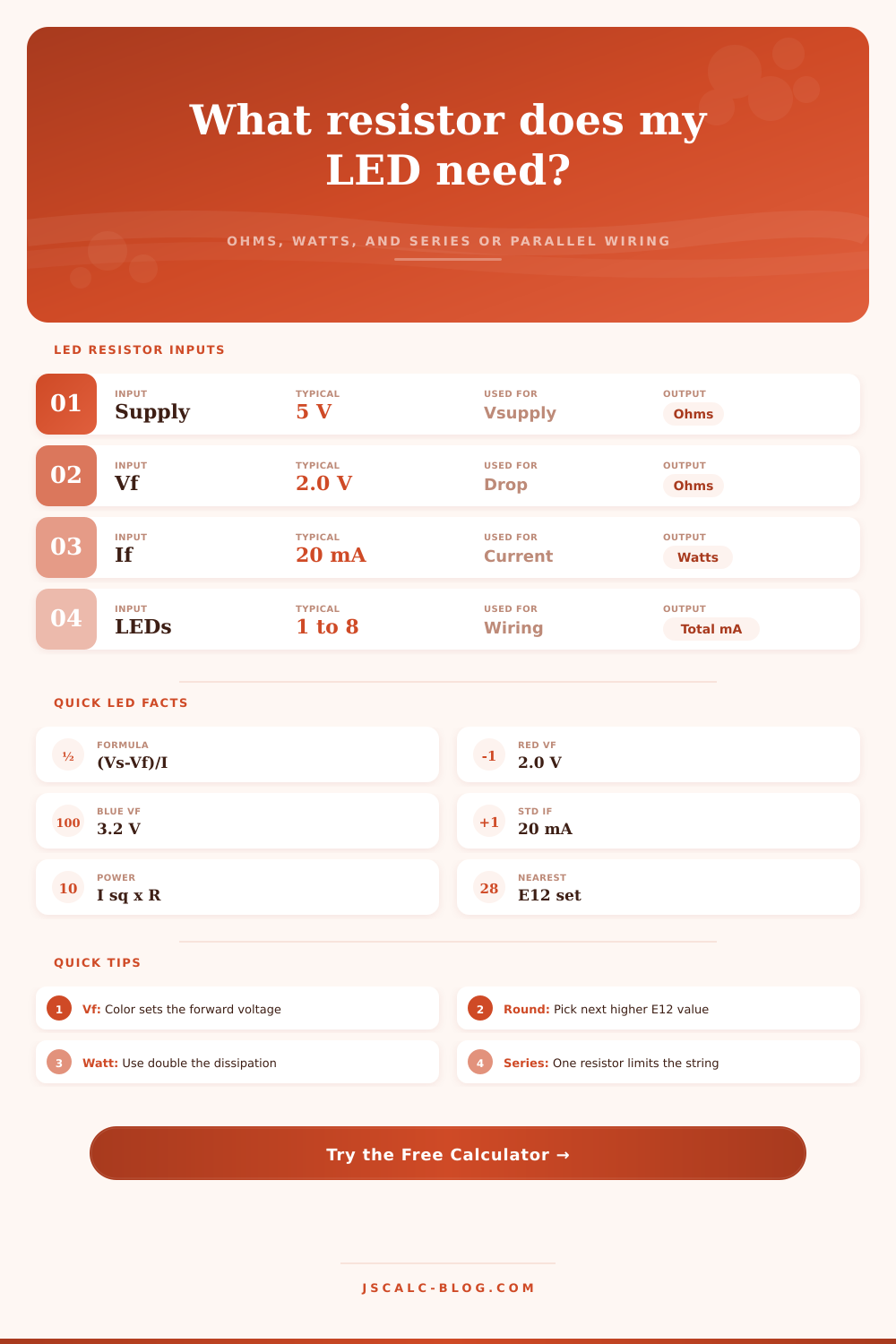
Size the current-limiting series resistor for any LED from supply voltage, forward voltage, and forward current. Get the exact ohm value, the nearest E12 standard, power dissipation with a safe wattage rating, and total current for single, series, and parallel wiring.
🎯Real LED Presets
📝Circuit Inputs
Read Vf from the LED datasheet at the target current.
🔢Formula Snapshot
🌈LED Forward Voltage by Color
| Color | Typical Vf | Range | Chemistry | Common If |
|---|---|---|---|---|
| Infrared | 1.5 V | 1.2 – 1.7 V | GaAs | 20 – 50 mA |
| Red | 2.0 V | 1.8 – 2.2 V | AlGaInP | 20 mA |
| Orange | 2.0 V | 2.0 – 2.2 V | AlGaInP | 20 mA |
| Yellow | 2.1 V | 2.0 – 2.4 V | AlGaInP | 20 mA |
| Green | 2.1 V | 2.0 – 3.5 V | InGaN / AlGaInP | 20 mA |
| Blue | 3.2 V | 2.8 – 3.6 V | InGaN | 20 mA |
| White | 3.2 V | 2.9 – 3.6 V | InGaN + phosphor | 20 mA |
| High-power | 3.0 V | 2.8 – 3.6 V | InGaN | 350 – 1000 mA |
🧮Standard E12 Resistor Values
| Base | x1 | x10 | x100 | x1k |
|---|---|---|---|---|
| The E12 reference grid appears after calculation. | ||||
The calculator rounds the exact resistor up to the next value in this decade series so the LED current never exceeds the target.
🔥Resistor Power Rating Guide
| Rating | Max Dissipation | Safe Continuous | Typical Use |
|---|---|---|---|
| 1/8 W | 0.125 W | up to 0.06 W | Low current indicators |
| 1/4 W | 0.25 W | up to 0.13 W | Most single 20 mA LEDs |
| 1/2 W | 0.5 W | up to 0.25 W | Higher voltage drops |
| 1 W | 1.0 W | up to 0.5 W | 12 V strings, big drops |
| 2 W | 2.0 W | up to 1.0 W | High-current single LEDs |
| 5 W | 5.0 W | up to 2.5 W | Power LED ballast |
🗂Series vs Parallel Comparison
| Wiring | Resistors | Resistor Formula | Supply Rule | Total Current | Best For |
|---|---|---|---|---|---|
| Single | 1 | (Vs - Vf) / If | Vs > Vf | If | One indicator LED |
| Series (2) | 1 | (Vs - 2Vf) / If | Vs > 2Vf | If | Efficient strings |
| Series (3) | 1 | (Vs - 3Vf) / If | Vs > 3Vf | If | 12 V from 3 reds |
| Series (n) | 1 | (Vs - nVf) / If | Vs > nVf | If | Max LEDs per rail |
| Parallel (2) | 2 | (Vs - Vf) / If each | Vs > Vf | 2 x If | Independent LEDs |
| Parallel (n) | n | (Vs - Vf) / If each | Vs > Vf | n x If | Uneven binning |
⚙Full Formula Breakdown
📋LED Wiring Tips
With a 9-volt battery and a new red LED, you hook things up hoping for a nice constant light to put on your night stand. What you get instead is the faint scent of burning plastic and some smoke. Before it even lights up, the diode die. That’s what happens to most electronics hobbyist.
LEDs are delicate creatures. Unlike old-fashioned bulbs, which take in exactly as much juice as they need, these guys grab all the electrons they can until there aren’t any left. To keep them from frying, you need to use a resistor to limit the flow.
How to Use Resistors with LEDs
Finding the correct size isn’t rocket science; it’s all about numbers. LEDs demand a certain level of current. Typically, they is rated for twenty milliamps. They also has a fixed forward voltage drop across them. What if you feed the LED with five volts when it calls for two? Where does the other three volts go? It goes through the resistor.
How do you know what size resistor to use? Take the voltage off the supply minus the forward voltage of the LED. Divide by the required current. In our example above where the supply was ten volts and the LED dropped two, we would of have eight volts remaining. Twenty milliamps requires a four hundred ohm resistor. Make a big mistake in the math and you fail.
This tool will perform the math for you fast so you can concentrate on connecting things instead of solving algebra problems. The part selection complicates things. Chances are you don’t have exactly 400 ohms. Standard resistors is made in series. They might be E12 or E24 etc. Pick the closest one. Round up a bit.
Bigger resistance resists more current (so dims the LED), but is safer. Smaller resistance lets more current flow (which can kill the LED fast!). Power rating is also important. When the resistor blocks voltage, it heats up. Half a watt dissipated? An eighth-watt resistor doesn’t make it. The tiny little carbon chip fries before the LED do. Use the chart on the page to pair your heat load with a proper package.
When you wire several LEDs in series they also accumulate voltage drop. Three red LEDs needing two volts each require six volts. No amount of resistor can drive them from a five volt supply. It appears that paralleling LEDs would be better. Then each gets full voltage. But resistors only belong in their branch. They don’t work if shared across parallel branches. One will burn out taking all the current while the others are left dark, and it makes things difficult.
Every branch must have its own. That way there’s no danger of darkness or unequal brightness. And it uses more components.
And the primary takeaway: Respect limitations. LEDs are good, but do not include built-in over-current protection. It is your job to provide that through careful selection and calculations. Whether it’s one indicator or a strand of holiday lights, keep power within bounds. Account for voltage loss, honor power limits. Check your numbers against what you can find. If done propery, the LED performs as designed without being damaged.