RC Time Constant Calculator
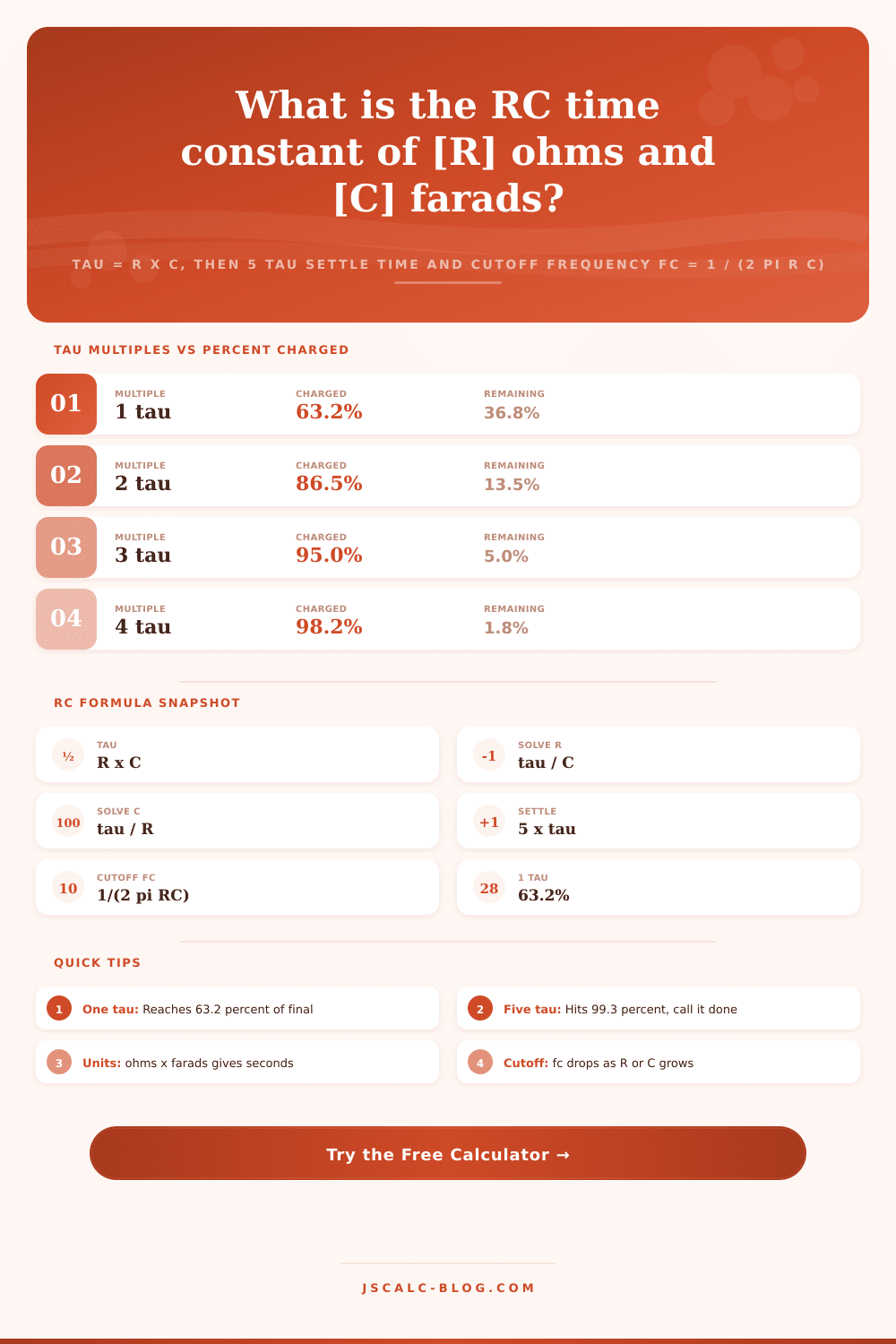
Enter a resistor and capacitor to get the RC time constant tau = R x C, the full 5 tau settle time that reaches 99.3 percent, and the cutoff frequency fc = 1 / (2 pi R C). You can also solve backwards for the resistance or capacitance that hits a target time constant.
⏱Real RC Presets
🔌RC Inputs
Pick the unknown; enter the other two below.
Series resistance in the RC network.
Multiplier applied to the R value.
Capacitance charging through R.
Multiplier applied to the C value.
Used when solving for R or C.
Applies to the target tau field.
Controls rounding on every result card.
🔢Formula Snapshot
📈Tau Multiples vs Percent
| Elapsed Time | Percent Charged | Percent Remaining | Reads As |
|---|---|---|---|
| 0.5 tau | 39.3% | 60.7% | Just started |
| 0.7 tau | 50.3% | 49.7% | Half point |
| 1 tau | 63.2% | 36.8% | One time constant |
| 2 tau | 86.5% | 13.5% | Most of the way |
| 3 tau | 95.0% | 5.0% | Near final |
| 4 tau | 98.2% | 1.8% | Almost there |
| 5 tau | 99.3% | 0.7% | Treated as settled |
| 7 tau | 99.9% | 0.1% | Effectively full |
📑Common R and C to Tau Lookup
| Resistance R | Capacitance C | Tau = R x C | Cutoff fc |
|---|---|---|---|
| 1 k | 1 uF | 1 ms | 159 Hz |
| 10 k | 10 nF | 100 us | 1.592 kHz |
| 10 k | 100 nF | 1 ms | 159 Hz |
| 100 k | 10 uF | 1 s | 0.159 Hz |
| 4.7 k | 1 uF | 4.7 ms | 33.86 Hz |
| 1 M | 100 uF | 100 s | 1.6 mHz |
| 50 ohm | 100 pF | 5 ns | 31.83 MHz |
| 100 ohm | 1000 uF | 100 ms | 1.592 Hz |
📏Time and Frequency Unit Conversions
| Unit | Equals | In Base Unit | Note |
|---|---|---|---|
| 1 s | 1000 ms | 1 s | One second |
| 1 ms | 1000 us | 0.001 s | Millisecond |
| 1 us | 1000 ns | 0.000001 s | Microsecond |
| 1 uF | 1000 nF | 0.000001 F | Microfarad |
| 1 nF | 1000 pF | 0.000000001 F | Nanofarad |
| 1 k ohm | 1000 ohm | 1000 ohm | Kilohm |
🗃RC Comparison Grid
| R | C | Tau | 5 Tau Settle | Cutoff fc | Typical Use |
|---|---|---|---|---|---|
| 1 k | 1 uF | 1 ms | 5 ms | 159 Hz | General timing |
| 1 k | 100 nF | 100 us | 500 us | 1.592 kHz | Fast reset |
| 10 k | 10 nF | 100 us | 500 us | 1.592 kHz | Audio filter |
| 10 k | 100 nF | 1 ms | 5 ms | 159 Hz | Switch debounce |
| 100 k | 10 uF | 1 s | 5 s | 0.159 Hz | 555 long timer |
| 4.7 k | 1 uF | 4.7 ms | 23.5 ms | 33.86 Hz | Bass cutoff |
| 1 M | 100 uF | 100 s | 500 s | 1.6 mHz | Long delay |
| 50 ohm | 100 pF | 5 ns | 25 ns | 31.83 MHz | RF matching |
| 100 ohm | 1000 uF | 100 ms | 500 ms | 1.592 Hz | Power bulk |
⚙Formula Breakdown
💡RC Timing Tips
Enter your cap and resistor values into the RC time constant calculator and it will tell you what time constant (tau) are. But more importantly, it shows how time works in an electrical circuit. Time isn’t only expressed in seconds; it’s frequentely described as the speed at which a circuit is charged or discharged.
For first order circuits, the time constant is the best number. It tell you how fast capacitor charges from the resistor, when a signal settles, and when a filter starts to roll off. Plug in the components and it instantly calculates that product for you, including cutoff frequency and settle time (you don’t have to do the math in your head). It even works backwards, you can determine exactly what component to use to get a specific timing window.
What Is an RC Time Constant Calculator?
Simply, the time constant equals resistance times capacitance. Ohms multiplied by farads will always produce time units (seconds). So if I have a 1-microfarad cap across a 1000-ohm resistor, then my tau would be one millisecond. And engineers love that it’s such a clean relationship. It scales perfectly. Whatever size capacitors and resistors you choose, kilohms? Megohms? Picofarads? Microfarads? The math works out the same. You can think in whatever natural units are printed on the part and trust the seconds you get back from the calculator. Everyone assumes they has to convert it all to base units first, but you don’t have to. It does that work for you.
More often than not, you’re told what part you’ve got and asked to supply the other component; design doesn’t usually give you both and ask for the answer. Given that tau is equal to R times C, if we know any two of these values, we can calculate the other. Need a one-millisecond delay? You have a 100-nanofarad capacitor in your parts bin, now what’s the required resistance? The calculator answers this question and it will tell you precisely which resistor value yield the desired time constant. This changes the tool from a simple checker to a true design aid: something that assists with decision-making when board space or available parts limit the design.
You can calculate that one tau will get you to 63.2 percent of the final value but this isn’t often good enough to practically do anything with. An analog-to-digital converter can only sample signals once they is stable, and a logic gate needs a stable signal to see a clean state. As such, the commonly quoted figure is that you’ll need five time constants to reach 99.3 percent of the final value. By then, you’re getting pretty darn close and can consider things to be settled. The calculator shows that 5 tau settle time clearly so you can confidently size your delays to match. If your tau is one millisecond, that means the full settle time is approximately five milliseconds. That is the amount of time you should of wait before you trust the signal… Something that’s critical to avoid false triggers or jitter in digital systems.
The same numbers produce the corner frequency of an RC network, which serves equally well as a first-order filter. That’s because the cutoff frequency is simply one over two pi times tau. When the signal reaches that point, the filter reduces it by 3 decibels, marking the boundary of the passband and the roll-off. For a time constant of a millisecond, the cutoff is around 159 hertz. Those components make up a simple low-pass filter, which transmits low-frequency tones (bass) but weakens high ones. The calculator spits out the frequency in whatever units are relevant: maybe millihertz for something with a slow sensor or megahertz for radio tuning. And linking the timing to the way the filter behaves is a powerful mental model.
The biggest error in RC math is unit slips. Kilohms has to turn into 1000 ohms and microfarads must be converted to base farads before you multiply. There will be no more misplaced decimal points and ruined designs. That’s what a calculator does, it stops those kinds of errors. It also keeps all the cutoff frequency, settle time, and tau formulas together for both selecting new parts and analyzing old ones. Just pick a preset, tweak a bit, and see how it will go.
Whether an engineer needs to size a delay, or a student wants to learn exponential response, the time constant is the first way to make your circuit behave. As long as you get it right. And time, here, is something you can sell with capacitance and buy with resistance.