Break Even Point Calculator
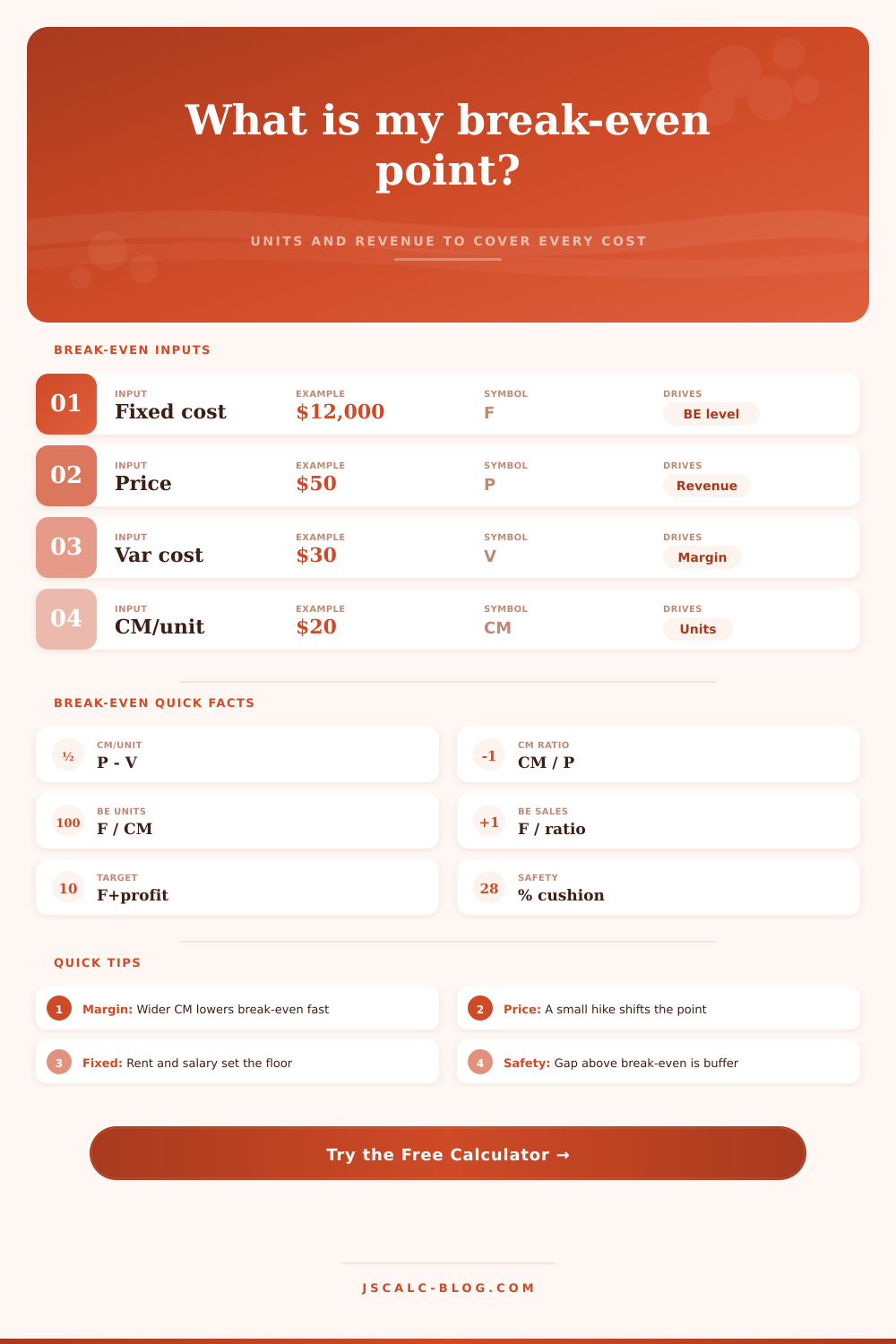
Find the units and sales revenue you need to cover every cost, then see contribution margin per unit, the contribution margin ratio, units required for a target profit, and your margin of safety.
🎯Real Business Presets
📝Cost and Price Inputs
Rent, salaries, insurance, and other costs that do not change with volume.
Materials, packaging, payment fees, and other per-unit costs.
Profit you want on top of covering all costs. Leave 0 for pure break-even.
Used for margin of safety and actual-profit estimate.
Shown in results, e.g. cups, seats, boxes, jobs.
🔢Formula Snapshot
💲Break-Even at Different Prices
| Price / Unit | CM / Unit | CM Ratio | Break-Even Units | Break-Even Revenue |
|---|---|---|---|---|
| Enter values above to build the price sensitivity table. | ||||
📈Profit at Various Sales Volumes
| Units Sold | Revenue | Variable Cost | Fixed Cost | Total Cost | Profit / Loss |
|---|---|---|---|---|---|
| The profit-by-volume table appears after calculation. | |||||
🛡Margin of Safety Reference
| Sales Level | Units | Revenue | Above Break-Even | Margin of Safety | Profit / Loss |
|---|---|---|---|---|---|
| The margin-of-safety comparison appears after calculation. | |||||
📊Contribution Margin Reference
| Business Type | Typical Price | Variable Cost | CM Ratio | Break-Even Note |
|---|---|---|---|---|
| Coffee shop drink | $4.50 | $1.35 | 70% | High margin, high daily volume |
| SaaS subscription | $40.00 | $4.00 | 90% | Very high margin, fixed-cost heavy |
| Handmade craft | $28.00 | $11.00 | 61% | Time and materials limit volume |
| Grocery / retail | $12.00 | $9.60 | 20% | Thin margin, needs high turnover |
| Consulting hour | $120.00 | $15.00 | 88% | Capacity is the real limit |
| Restaurant plate | $18.00 | $6.30 | 65% | Labor sits in fixed costs |
⚙Full Formula Breakdown
💡Practical Break-Even Tips
When it comes to launching a product, you have energy but no idea if you’re actualy making money. Why? Because when you’re excited, the math of survival go unnoticed. Your break even point is the moment your revenue equals all expenses, there’s nothing left over in profit. Break even isn’t something to hit & forget. It’s reality… The baseline against which your business plan will either work … or collapse. Understanding your number stops guessing … and begins planning.
To understand the math, it’s as easy as dividing your fixed costs by your contribution margin (selling price less variable cost) per unit sold. Fixed costs don’t vary based off sales volume. Contribution margin tell you how much money you add in cash with every sale. This allows you to pay bills like insurance, salaries, and rent. Use a calculator instead of a spreadsheet and spend more time thinking about what those numbers mean to day-to-day operations.
How to Calculate Your Break-Even Point
Let’s take a coffee shop, for instance. Suppose their cost of goods sold (bean + cup) come to $1.50 per latte. They pay twelve grand a month in rent/wages, and they sell every single latte for $5. Their contribution margin is, so, $3.50 per latte. How many lattes do they need to sell to cover overhead? Simply divide fixed costs by the contribution margin. In this case, it is just shy of 3,400 lattes. Which sounds like a lot… Until you realize that’s about one-hundred cups a day. This is terrifying or achievable depending on your foot traffic.
Variable cost is more important than price (variable = something that changes: shipping cost, materials cost, etc.) The temptation is to raise price a little bit (and drop volume significantly). Raising price 50¢ may sound good, but it doesn’t do as much to help margin as trimming one dollar off shipping fee / material cost. This calculator makes it easy to tinker with those variables right now, immediately showing where your business might have an advantage in the market. Try out different scenarios without putting your money at risk of betting wrong on a pricing tactic.
Your bottom line is pulled down by a force called “fixed costs.” Each software subscription, each lease renewal, and each new hire drags you down. It is up to sales to pull those numbers back up. This is why service businesses with heavy labor overhead can be difficult. After creating digital products, there are near zero variable costs. There are massive fixed costs for time for the former and no fixed costs for the latter. Before you sign any contract, think about whether you should of outsource your work or automate it; understanding this dynamic will help.
Another idea that’s good to monitor: margin of safety. This tells you how many extra units you’re selling beyond the breakeven point. So if your breakeven point is six-hundred unit and you sell nine-hundred, you have breathing room; you can survive some dud months without falling into the red. The smaller your margin, the closer you’ll edge toward loss with just one decline in demand. Ideally, you’d like plenty of wiggle room for when the weather gets chilly; or if the market turns topsy-turvy.
The tool also offers benchmark reference tables that are quite helpful. For example, typical margin contributions varies by industry; SaaS companies have a higher percentage than retail grocery stores. Where a supermarket is fighting to get a 20 percent contribution, a software company might be reveling at a 90 percent contribution. That’s why we see tech startups splurging huge amounts of money on marketing blitzes and retailers sweating over their inventory turn. Comparing yourself to others in different spaces require context.
From there, we build a target profit plan. Each additional unit you sell goes straight to profits at the same profit per unit after your cost is covered. Want a $10k profit? Add it to your fixed costs and re-calculate how many units are needed. The resulting number becomes a real sales target for your team to pursue. Removing the guess-work from goal-setting makes your quarterly plans crystal clear.
The real value lies in using these figures as a decision framework rather than just a static report. Supplier prices vary; seasonality drives demand patterns, which change from year to year. When you revisit this every month, you stay current instead of looking back at last year. This allows you to have hard discussions about your pricing power and efficiency before minor problems turn into major threats.
At its core, break even analysis is simple survival math, the antithesis of complicated finance. It removes distractions to show you bare minimum required to survive. Whether it’s hours for consultant work or units of handmade goods, once you know your floor, you can construct on top of that foundation at ease. This number separates hobby from sustainable business. Honor it and keep it in view.