Natural Logarithm Calculator
Compute the natural log ln(x), the exponential e^x, any logarithm log base b of x with change-of-base, and solve e^x = value. Each mode shows the inverse check, a related value, and full worked steps.
🎯Real ln and e Presets
📝Function Inputs
For ln and log modes x must be greater than 0. For e^x any real x is allowed.
Base must be greater than 0 and not equal to 1. Used only in the log base b mode.
Target must be greater than 0 because e^x is always positive.
🔢Constants Snapshot
📊ln(x) Reference Table
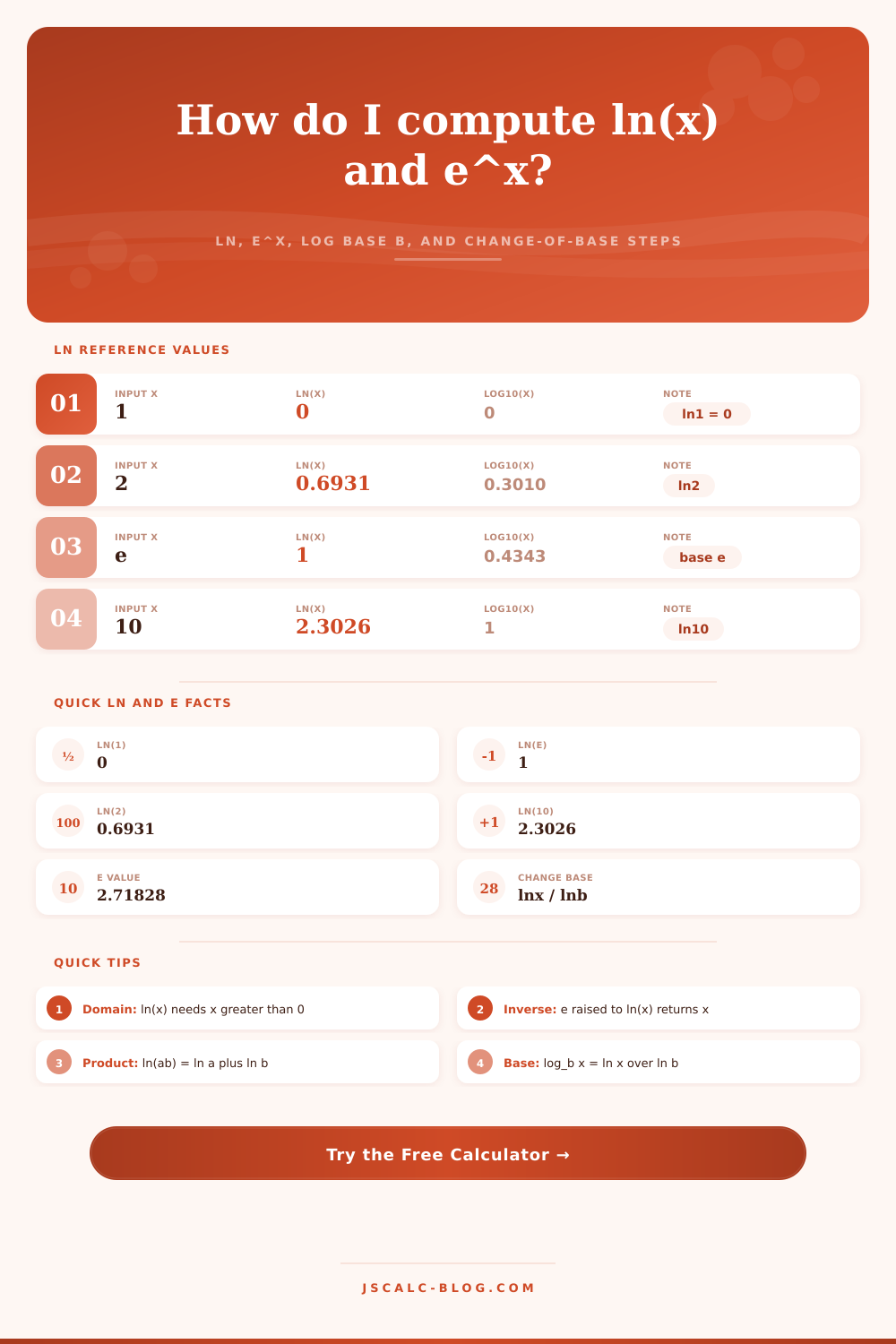
| x | ln(x) | log10(x) | Relationship |
|---|---|---|---|
| 0.5 | –0.693147 | –0.301030 | ln(1/2) = –ln 2 |
| 1 | 0.000000 | 0.000000 | ln 1 = 0 for every base |
| 2 | 0.693147 | 0.301030 | ln 2 building block |
| e | 1.000000 | 0.434294 | ln e = 1 by definition |
| 3 | 1.098612 | 0.477121 | ln 3 building block |
| 5 | 1.609438 | 0.698970 | ln 5 = ln 10 – ln 2 |
| 10 | 2.302585 | 1.000000 | ln 10 scale factor |
| 100 | 4.605170 | 2.000000 | ln 100 = 2 × ln 10 |
📈e^x Reference Table
| x | e^x | e^(–x) | Note |
|---|---|---|---|
| 0 | 1.000000 | 1.000000 | e^0 = 1 |
| 0.6931 | 2.000000 | 0.500000 | e^(ln 2) = 2 |
| 1 | 2.718282 | 0.367879 | e^1 = e |
| 2 | 7.389056 | 0.135335 | e^2 |
| 3 | 20.085537 | 0.049787 | e^3 |
| 2.302585 | 10.000000 | 0.100000 | e^(ln 10) = 10 |
🔄Change-of-Base Reference
| Base b | ln(b) | log_b(x) formula | Example log_b(8) |
|---|---|---|---|
| 2 | 0.693147 | ln(x) / 0.693147 | 3.000000 |
| e | 1.000000 | ln(x) / 1 = ln(x) | 2.079442 |
| 10 | 2.302585 | ln(x) / 2.302585 | 0.903090 |
| 5 | 1.609438 | ln(x) / 1.609438 | 1.292030 |
| 16 | 2.772589 | ln(x) / 2.772589 | 0.750000 |
🧮Logarithm Identities
| Rule | Identity | Worked Example | Check |
|---|---|---|---|
| Product | ln(ab) = ln a + ln b | ln(6) = ln 2 + ln 3 | 1.791759 |
| Quotient | ln(a/b) = ln a – ln b | ln(5) = ln 10 – ln 2 | 1.609438 |
| Power | ln(a^p) = p × ln a | ln(8) = 3 × ln 2 | 2.079442 |
| Reciprocal | ln(1/a) = –ln a | ln(1/2) = –ln 2 | –0.693147 |
| Base one | ln(1) = 0 | e^0 = 1 so ln 1 = 0 | 0.000000 |
| Inverse | ln(e^x) = x | ln(e^4) = 4 | 4.000000 |
| Exp inverse | e^(ln x) = x | e^(ln 7) = 7 | 7.000000 |
🗂Function Comparison Grid
| x | ln(x) | log10(x) | log2(x) | e^x | Domain |
|---|---|---|---|---|---|
| 0.25 | –1.386294 | –0.602060 | –2.000000 | 1.284025 | logs need x>0 |
| 0.5 | –0.693147 | –0.301030 | –1.000000 | 1.648721 | logs need x>0 |
| 1 | 0.000000 | 0.000000 | 0.000000 | 2.718282 | all defined |
| 2 | 0.693147 | 0.301030 | 1.000000 | 7.389056 | all defined |
| e | 1.000000 | 0.434294 | 1.442695 | 15.154262 | all defined |
| 8 | 2.079442 | 0.903090 | 3.000000 | 2980.958 | all defined |
| 10 | 2.302585 | 1.000000 | 3.321928 | 22026.47 | all defined |
| 100 | 4.605170 | 2.000000 | 6.643856 | 2.688e43 | all defined |
⚙Full Formula Breakdown
📋Domain and Usage Notes
| Case | Rule | Result | Reason |
|---|---|---|---|
| x > 0 | ln(x) defined | a real number | e^y covers all positives |
| x = 1 | ln(1) | exactly 0 | e^0 equals 1 |
| 0 < x < 1 | ln(x) | negative | e to a negative power |
| x = 0 | ln(0) | undefined | limit goes to minus infinity |
| x < 0 | ln(x) | undefined (real) | no real power of e is negative |
| base b = 1 | log_b(x) | undefined | ln(1) = 0 divides by zero |
💡Practical ln Tips
You must understand that natural logarithm is behind exponential growth and exponential decay, which is the mechanism behind everything from radioactivity to our perception of sound. These things don’t happen along linear scales; they happen exponentially. Why does it matter? Because natural log turns those exponential functions into a straight line. That’s why mathematicians uses base e instead of base 10 (though we all learn about common logs first).
That’s where this calculator comes in. The calculator is above. It’ll do all of the calculating for you. No need to do it by hand with ln(*x*) and reversing it back out again with *e**^x*. With the change-of-base formula, it will calculate any type of log in any other base.
How to Use the Calculator
And it does its checks backwards; so you know that everything are correct. That way if you’re doing an engineering estimate on a house, or checking your homework, you know what steps were taken along the way. Not just what the answer was. It is nice to see how they gets there.
Know your inputs: With the natural log function, x has to be positive. There is no possible power of e which will give you a negative number or even a zero. At a vertical asymptote, ln(x) approaches negative infinity when x are zero. It’s flagged by the calculator as an undefined quantity. That protects against equation errors further down the road.
Anything between 0 and 1 will always return a negative number. Think of it as finding a fractional exponent that shrinks e into a smaller number. This is where ln comes in, the two are inverses of each other. Taking the natural log reverses *e* raised to any power. Look at the table on the page and you’ll see just what I mean.
There’s a whole section devoted to the connection of ln(10), which is around 2.3026, and how bases corresponds through division. You don’t need to memorize these constants if you understand the structure though. Recall that ln(e) = 1 always. That’s going to serve as an anchoring point for checking your work.
In practical situations, such as continuous compounding and half-life calculations, precision is important. Exponential functions increases rapidly, so even a slight mistake in the exponent leads to big differences in the outcome. For precise comparisons of scientific measurements or financial forecasts, you can tweak number of decimal places on the calculator.
Base confusion is another mistake; for example, people think the “log” function refers to natural log, while in practice it usualy refers to base 10. The change-of-base rule explains why: log_b(x) = ln(x)/ln(b). This formula also connects all of the systems of logs into one. It is important to know if you switch from textbook problems using a particular convention to analyzing real world information that uses a different convention.
With the tool, you can also tackle problems that has *x* raised to another power. That is, you can solve for an equation that has an exponent. For example, you can find out when your investment will hit some amount. Rather than try and guess it out, go into solve mode, enter the goal and follow steps. It will guide you to take the log of each side of the equals sign and then isolate the *x*. This makes what would of been a guessing game a straight up calculation.
It’s a logarithmic scale, which is all about proportionality. Proportions are maintained but the range is compressed to something reasonable. That makes sense if you’re looking at growth or working with data. There’s value in shifting from linear to exponential perspectives, and vice versa. The calculator does it for you.
But knowing how the functions work allow you to trust what they produce. It is not because the answer is correct, but because you understand why it makes sense.