Markup Percentage Calculator
Turn product cost into a selling price, find the markup hidden in a price you already charge, price to a target profit margin, and see exactly how markup and margin differ using the multiplier method.
🏷Real Markup Presets
📝Pricing Inputs
Switch modes to change which field is solved for you.
Your landed cost per item, before markup.
Used in cost + markup mode.
Used when solving for markup or cost.
Used in price + margin mode. Must stay under 100%.
Scales profit into a total for the batch.
Picking a multiplier writes its markup into the field above.
Charm pricing rounds up to the next .99 endpoint.
🔢Formula Snapshot
🔄Markup to Margin Conversion
| Markup % | Multiplier | Margin % | On $50 cost, price is | Profit |
|---|---|---|---|---|
| Enter values above to build the conversion table. | ||||
📈Profit at Quantity
| Units | Total cost | Total revenue | Total profit | Profit each | Margin % |
|---|---|---|---|---|---|
| The quantity ladder appears after calculation. | |||||
🏬Keystone & Industry Reference
| Scenario | Typical Markup | Multiplier | Implied Margin | Why It Is Used |
|---|---|---|---|---|
| Grocery staples | 10% to 15% | 1.10x to 1.15x | 9% to 13% | High volume, thin per-item profit |
| Consumer electronics | 15% to 25% | 1.15x to 1.25x | 13% to 20% | Price transparency keeps markup low |
| Wholesale to retailer | 25% to 50% | 1.25x to 1.50x | 20% to 33% | Leaves room for the retailer markup |
| Retail keystone | 100% | 2.00x | 50% | Double the cost as a fast default |
| Apparel and boutique | 120% to 150% | 2.20x to 2.50x | 55% to 60% | Covers markdowns and unsold stock |
| Jewelry | 150% to 250% | 2.50x to 3.50x | 60% to 71% | Low turnover and high service cost |
| Restaurant food | 200% to 400% | 3.00x to 5.00x | 67% to 80% | Labor, waste, and overhead loaded in |
🗂Markup Comparison Grid
| Markup | Multiplier | Margin | $20 cost price | $100 cost price | Profit on $100 |
|---|---|---|---|---|---|
| 15% | 1.15x | 13.0% | $23.00 | $115.00 | $15.00 |
| 25% | 1.25x | 20.0% | $25.00 | $125.00 | $25.00 |
| 40% | 1.40x | 28.6% | $28.00 | $140.00 | $40.00 |
| 50% | 1.50x | 33.3% | $30.00 | $150.00 | $50.00 |
| 75% | 1.75x | 42.9% | $35.00 | $175.00 | $75.00 |
| 100% | 2.00x | 50.0% | $40.00 | $200.00 | $100.00 |
| 150% | 2.50x | 60.0% | $50.00 | $250.00 | $150.00 |
| 200% | 3.00x | 66.7% | $60.00 | $300.00 | $200.00 |
| 300% | 4.00x | 75.0% | $80.00 | $400.00 | $300.00 |
⚙Full Formula Breakdown
📋Reference Values
| Term | Base It Uses | Formula | Common Mistake |
|---|---|---|---|
| Markup | Cost | (Price – Cost) / Cost | Reading it as margin and underpricing |
| Margin | Selling price | (Price – Cost) / Price | Adding margin % to cost like markup |
| Multiplier | Cost | 1 + markup / 100 | Confusing 1.5x with a 150% markup |
| Keystone | Cost | Price = Cost × 2 | Assuming it fits every category |
| Profit | Both | Price – Cost | Ignoring quantity for the batch total |
💡Practical Markup Tips
Knowing exactly what number sits between your cost and your price allow you to quote a customer with confidence. It’s the difference that will keep you in business, or bankrupt you.
A lot of shop owner use the words “margin” and “markup” interchangeably, but they’re not the same thing. Use one instead of the other and you’ll lower prices thinking you raised them. The calculator above convert immediately so you won’t need to carry two percentages around in your head. Cost times markup = gross profit Selling price times margin = gross profit
Why Margin and Markup Are Different
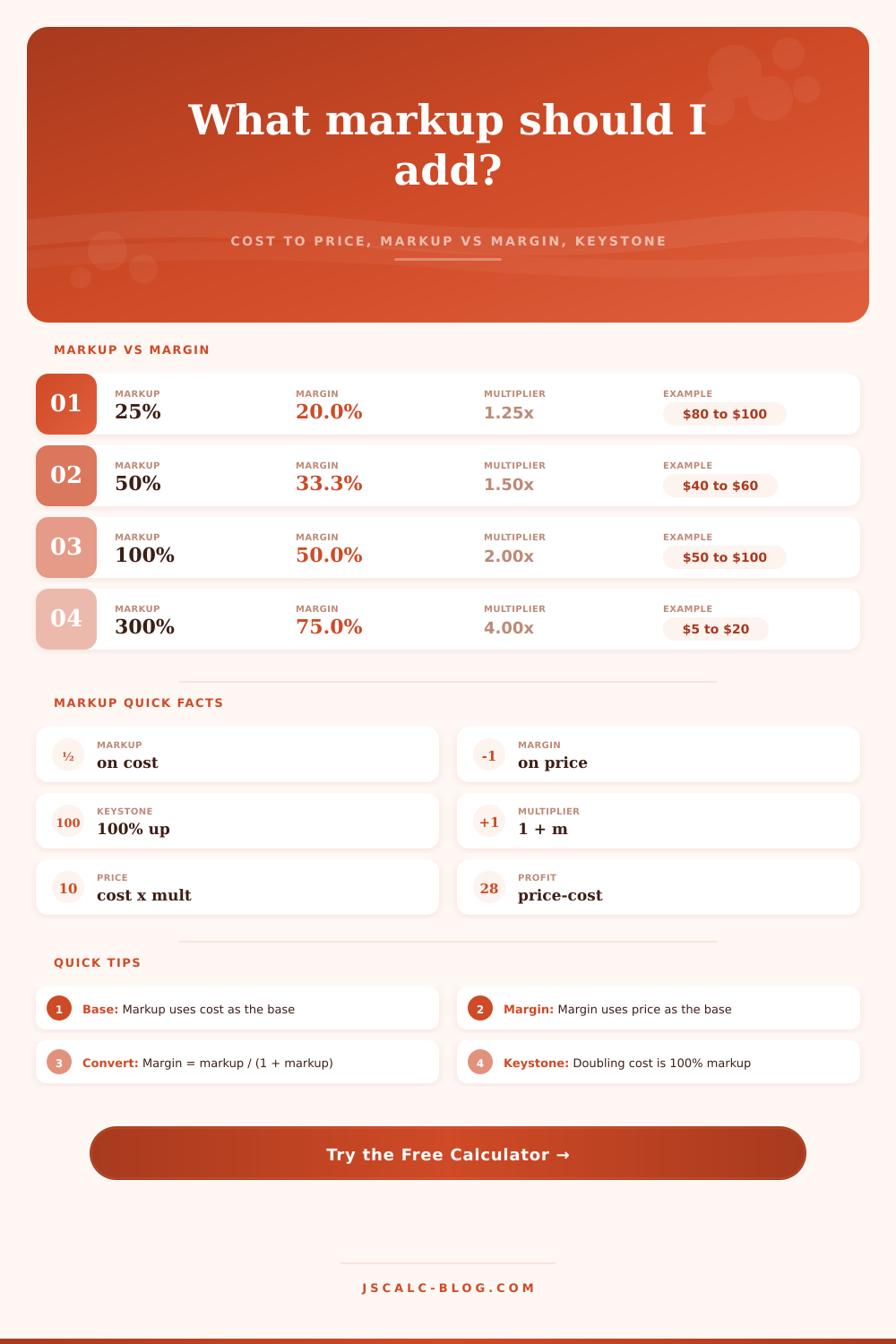
This may seem like splitting hairs, but when you’re trying to pay rent while operating at zero margin it becomes important. You purchase a widget for $40 and sell it for $60. The markup is 50 percent: Half of the cost was added. But the margin is thirty-three percent; the margin is based off the money left over (the numerator) compared to total price (the denominator). A little change in the denominator have a big impact on the percentage.
Retailers gets confused about this all the time, they don’t double-check their math. Every industry has a rule for how fat it can be. Volume is king; food stores live on narrow margins because stuff sells quickly. Consumers shop around online: electronics remain slim. Risky inventory (dead stock) demand steep markups in high-end clothing. Take a look at the reference table and you’ll find the norms. For example, a wholesaler may settle for a 1.25 multiplier as long as he moves enough volume, whereas a restaurant must charge a four times multiplier just to cover waste and labor. Know what’s normal for your field so that you don’t price yourself into poverty or out of the market.
For fast mental math, it’s far simpler then juggling raw percentages. Doubling the cost is known as keystone pricing. That’s your two point zero multiplier. That gets you a healthy fifty percent margin, great for most retail goods but deadly if you’re selling a product head-to-head with competitors. Think of the multiplier as your main tool.
Next quarter, when costs go up ten percent, use the multiplier to tweak just enough so the bottom line stays intact, no need to recalculate all SKU. Toggle the multiplier up or down and get exact cents or even end-in-ninety-nine charm pricing, because that psychological nudge make a difference at checkout time.
Set your target profit margin carefully. A lot of folks assume that if they add thirty percent to cost they will get a thirty percent margin, which is not true. Thirty percent added onto the cost means the actualy margin will be less since the base of the equation changes. To calculate properly, take the cost divided by one minus the desired profit margin. Switching modes in the calculator do this math for you and avoids the arithmetic mistake that kills many small business. It also guarantees that total price generates the exact slice of revenue you intend.
The pricing isn’t just a mathematical issue; it’s also a perception game. If you’re too cheap, people think you might be shoddy, but if you’re too expensive, people go elsewhere. You should of use the tools as your floor for survival. Beyond that, you need to determine your brand positioning to decide your ceiling.
Price can be a differentiator, some companies compete on price with thin margins, while others compete on service with high prices. Either way, neither is inherently better, since it all hinges on who is buying what and why.
Run the numbers; but first make sure your inputs are clean If you assemble it, labor, packaging, duties and shipping all goes into landed cost. Don’t just count what the supplier charged on their invoice. You’re underestimating how much it cost to get this product into somebody else’s hands. Build that buffer into your profit column because there may be damaged goods and/or return in your industry. Your profit column will look generous until the bills arrive.
That’s power. It puts the growth path under your control when you understand how this works. The distance between price and cost; that’s where the value lies, as long as you know how to measure it. And when you can plainly see the distinction between margin and markup, you’ll probably also notice some ways to increase cash flow that have been hidden in plain sight all along.
Make sure the numbers don’t simply fill a spreadsheet; use the data to drive your strategy.