Lease Rate Per Square Foot Calculator
Convert rent into annual and monthly price per rentable square foot, then adjust for usable area, load factor, lease type, NNN, free rent, TI allowance, term, and escalation.
🏢Lease Rate Presets
📋Lease Inputs
Enter total rent or a quoted psf rate, depending on the period below.
Most commercial lease rates are quoted on rentable square feet.
Used to show usable-area rate and implied load factor.
Leave at 0 for a gross quote that includes recoveries.
Effective psf subtracts tenant improvement allowance across the term.
📊Rate Snapshot Grid
📘Lease Type Reference
| Lease type | NNN treatment | Calculator factor | Common use | Rate comparison note |
|---|---|---|---|---|
| Triple net (NNN) | Added to base rent | 100% | Retail, industrial | Compare base and all-in psf |
| Absolute net | Added to base rent | 100% | Single tenant | Confirm tenant-paid items |
| Modified gross | Partly added | 50% | Office, flex | Check base year stop language |
| Industrial gross | Usually partly added | 35% | Warehouse, flex | Separate CAM from utilities |
| Full service gross | Usually included | 0% | Multi-tenant office | Base quote may be all-in rent |
| Gross lease | Usually included | 0% | Small office, studio | Review exclusions and caps |
📑Preset Comparison Table
| Preset | Basis | RSF | USF | Lease type | Annual psf | Monthly rent | NNN/mo | Effective psf |
|---|
📈Escalation Sensitivity Table
| Scenario | Escalation | Year 1 psf | Final year psf | Base term rent | Effective all-in psf |
|---|
🧮Formula Reference
| Metric | Formula | Uses | Input source | Output unit |
|---|---|---|---|---|
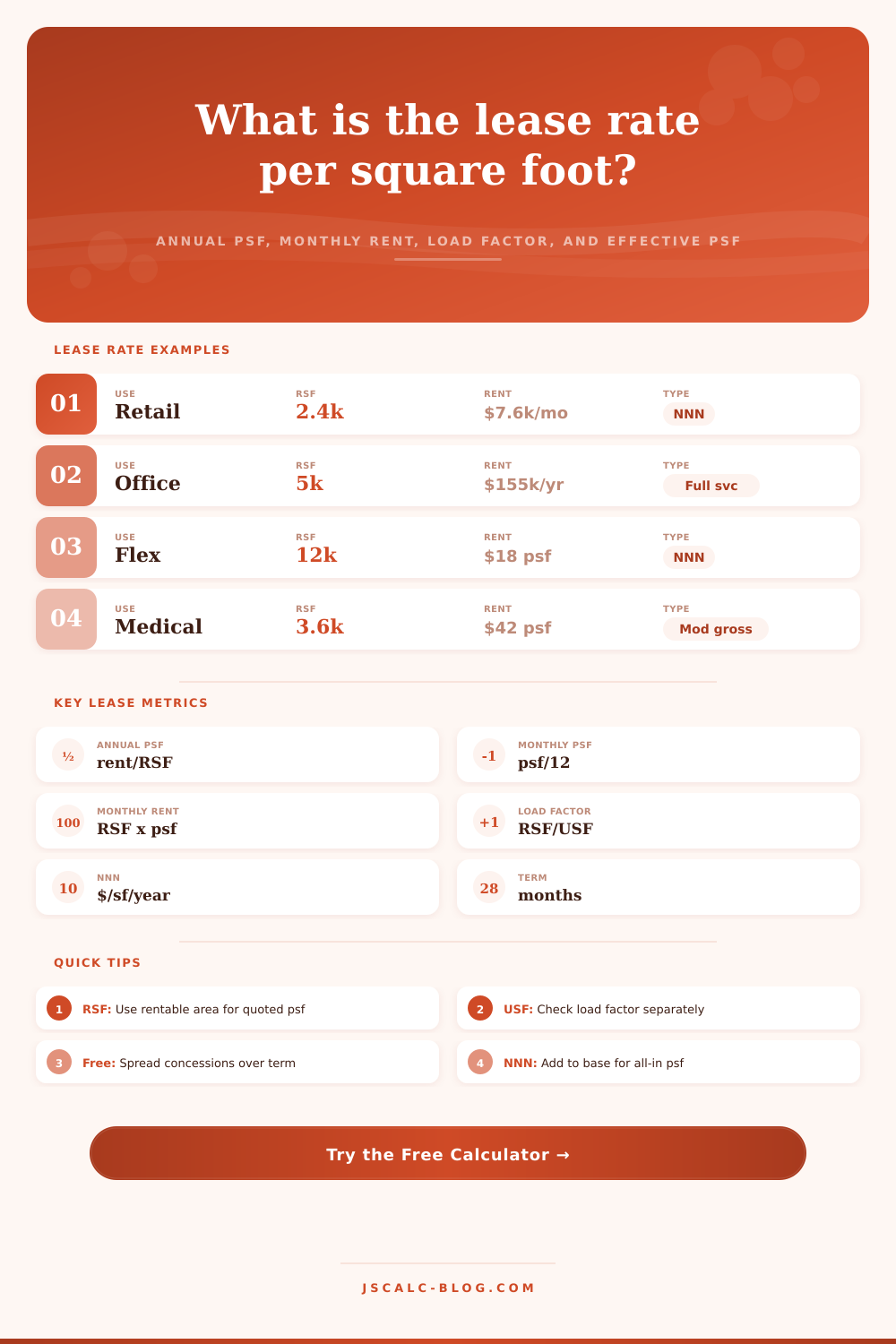
| Annual rate psf | Annual rent / rentable sq ft | Compare quoted rates | Rent and RSF | $/sf/year |
| Monthly rent | Rentable sq ft x annual rate / 12 | Monthly obligation | RSF and annual psf | $/month |
| Monthly psf | Annual psf / 12 | Month-to-month rate view | Annual psf | $/sf/month |
| Load factor | Rentable sq ft / usable sq ft - 1 | Space efficiency check | RSF and USF | Percent |
| Effective psf | Term rent - free rent - TI + NNN | Negotiation comparison | Term inputs | $/sf/year |
| Usable psf | Annual rent / usable sq ft | Compare usable space burden | Rent and USF | $/sf/year |
💡Two Practical Tips
The agent says that rent is forty dollars a square foot. That sounds like a lot, but you are getting three months of free rent and a tenant improvement allowance of twenty dollars for every foot of space. On top of that, they will throw in a triple net charge which adds another eight dollars to your annual bill. The sticker price doesn’t account for any of this stuff so it doesn’t tell you how much it costs to occupy commercial space. To understand your raw lease terms, you must understands the effective annual rate. Most people see the headline number and stop there. But the adjustments are where real math plays out.
Usable Square Feet vs. Rentable Square Feet: This is the bedrock of all lease calculations. Your usable square footage refer to your private space alone. Your rentable square footage also includes a pro-rata portion of the other (common) spaces within the building (such as parking lots), lobbies, restrooms, etc. Every building has its own “load factor” that measures this discrepancy, which can range drastically based off building types. For example, an office building might have a 15% load factor if it’s a very dense high rise where everyone must use those massive hallway. In contrast, a low-rise warehouse might have almost a one-to-one ratio because it lack any common amenities to distribute across.
Understanding Real Lease Costs
If you don’t understand this, then you’re shopping for space using apples-to-oranges comparisons, and overpaying for less actual space than anticipated. The calculator above lets you plug in your measurements so the math gets done for you, avoiding division mistakes by hand and allowing you to compare rates fair at all times.
Even if you’re a seasoned tenant, there’s one more wrinkle that trips people up: Lease structures. These is some common ones. A Triple Net Lease is common with industrial and retail properties. The base rent is paid along with taxes, insurance, and maintenance, which are billed separately. Think of it as a sandwich: Taxes, Insurance, Maintenance
A Full Service Gross Lease is common with multi-tenant office properties. Landlord rolls everything into the base rate. It’s like a sandwich where you never see what’s inside. This isn’t to say that the quoted rate is any less meaningful. In fact, reference table on the page shows you how each type of lease treats these recoveries. This allows you to compare quotes that look different on the surface but may ultimately cost the same.
Before you can figure out your required monthly cash flow though, you must understand whether the quoted rate is all-inclusive or a bare shell price. Normal negotiating ploys, things like tenant improvement allowances and free rent periods, also screw up the initial rate unless you take time to amortize those concessions correctly. For example, a 6-months free rent concession on a 5-year lease isn’t worth half as much: it’s a discount on all 5 years. Likewise, a $20/square foot TI allowance isn’t a reduction in your net occupancy cost, it’s money that gets credited against your out-of-pocket spending required to create the space. When you spread out those credits over the full length of the lease, you see the effective rate which is the only one that counts when you’re thinking long-term. Sometimes a higher, heavily loaded headline rate work out cheaper then a lower, clean base rate with no concessions.
Secondly: The escalation clause (i.e., what happens to your rent over time) can be important. It may only rise three percent annually, which sounds reasonable for year one … but compounded at that rate, it gets steep after year five (or 10). If you’re in a high-inflation city, this can catch up with you quickly; know what you’ll pay. You should of always project to the last year, not the first.
In the end, leasing is about purchasing utility, not square feet. Your actual lease price includes all adjustments, fees, and credits. These items impact your bottom line for the duration of the lease. When you take out the marketing speak and plug in all the numbers, you’ll find that the sweetest offer often isn’t the one with the lowest sticker price; it’s the one with the lowest effective rate. It is a little thing, but it is very important if you’re signing a multi-year agreement. There’s no better protection for your business against stealthy real estate expenses than knowing the distinction between sticker and effective price.