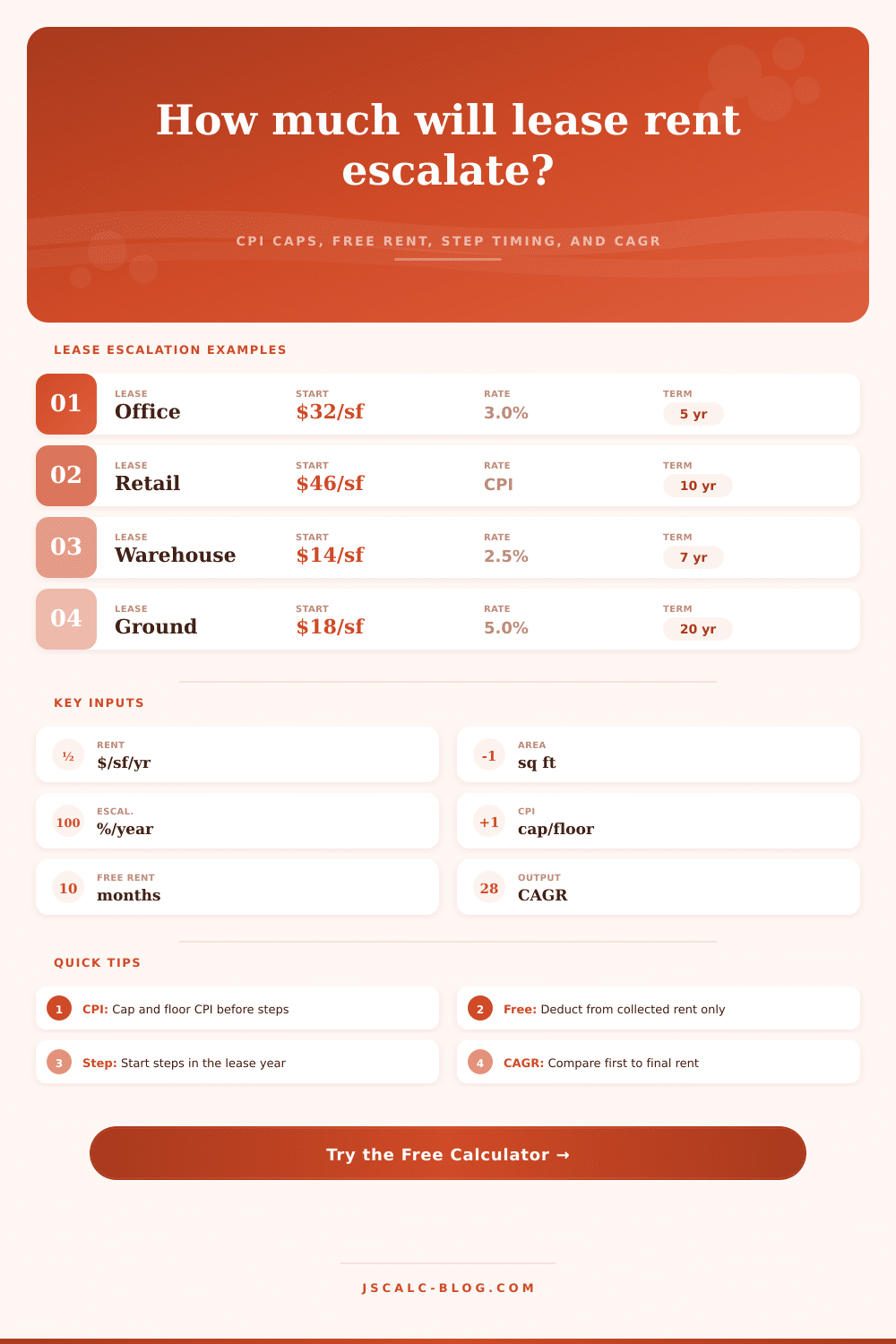
Lease Escalation Calculator
Project lease rent increases using fixed escalation or CPI with cap and floor, then calculate monthly rent, free-rent deductions, cumulative lease cost, final rent, and effective annual growth.
📌Lease Escalation Presets
📝Lease Escalation Inputs
Enter the amount that matches the rent basis field.
Annual per sq ft uses rentable square feet to build monthly rent.
Use rentable area stated in the lease or proposal.
The schedule uses full lease years and sums all monthly rent.
Used for fixed steps or compared with CPI in greater/lesser modes.
CPI mode applies the cap and floor before rent escalates.
Maximum CPI rate used by CPI-linked clauses.
Minimum CPI rate used by CPI-linked clauses.
Greater/lesser modes compare the fixed rate to capped CPI.
Subannual options convert the annual rate to equivalent periodic steps.
Free rent is applied from the lease start to collected rent only.
Use 2 for a first anniversary increase, 1 for an immediate step.
📊Lease Escalation Snapshot
📅Annual Lease Rent Schedule
| Lease year | Months | Steps | Avg monthly | Annual $/sf | Scheduled rent | Free months | Collected rent | Cumulative | YOY |
|---|
📈Escalation Sensitivity Table
| Scenario | Input rate | Effective rate | Final monthly | Cumulative cost | CAGR |
|---|
📋Preset Comparison Table
| Preset | Basis | Sq ft | Method | Frequency | Term | Free rent | Final $/sf | Cumulative cost |
|---|
📐Formula and Method Notes
🔎Clause Type Quick Lookup
| Clause type | Calculator method | Cap/floor use | Step timing | Modeling note |
|---|---|---|---|---|
| Fixed annual bump | Fixed percentage | Ignored | Usually year 2 | Enter the stated annual escalation rate |
| CPI indexed rent | CPI with cap and floor | Applied to CPI | Annual or anniversary | Enter the CPI change before limits |
| Greater-of clause | Greater of fixed or CPI | Applied to CPI first | Per lease wording | Common when rent must rise at least a fixed rate |
| Lesser-of clause | Lesser of fixed or CPI | Applied to CPI first | Per lease wording | Common when rent cannot exceed a fixed cap |
| Free-rent concession | Free rent months | Not a rent step | Lease start | Reduces collected rent, not scheduled rent |
| Multi-year step | Every 2 or 3 years | Depends on method | Block anniversary | Steps less often but can still compound |
💡Practical Lease Escalation Tips
At lease signing, it feels like you’ve captured a known cost. “The rent is fine,” you think to yourself; “the term isn’t bad.” On paper, it make sense. However, few commercial leases stays as written. Because they’re living financial tools, a lease bends and changes form over time.
Rent escalation clauses bend it. Avoiding a budget disaster five years later require understanding them. Everyone obsesses over the first month’s check. They should not. The beginning rent is a baseline. We’re talking about directionality here: what happens as time go forward?
Why Your Rent Will Go Up Over Time
Yes, a 3% annual rent hike doesn’t sound like much. But compound that… And compound it quietly… And it becomes a big pile of your operating budget by year five. Run the math through the calculator above and you’ll see just how much these little percentage humps adds up to a massive total cost.
How this escalates depend on how you define it in your lease. A fixed percent increase is simple: You know that the next step is x. A clause linked to CPI injects some market volatility into your rent formula. Your rent go up if inflation goes up. But almost all good leases also contains floors and caps. The cap guards against cost spiraling during inflationary times. The floor makes sure the owner gets growth even if the inflation rate are negative or flat. The caps and floors smooth out the edges, giving you a more predictable range that you can plan within over time.
Then there’s the second level of confusion: Free rent concessions. It’s tempting to think, “Hey, this landlord is giving me two or three months for free! That lowers my cash outlay and sounds like a good thing.” Except: When it comes time for the escalations, they’re based off the original schedule, not on the lower cash payment you made while the space was free. In other words, following rent step will increase like you’d been paying the listed rent at full rate from day one. (And this makes a huge difference when modeling cash flow in the first year.)
Timing also matters. If your lease has an anniversary date for when the base changes, some do. Or maybe your lease runs by calendar year or fiscal period. Get those dates misaligned from your budget cycle and you could of get caught off guard by a shortfall. You thought the step-up came in January but it shows up in March. The chart on the page will help you see at a glance when the step comes into your time frame.
If you mis-model long term leases, then these are even riskier. A 3 year office lease for X dollars per square foot will end at a far different number then a 20 year ground lease for X dollars per square foot with a 5% escalation annually. The longer the time frame, the more increased that percentage become. This is where testing different scenarios help, as adjusting those input rates up/down a bit highlights just how vulnerable your assumptions are to an aggressive landlord offer or an unexpected spike in inflation.
To do this, you’ll have to think ahead when negotiating the details. Inflation isn’t something you can control (but if it affects your rent, you can cap it). You can also ask how “free” rent will be applied against the base in subsequent years. This won’t be favorable, but it never hurts to ask!
The idea here is that lease should reflect your company’s risk tolerance and growth path. This goes back to how lease escalation isn’t all about numbers. Lease escalation is about controlling the unknowns down the road within a seemingly set-in-stone contract now. You can avoid an unpleasant surprise by getting the details correct up-front. And when you see that final cumulative number, you’ll know exactly what those small percentage points adds up to on your bottom line.