Land Value Per Acre Calculator
Calculate gross value per acre, square-foot conversion, usable-acre value, frontage value, adjusted value, and value per planned lot from one land record.
Use the total land-only value you want to divide.
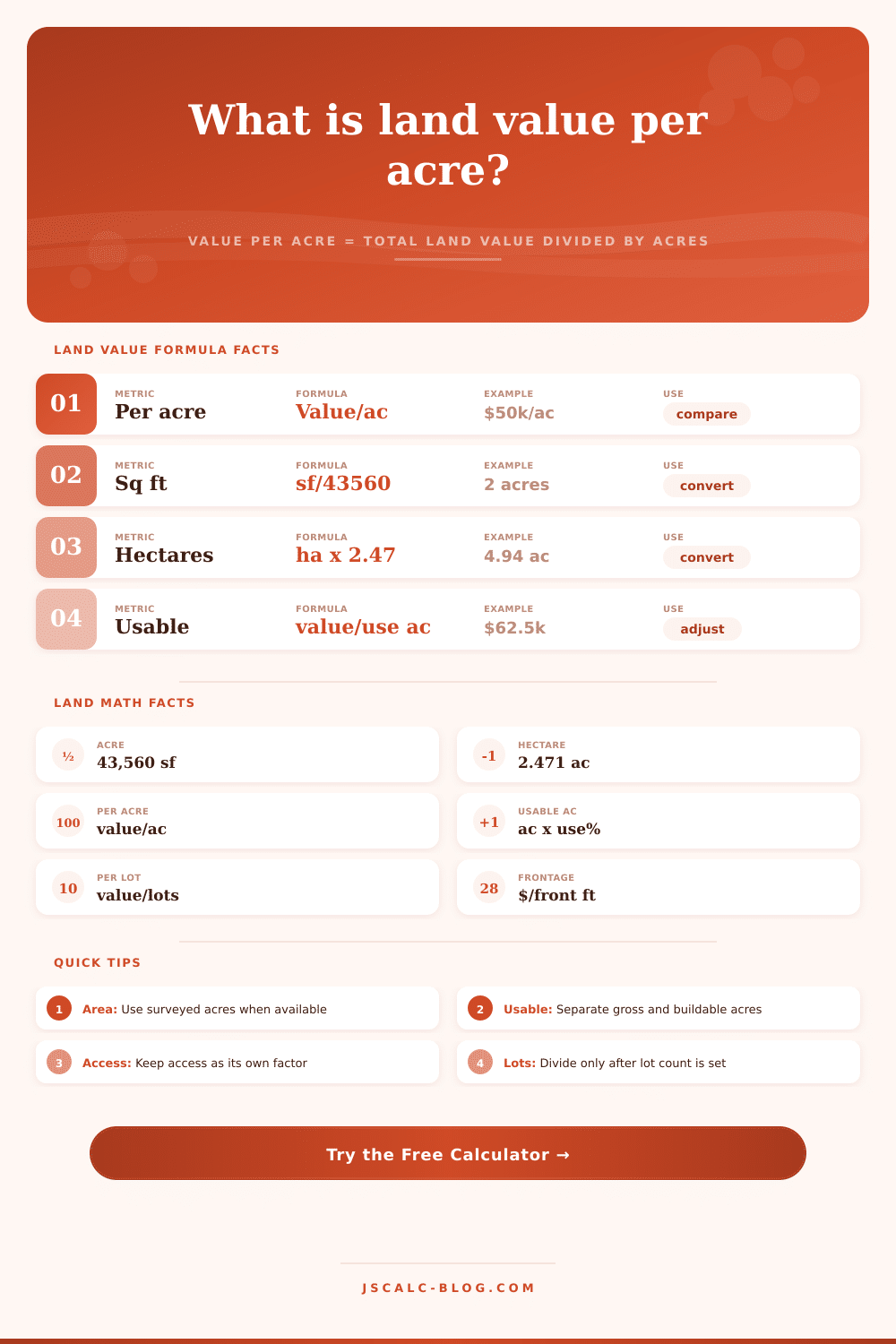
Acres = square feet / 43,560.
Acres = hectares x 2.47105.
Keep this as a separate math factor, such as 0.90, 1.00, or 1.20.
| Use type | Default usable share | Frontage emphasis | Calculator metric |
|---|---|---|---|
| Rural residential | 70% to 90% | Road frontage | Gross and usable acres |
| Urban infill lot | 85% to 100% | Street frontage | Value per square foot |
| Farmland | 75% to 98% | Access frontage | Value per tillable acre |
| Timber or recreation | 55% to 90% | Road or trail access | Gross-acre comparison |
| Commercial pad | 80% to 100% | Visibility frontage | Adjusted acre and frontage |
| Subdivision land | 65% to 90% | Road network | Value per planned lot |
| Waterfront land | 65% to 95% | Water frontage | Value per frontage foot |
| Area input | Acres | Square feet | Hectares |
|---|---|---|---|
| 0.25 acre lot | 0.25 | 10,890 | 0.101 |
| 0.50 acre lot | 0.50 | 21,780 | 0.202 |
| 1 acre parcel | 1.00 | 43,560 | 0.405 |
| 5 acre parcel | 5.00 | 217,800 | 2.023 |
| 10 acre tract | 10.00 | 435,600 | 4.047 |
| 1 hectare site | 2.471 | 107,639 | 1.000 |
| Scenario | Total value | Gross acres | Usable % | Value/acre | Usable value/ac | Lots |
|---|---|---|---|---|---|---|
| Rural 5-acre parcel | $250,000 | 5.00 | 80% | $50,000 | $62,500 | 1 |
| Urban infill lot | $180,000 | 0.17 | 95% | $1,045,296 | $1,100,312 | 1 |
| Farmland tract | $1,250,000 | 160.00 | 92% | $7,813 | $8,492 | 1 |
| Timber parcel | $480,000 | 80.00 | 70% | $6,000 | $8,571 | 1 |
| Commercial pad | $900,000 | 1.25 | 90% | $720,000 | $800,000 | 1 |
| Subdividable acreage | $2,400,000 | 24.00 | 75% | $100,000 | $133,333 | 36 |
| Waterfront premium | $650,000 | 2.00 | 82% | $325,000 | $396,341 | 1 |
| Adjustment | Multiplier | Formula location | Meaning in this calculator |
|---|---|---|---|
| Limited access | 0.85 | Per-acre x 0.85 | Separate access discount factor |
| Basic gravel access | 0.95 | Per-acre x 0.95 | Minor access factor |
| Standard paved access | 1.00 | No access change | Baseline calculation |
| Corner or dual access | 1.08 | Per-acre x 1.08 | Separate road access factor |
| High-visibility access | 1.15 | Per-acre x 1.15 | Separate frontage/access factor |
The first time you buy land, you only see one number: Price per acre. You think you’ve found a deal, but it turns out it wasn’t a deal at all. It was five acres of wooded hillside in the countryside. Your wallet got lighter just looking at the price. But then the surveyor gestured toward a creek that sliced through forty percent of the buildable space. And he explain how road access was really nothing but a muddy track that three other properties shared.
On paper, it had seemed like a great deal. But on ground, it was something else entirely. That’s the trap of raw acreage numbers. They appears simple until you pause and consider what those acres can actualy do for you. An acre is most commonly perceived as a fixed amount, like a pound of flour or a gallon of milk. In real life, however land is a mess. It has access issues. It have wet spots. It has slopes and views. All these things dramatically affect its value, based off its use.
Why Price Per Acre Can Be Wrong
That’s where the above calculator come in to help untangle the mess. The way it works is this: You plug in total land value and then the number of acres, but the real magic happen when you start fiddling with adjustments. Not all acres are created equal. Part of deed may contain a steep slope. It is great for nature but bad for building foundations. When you divide your total value by just the tilled/tillable or buildable acres, you get a truer sense of how much you’re actually getting per square foot of usefulness.
For example, if you’re looking at two pieces of property side by side, one that is listed as ten thousand dollars an acre, and another at fifty thousand, this is important. It could be that high-priced option is level and building-ready while the low-priced option include half its acreage in swampy areas. In that case even though price per acre seems like a bargain, your actual cost-per-buildable-acre may almost be the same.
It also takes into account something most people overlook until they’ve already bought. Frontage. This is what determines how far up you can put docks, where your swimming areas will be located and where you’ll get to garden. The calculator do all that math for you by converting hectares, square feet, and other measurements. It creates a shared understanding. It also lets you strip away the marketing jargon so you can understand how much each property is really going to cost you.
And then there are the silent killers of value: access. Even if a parcel is beautiful, if you require an easement across someone’s property, and they hate change, you’ll have to pay something for that convenience. The tool also has multipliers for road quality, recognizing that a paved street supports value, whereas a dirt track deplete it. It’s not just theory; this is how appraisers think. They use physical attributes to adjust their comparable sales before coming up with a fair market price. You can do the same thing here by tweaking the access and location factors to match your specific situation.
The number of lots make all the difference when evaluating subdivision potential. One million-dollar twenty acre tract sounds expensive, but divided into forty lots? That’s pretty darn cheap per-unit. Don’t lose your head though. Before you begin pouring concrete, zoning laws can changes things. These laws, among other factors, typically reduce total to something much less than the full amount. Enter your intended lot count here and the calculator will spit out a range of possibilities instead of a single locked-in answer.
The art of land buying is not about finding cheap dirt; it’s about learning not to make an expensive mistake. Know what you’re measuring. Are you measuring the total parcel or only what is usable? Do you have guaranteed access, or does it depend on neighborly goodwill and good weather? When you take the romance of the view out of the equation and put the math of the metrics in, its much easier to see your way clear.
So, let’s go back to my example above, the five-acre wooded hillside. It was no deal. And understanding the cost of access and usable acres kept me from doing that again. But twice.