Kinetic Energy Calculator With Steps
Solve KE = ½mv² for kinetic energy, mass, or velocity and see the full numbered working – write the formula, substitute values, square the speed, multiply, and read the result with unit conversions.
⚡Real Example Presets
📝Enter What You Know
Converted to kilograms before the math.
Converted to metres per second before squaring.
Converted to joules before rearranging.
🔢Formula Symbols
🔄Formula Rearrangements
| Solve For | Rearranged Formula | Steps To Take | Result Unit |
|---|---|---|---|
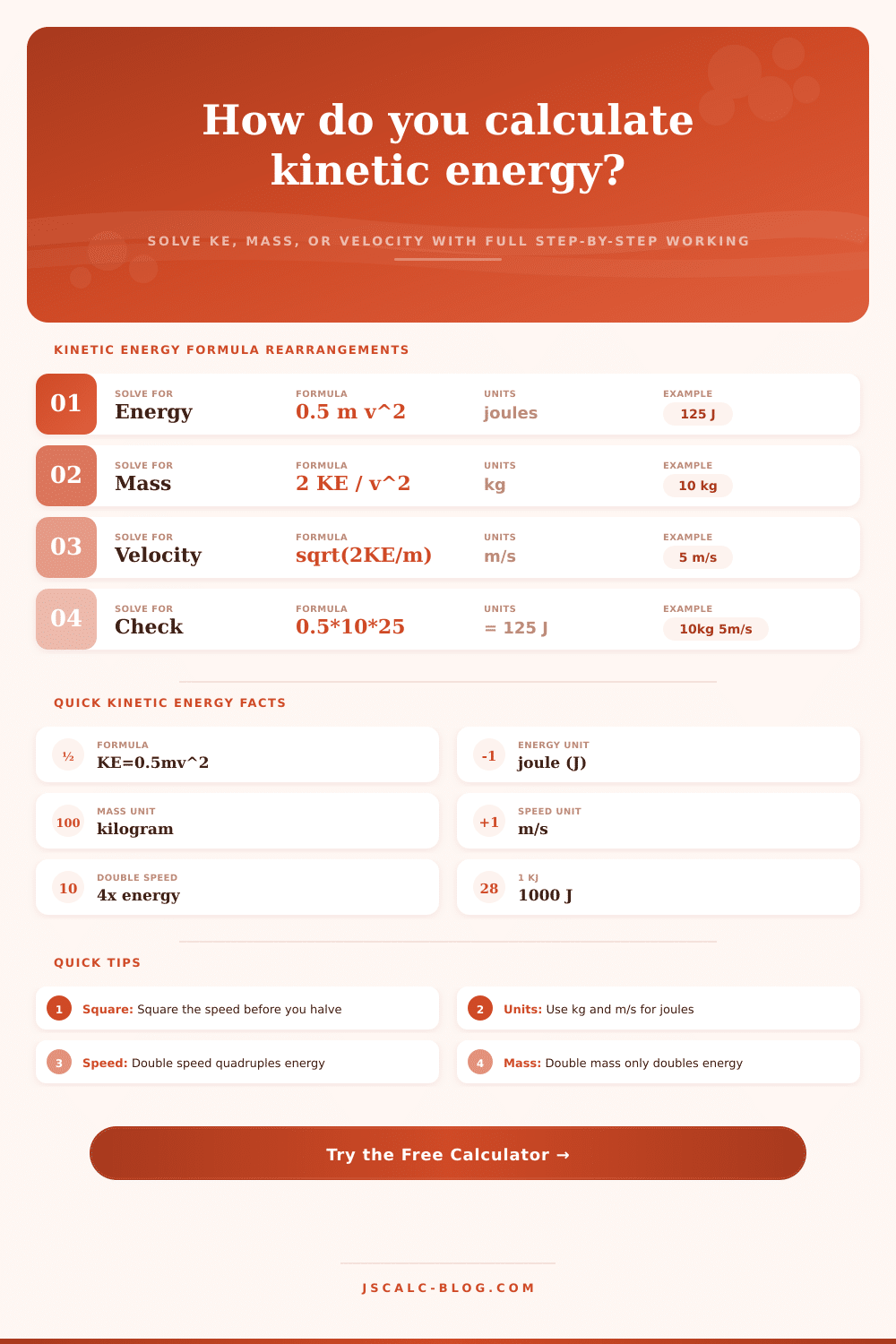
| Kinetic energy | KE = ½ × m × v² | Square v, multiply by m, halve it | joule (J) |
| Mass | m = 2 × KE / v² | Square v, double KE, then divide | kilogram (kg) |
| Velocity | v = √(2 × KE / m) | Double KE, divide by m, square root | metre per second (m/s) |
| Check work | KE = ½ × 10 × 5² | 0.5 × 10 × 25 = 125 | 125 J |
📈The Velocity-Squared Effect
| Speed Change | Old v | New v | v² Multiplier | KE Change |
|---|---|---|---|---|
| Same mass, 1.5× speed | 10 m/s | 15 m/s | 2.25× | 2.25× energy |
| Same mass, 2× speed | 10 m/s | 20 m/s | 4× | 4× energy |
| Same mass, 3× speed | 10 m/s | 30 m/s | 9× | 9× energy |
| Same mass, half speed | 10 m/s | 5 m/s | 0.25× | ¼ energy |
| Double mass, same speed | 10 m/s | 10 m/s | 1× | 2× energy |
| Half mass, double speed | 10 m/s | 20 m/s | 4× | 2× energy |
🗂Kinetic Energy Comparison Grid
| Object | Mass | Velocity | Speed (m/s) | KE (joules) | KE (alt) |
|---|---|---|---|---|---|
| Air rifle pellet | 0.005 kg | 300 m/s | 300 | 225 J | 0.225 kJ |
| Rifle bullet | 0.01 kg | 400 m/s | 400 | 800 J | 0.80 kJ |
| Archery arrow | 0.02 kg | 70 m/s | 70 | 49 J | 0.049 kJ |
| Thrown baseball | 0.145 kg | 40 m/s | 40 | 116 J | 0.116 kJ |
| Sprinting runner | 70 kg | 6 m/s | 6 | 1,260 J | 1.26 kJ |
| Road cyclist | 80 kg | 30 km/h | 8.33 | 2,778 J | 2.78 kJ |
| City car | 1000 kg | 20 m/s | 20 | 200,000 J | 200 kJ |
| Highway car | 1200 kg | 30 m/s | 30 | 540,000 J | 540 kJ |
| Loaded truck | 18000 kg | 25 m/s | 25 | 5,625,000 J | 5,625 kJ |
| Freight train | 1,000,000 kg | 30 m/s | 30 | 450,000,000 J | 450,000 kJ |
📏Unit Conversion Factors
| Quantity | From Unit | Multiply By | To Base Unit |
|---|---|---|---|
| Mass | gram (g) | × 0.001 | kilogram (kg) |
| Mass | pound (lb) | × 0.45359237 | kilogram (kg) |
| Mass | tonne (t) | × 1000 | kilogram (kg) |
| Velocity | km/h | ÷ 3.6 | metre/second (m/s) |
| Velocity | mph | × 0.44704 | metre/second (m/s) |
| Velocity | ft/s | × 0.3048 | metre/second (m/s) |
| Energy | kilojoule (kJ) | × 1000 | joule (J) |
| Energy | calorie (cal) | × 4.184 | joule (J) |
| Energy | foot-pound (ft-lb) | × 1.355818 | joule (J) |
⚙How The Steps Are Built
💡Practical Kinetic Energy Tips
The principle is called kinetic energy, it’s the energy of movement. While a single grain of sand shot out of a revolver could shatter bone, it’s nothing compared to a feather falling from a tree, since size plus speed equals energy that has to be dissipated. For engineers building safety into their designs and for physics majors working they way through homework problems, understanding this relationship is important.
The next time you want to figure out how much kinetic energy is in an object in motion, you won’t have to calculate the answer yourself each time. Just plug the information in and let the calculator do the math. Then, you can focus on figuring out what all the numbers mean for your application.
What Is Kinetic Energy?
KE equals one-half times mass times velocity squared. That’s the core equation, and it seems straightforward except when you try to convert units and then square large numbers, at which point most of us get tripped up. The key thing to realize is that velocity is the primary variable, since it’s squared in the equation.
You double your speed? Your energy isn’t doubled; it’s quadrupled. Triple your speed? Energy increases ninefold. Because we intuitively think about motion on a linear scale, this non-linear relationship is counterintuitive: doubling your speed won’t mean you’ll arrive twice as soon, but the crash dynamics will be four times worse.
What the tool does is automate that math so that you don’t forget to multiply mass by speed without considering that squared part of the equation. The other factor here is mass which actualy has a direct relationship with energy. The higher the mass and the faster it moves the greater its kinetic energy. If you double the mass of an object and maintain the same speed, you’ll double its kinetic energy.
Keep this in mind as you start to compare things. Depending on what numbers we’re talking about, a slow moving, heavy truck could have just as much or even more energy than a lighter sports car going very quickly. On paper, I know it seems like the object traveling fastest should always win out. But that simply isn’t true, especially in the real world.
So the chart they include on the page does a good job of showing where the varying velocities and masses intersect to create widely different amounts of energy. It shows why the stopping distance really starts to add up at highway speeds versus city driving.
But then there’s unit consistency. For example, the typical formula is set up so that mass must be given in kilograms, velocity in meters per second, and you’ll get back an answer in joules. But what if you’re thinking in terms of weight in pounds and speed in miles per hour? Unless you do some conversion beforehand, you won’t get the right answer.
Converting units isn’t simply a matter of busywork; doing so means your numbers represent physical reality. A meter per second is a far larger amount of motion compared than a kilometer per hour. Errors of hundreds of times are possible if you don’t account for such differences. The calculator does all this conversion work behind the scenes, so you can enter the values you think of naturaly and recieve answers either as convenient kilojoules or as standard joules.
Think also of a cyclist riding down a flat road at cruise speed compared to a sprinter at top speed. That sprinter may weigh less but exert much more intensity, whereas the cyclist has more total momentum but a lower overall relative intensity. If you calculate each of these athletes’ energies, you can figure out which athlete takes more effort to halt. It’s not necessarily simply that one is faster than another; it’s that they’re carrying a certain packet of total energy.
And this extends to the design of safe vehicles. A car doesn’t only care about its maximum speed; it cares about how much energy it takes in during an accident via airbags and crumple zones. As you try different input speeds, pay attention to how sensitive it is to faster (or slower) output. Increase that speed just a bit and it will lead to an outsized jump in power.
That’s why we have speed limits. And no, they’re not random numbers pulled from a politician’s ass. They are based off math: the distance a vehicle needs to stop and the time it takes a person to react. Going over increases your kinetic energy into areas where a simple misjudgment becomes disastrous. Slowing down even a little bit makes a huge difference for safety.
So in short: Motion costs something. That something is called kinetic energy. The joules produced need to go somewhere, typically in the form of some combination of heat and shape change. Whether this shows up in a textbook exercise, or when considering highway safety, it’s worth keeping in mind that velocity trumps mass in the equation.
The mathematics are exacting, but the consequences? They’re everywhere. Energy commands respect, from the train rushing into the station to the bullet shooting out of the gun barrel. Watch your squared term and remember: The best way to get around is always to go slow.