Crossbow Kinetic Energy Calculator
Find bolt kinetic energy in ft-lbs from bolt weight in grains and speed in fps, plus momentum in slug-ft/s, energy in joules, and a game-suitability verdict for ethical hunting.
🎯Real Crossbow Presets
📝Bolt and Crossbow Inputs
Used when entry is total weight. 1 grain = 1/7000 lb.
Shaft plus fletching, used in parts mode.
Insert plus nock, used in parts mode.
Reference only, not used in the KE math.
Reference only, longer stroke stores more energy.
🔢Formula Snapshot
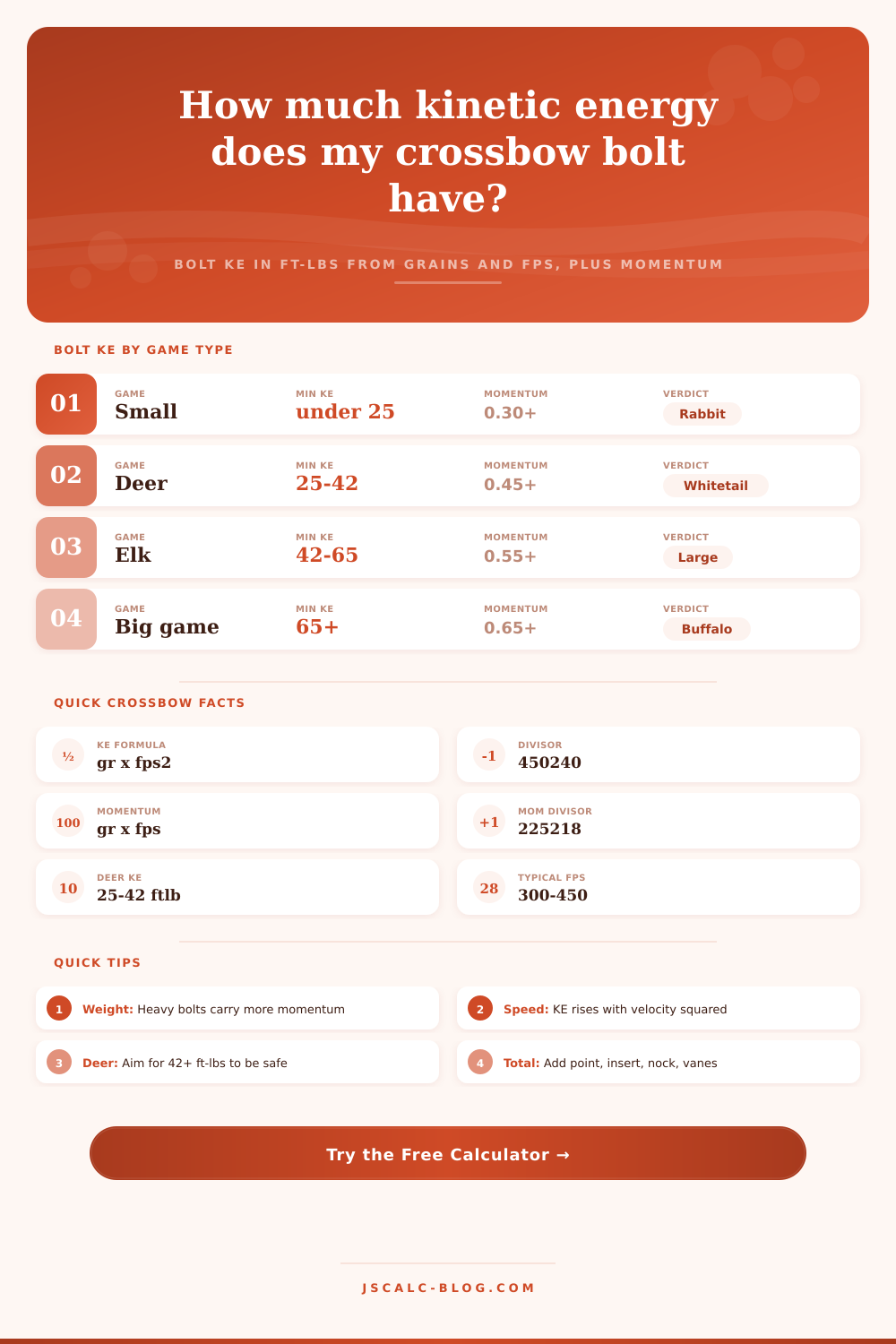
🦈Kinetic Energy by Game Type
| Game Class | Min KE (ft-lbs) | Suggested Momentum | Examples |
|---|---|---|---|
| Small game | Under 25 | 0.30 slug-ft/s | Rabbit, squirrel, grouse |
| Turkey / upland | 25 and up | 0.40 slug-ft/s | Turkey, small predators |
| Deer / medium | 25 to 42 | 0.45 slug-ft/s | Whitetail, hog, antelope |
| Elk / large | 42 to 65 | 0.55 slug-ft/s | Elk, moose, black bear |
| Dangerous / big game | 65 and up | 0.65 slug-ft/s | Cape buffalo, brown bear |
⚖Bolt Weight vs KE at 380 fps
| Bolt Weight (grains) | KE (ft-lbs) | Momentum (slug-ft/s) | Energy (joules) | Typical Use |
|---|---|---|---|---|
| 300 | 96.2 | 0.506 | 130.5 | Speed setup, small game |
| 350 | 112.3 | 0.590 | 152.3 | Fast deer bolt |
| 400 | 128.3 | 0.675 | 174.0 | Balanced deer / hog |
| 450 | 144.3 | 0.759 | 195.7 | Elk-ready momentum |
| 500 | 160.4 | 0.843 | 217.5 | Heavy big-game bolt |
| 550 | 176.4 | 0.928 | 239.2 | Maximum penetration |
📊Bolt Weight vs KE Across Speeds
| Bolt Weight | KE at 300 fps | KE at 350 fps | KE at 400 fps | Mom at 400 fps | Best For |
|---|---|---|---|---|---|
| 300 gr | 60.0 | 81.6 | 106.6 | 0.533 | Youth / small game |
| 350 gr | 70.0 | 95.2 | 124.4 | 0.622 | Turkey / light deer |
| 400 gr | 79.9 | 108.8 | 142.1 | 0.710 | Deer / hog |
| 425 gr | 84.9 | 115.6 | 151.0 | 0.755 | Deer plus margin |
| 450 gr | 89.9 | 122.4 | 159.9 | 0.799 | Elk / large |
| 500 gr | 99.9 | 136.0 | 177.7 | 0.888 | Big game / buffalo |
| 550 gr | 109.9 | 149.6 | 195.4 | 0.977 | Deep penetration |
🗂Crossbow Class and FPS Ranges
| Crossbow Class | Typical FPS | Draw Weight | Common Bolt | Typical KE |
|---|---|---|---|---|
| Youth / recurve | 245 to 300 | 75 to 125 lbs | 340 to 400 gr | 45 to 80 ft-lbs |
| Entry compound | 300 to 350 | 150 to 175 lbs | 370 to 420 gr | 75 to 110 ft-lbs |
| Mid-range hunting | 350 to 400 | 160 to 200 lbs | 380 to 450 gr | 105 to 150 ft-lbs |
| High-speed flagship | 400 to 450 | 135 to 200 lbs | 400 to 500 gr | 140 to 195 ft-lbs |
| Extreme / Ravin R500 | 450 to 500 | Cam driven | 400 to 550 gr | 180 to 260 ft-lbs |
⚙Full Formula Breakdown
📋Momentum and Penetration Thresholds
| Target | Min KE (ft-lbs) | Min Momentum | Why It Matters |
|---|---|---|---|
| Small game | 15 to 25 | 0.25 to 0.35 | Enough for clean pass on light animals |
| Turkey | 25 | 0.40 | Dense feathers and bone need momentum |
| Deer / hog | 25 to 42 | 0.45 | Reliable two-hole pass-through |
| Elk / large | 42 to 65 | 0.55 | Heavy bone and thick hide penetration |
| Big / dangerous | 65 and up | 0.65 | Deep drive through heavy structure |
💡Practical Bolt Energy Tips
It is a numbers game. Hunting with a crossbow is a numbers game, but it isn’t forgiving. Manufacturers love to shout a single number like velocity to grab your attention, but that’s only part of the story. Three hundred and eighty feet per second appear on the box; your brain reads it as lethality and power. It is an understandable impulse, but it is dangerously incomplete.
While velocity (how fast the bolt flies through the air) has much to do with trajectory, it tell you very little about its impact when it hits bone and meat. Momentum and kinetic energy are true story of a successful hunt. They work together to make sure not only is shot ethical, but also the animal suffers no pain.
Why Kinetic Energy Matters More Than Speed
At the range, we all want our crossbows to feel faster. Because speed seems so important to most hunters they go light with their bolts in order to squeeze out a few more feet-per-second. What these guys don’t realize is that they’re paying good money for something that’s going to put a hole in the freezer; rather than putting something in the freezer.
What is kinetic energy? It is the ability to perform work. That work translate into penetrating deeply enough to hit vital organ when applied to hunting. Use the calculator above and let it do the math for you. Enter your velocity in feet per second and your bolt weight in grains. It will then give you a precise measurement of foot-pounds.
To understand what this number signifies, you’ll need to stop staring at numbers and consider physics. While we can appreciate a 400 fps bolt weighing maybe only two ounces and traveling light on its way, it often lack the mass needed to punch through shoulder bone or thick hide. Picture attempting to pound a nail with a fast-moving ping pong ball instead of slow-moving heavy hammer. The hammer wins every time because it has more momentum.
Crossbow ballistics also depend off momentum to ensure a bolt maintains its energy along its path and into the tissue. More momentum equate to heavier bolts carrying more of that momentum and pushing back against resistance instead of deflection. You want at least 42 foot pounds of kinetic energy to penetrate with certainty. That’s roughly what you’d expect from a deer hunt or medium-sized game. Larger creatures such as moose and elk requires much more due to their greater size and toughness.
This is where the chart on the page comes into play. They break it all down by game type and minimums required. Hitting hard isn’t the only thing to consider; it also has to hit deep. Stopping in the shoulder may eventually kill the animal, but it will likely cost you some meat and turn your chance into a miss.
But it’s not just weight of your arrow you have to take into account, what exactly are you shooting? A bare shaft doesn’t weigh much but one with nock, insert, broadhead, and fletch weighs something else entirely. Too many folks overlook the weight of their accessories when making assumptions so they end up with overly high energy numbers.
This tool allows you to break down the components, which might seem like a small thing but again, goes a long way for accuracy. It makes you face facts of your set-up instead of spec numbers from manufacturers based off idealized conditions. You can plug in the real world weight of the broadhead you’re shooting and then verify the actual velocity on a chronograph. Those numbers tell a much more honest story about what your equipment can do.
Speed vs. Weight: There’s never an exact answer here as it all boils down to the game being hunted. For small game and turkey, you’re looking for something that flies well and doesn’t require much penetration, so lighter bolts is acceptable there. However, if you’ve got some meaty bone structure in your sights, adding weight to the bolt will almost always be the smart call.
Yes, it’ll slow the crossbow down just a hair, but that trade-off earn you increased confidence when it really counts. Tracking a blood trail through the woods with questions about the power of your shot doesn’t make for a good day in the sticks. Knowing you have the equipment capable of doing the job gives you great confidence.
That begins with knowing the difference between raw speed and real impact. In short, the fastest crossbow isn’t necessarily the best crossbow setup, it’s the one that carries enough energy to get the job done cleanly, each and every time. You should of checked your mass first.