Change In Kinetic Energy Calculator
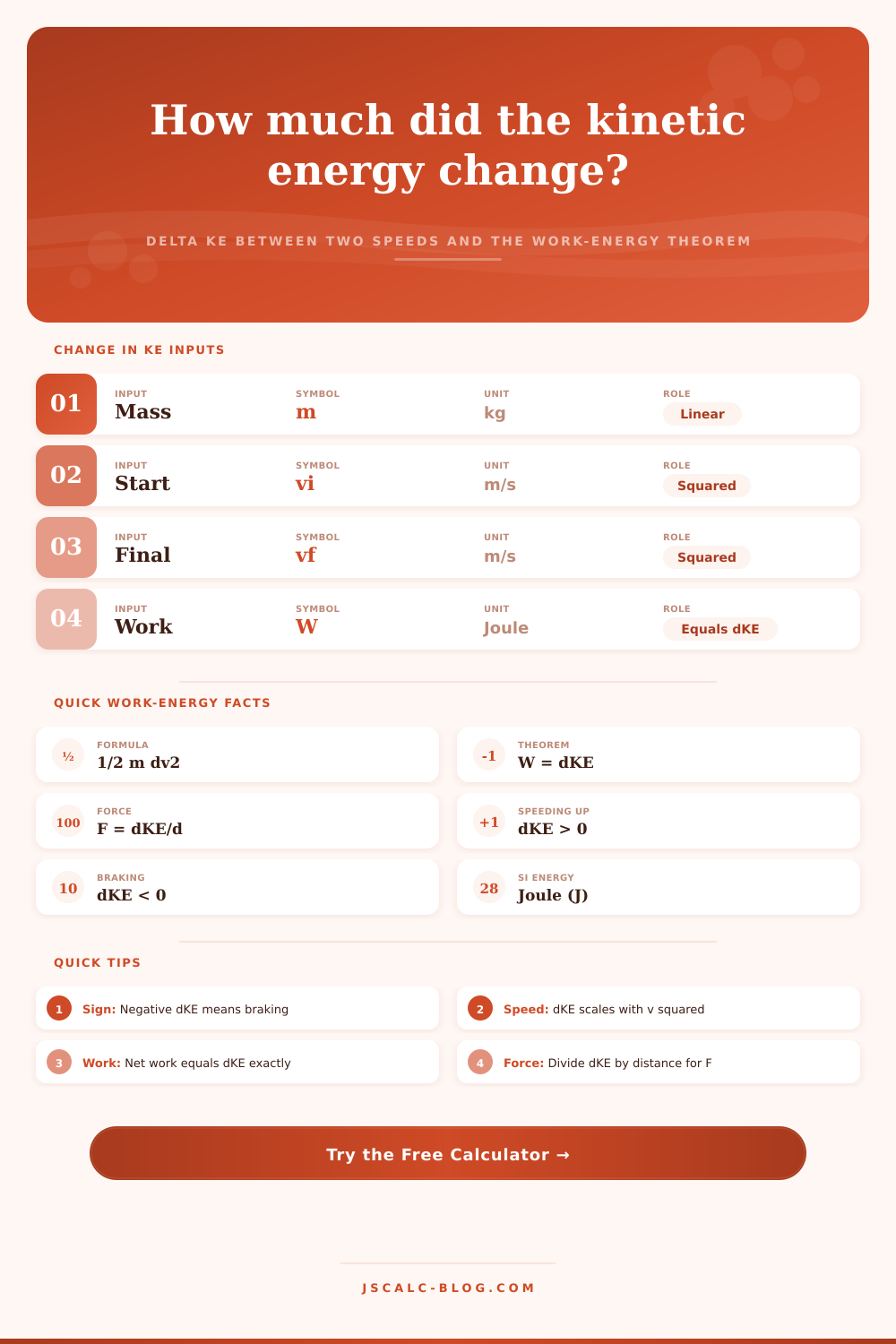
Find the change in kinetic energy ΔKE = ½m(v_f² – v_i²) between a starting and final speed, the net work done from the work-energy theorem W = ΔKE, and the average net force over a distance.
🎯Real Motion Presets
📝Motion Inputs
Speeds mode uses ½m(v_f² – v_i²). Force mode uses W = F × d.
Used only in force-from-work mode.
Optional. Enables average net force F = ΔKE / d.
🔢Formula Snapshot
📊Speed Change vs ΔKE (1 kg object)
| v_i (m/s) | v_f (m/s) | Initial KE | Final KE | ΔKE (J) | Effect |
|---|---|---|---|---|---|
| 0 | 10 | 0 J | 50 J | +50 | Speeding up |
| 10 | 20 | 50 J | 200 J | +150 | Speeding up |
| 20 | 30 | 200 J | 450 J | +250 | Speeding up |
| 30 | 40 | 450 J | 800 J | +350 | Speeding up |
| 20 | 0 | 200 J | 0 J | –200 | Braking |
| 25 | 15 | 312.5 J | 112.5 J | –200 | Braking |
Each +10 m/s costs more energy than the last because ΔKE depends on the difference of the squares, not the speed itself.
🌍Kinetic Energy Of Common Objects
| Object | Mass | Speed | Kinetic Energy | Comparison |
|---|---|---|---|---|
| Thrown baseball | 0.145 kg | 40 m/s | 116 J | Fast pitch |
| Sprinting person | 70 kg | 10 m/s | 3,500 J | Top sprint |
| Rifle bullet | 0.010 kg | 900 m/s | 4,050 J | High muzzle |
| Bicycle + rider | 90 kg | 8 m/s | 2,880 J | Cruising |
| Compact car | 1,200 kg | 25 m/s | 375,000 J | Highway |
| Loaded truck | 15,000 kg | 25 m/s | 4,687,500 J | Highway |
🗂Scenario Comparison Grid
| Scenario | Mass | v_i | v_f | ΔKE | Net Work |
|---|---|---|---|---|---|
| Car 20 to 30 m/s | 1,200 kg | 20 m/s | 30 m/s | +300,000 J | +300 kJ |
| Braking to stop | 1,200 kg | 25 m/s | 0 m/s | –375,000 J | –375 kJ |
| Ball 0 to 10 m/s | 0.145 kg | 0 m/s | 10 m/s | +7.25 J | +7.25 J |
| Bullet acceleration | 0.010 kg | 0 m/s | 900 m/s | +4,050 J | +4.05 kJ |
| Cyclist speeding up | 90 kg | 4 m/s | 8 m/s | +2,160 J | +2.16 kJ |
| Falling object gain | 2 kg | 0 m/s | 20 m/s | +400 J | +400 J |
| Truck slowing down | 15,000 kg | 25 m/s | 15 m/s | –3,000,000 J | –3,000 kJ |
| Sprinter start | 70 kg | 0 m/s | 10 m/s | +3,500 J | +3.5 kJ |
⚙Full Formula Breakdown
📋Work-Energy Relationships
| Situation | Sign of ΔKE | Net Work | What It Means |
|---|---|---|---|
| v_f > v_i | Positive | W > 0 | Work added, object speeds up |
| v_f < v_i | Negative | W < 0 | Work removed, object slows (braking) |
| v_f = v_i | Zero | W = 0 | No net work, speed unchanged |
| Same speeds | Zero | W = 0 | Direction may differ, |v| equal |
| Force over distance | Either | W = F × d | F = ΔKE / d gives average force |
🔄Unit Conversions
| Quantity | From | To Base | Multiply By |
|---|---|---|---|
| Mass | gram (g) | kilogram | 0.001 |
| Mass | pound (lb) | kilogram | 0.453592 |
| Speed | km/h | m/s | 0.277778 |
| Speed | mph | m/s | 0.44704 |
| Energy | joule (J) | kilojoule | 0.001 |
| Energy | joule (J) | calorie | 0.239006 |
💡Practical Work-Energy Tips
When you slam on the brake, you experience sense of loss, and that’s explained by the work-energy theorem. That sense of loss arises from removal of energy from your motion. It’s more than something for tests in class; it extends to uses in the world (sprinting power; brakes on cars). You use this concept to quantify how much effort it takes to alter speed of an object. It bridges gap between gut feelings and actualy numbers.
Speed doesn’t increase kinetic energy linearly. “Double your speed” isn’t like getting twice as efficient; it’s more like getting four times as expensive. You can calculate how much kinetic energy (motion) you’re carrying at any moment if you know your speed; for example, at 20 mph, you have a certain amount. Double to 40 mph and now you’ve got four times that many. That’s why tiny gains in speed consume huge amounts of battery life/fuel. Because speed is squared.
How to Use the Kinetic Energy Calculator
We plug that math into our calculator when you specify velocity changes and mass. That way we don’t need to worry about manually converting units or mucking up the exponent. The input fields covers the common motions. Here’s what it asks: How much does the thing weigh? (It will normalize it for you in pounds, kilograms, and grams.) What velocity does it have at the start? And what about at the end?
Because if final velocity is less than initial velocity, then the answer comes back negative. That means that some force has removed energy from the object. Friction, air resistance, brakes, they all does negative work on an object. They take motion of the object and convert it to something else: heat. It becomes heat because you’ve taken kinetic energy away. After a hard ride down a long hill, you can feel the brake pads heating up. This sign flip is automatically picked up by the calculator. It’ll let you know instantly if the system is gaining or losing energy.
The ability to include distance in the force calculation is another cool feature to highlight here. Force times distance are work. So if you know how much energy was changed and over what distance, then that gives you average net force. It is useful in engineering or safety analysis. Say for instance you are making a car crumple zone. You want to see how much force the car can take to come to a stop in x amount of distance. The tool shows how energy relates directly to mechanical stress.
The same applies to real world situations. When a baseball player pitches the 0.145 kilogram ball, they are performing positive work on that object over a fraction of a second, transferring energy to it. This leads to huge amounts of force. On the other hand, a cyclist ascends a hill and converts their kinetic energy into potential energy. As the cyclist rises, he or she slow down.
The calculator is only calculating magnitude of your speed vector. Momentum does care about direction. Kinetic energy is a scalar quantity. It only cares about your speed, not the direction you travel. Some common errors are forgetting about the square relationship with speed and messing up on units. If you type in miles per hour instead of meters per second and forget to convert, your answer will be off by a factor of ten or more. The calculator takes care of all that for you, provided you pick the right options from the drop down menus.
But never blindly trust any such tool because you know how it works: the physics behind it. Does value seem reasonable compared to the velocities and masses at play? Because even though the bullet is tiny, it moves like crazy fast so there’s still a lot of energy there. And although the truck isn’t going super fast, it weighs a ton (literally) so it packs quite a punch too. They’re both hard to bring to a halt.
For those who don’t want to plug numbers into the input boxes, there are reference tables (on the page) which let you see a fast comparison between common situations. You can get a sense of what things should look like without having to type the numbers. For instance, I knew that the energy generated by an elite athlete was impressive, but seeing that it’s 3,500 joules makes it more concrete.
Speed isn’t everything. It’s mass going at speed. That relationship informs how you think about motion. There’s a price paid in energy with every acceleration. It is a battle with inertia. Knowing the price of motion is useful. It applies whether you’re thinking about your day-to-day physics, trying to analyze performance of athletes, or even designing a vehicle. The numbers won’t lie if only they’re fed the correct inputs.
In the end, however, kinetic energy is money. Money spent moving; money recouped/dissipated when stopped. That’s what the calculator provides as a visible bill of sale. It is a way to quantify something so intangible, movement, that it becomes measurable and manageable. Next time you’re in a lurch from braking, remind yourself: You are witnessing energy being transferred. It is not merely stopping. It is accounting. And now, here is what your ledger shows.