Junior High GPA Calculator
Turn your middle school report card into an unweighted 4.0 GPA. Enter letter grades or percent scores for each class, keep the standard 1.0 credit, and see your term GPA, letter equivalent, and honor roll band right away.
📚Middle School Presets
⚙Grading Options
Percent uses the standard middle school 90 = A, 80 = B bands.
Many junior high schools report whole letters only.
Your GPA carried in from earlier terms.
How many past terms your prior GPA covers.
Card four shows how far you are from this goal.
📝Your Classes
🔢GPA Formula Snapshot
📊Letter, Percent, and Grade Points
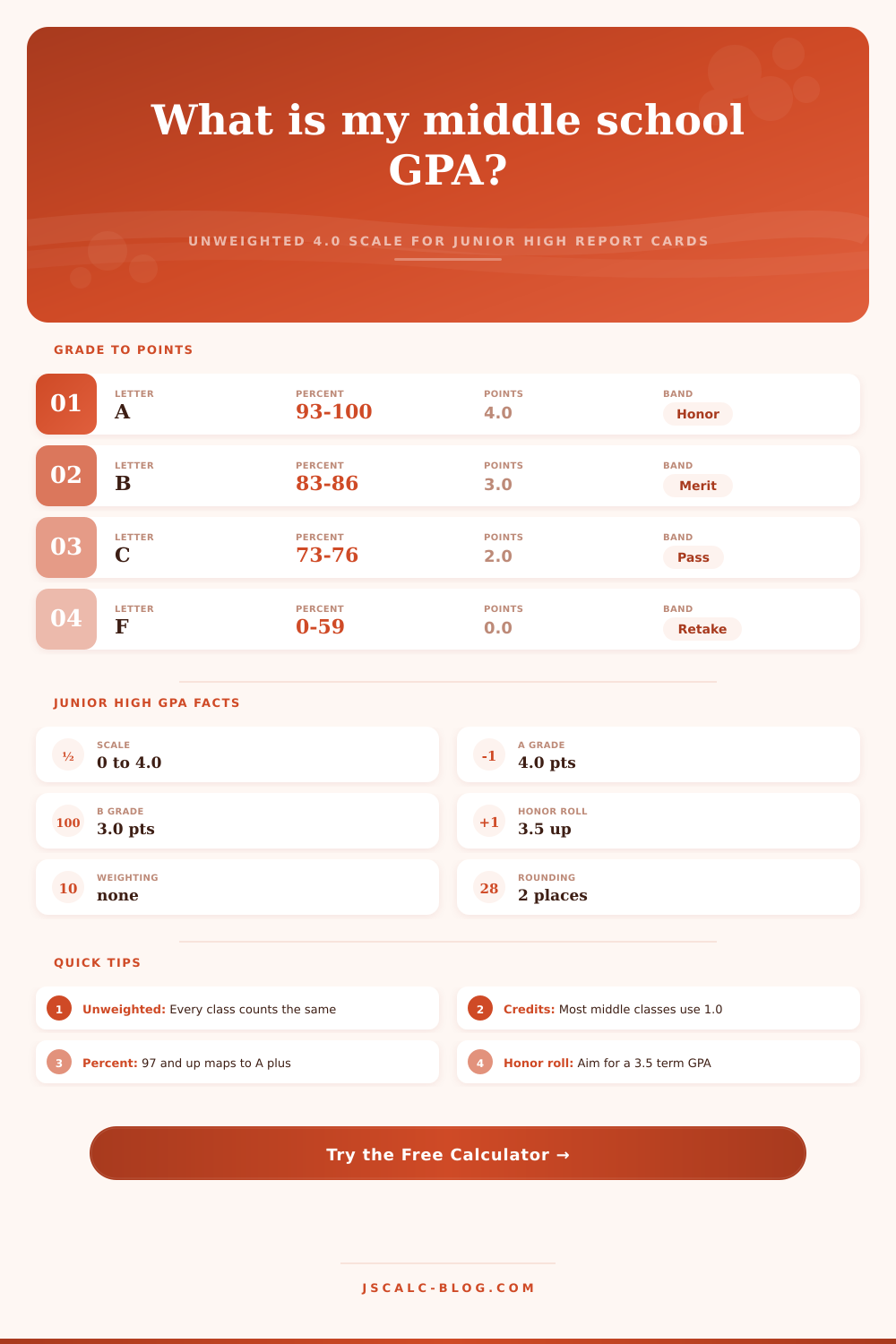
| Letter | Percent Range | Grade Points | Whole-Letter Points | Meaning |
|---|---|---|---|---|
| A+ | 97 to 100 | 4.0 | 4.0 | Excellent mastery |
| A | 93 to 96 | 4.0 | 4.0 | Strong work |
| A- | 90 to 92 | 3.7 | 4.0 | Very good |
| B+ | 87 to 89 | 3.3 | 3.0 | Above average |
| B | 83 to 86 | 3.0 | 3.0 | Good, on track |
| B- | 80 to 82 | 2.7 | 3.0 | Solid effort |
| C+ | 77 to 79 | 2.3 | 2.0 | Fair, review gaps |
| C | 73 to 76 | 2.0 | 2.0 | Passing average |
| C- | 70 to 72 | 1.7 | 2.0 | Needs support |
| D+ | 67 to 69 | 1.3 | 1.0 | Below target |
| D | 63 to 66 | 1.0 | 1.0 | Barely passing |
| D- | 60 to 62 | 0.7 | 1.0 | At-risk grade |
| F | 0 to 59 | 0.0 | 0.0 | No credit, retake |
🏅Honor Roll Bands
| GPA Range | Common Band Name | Letter Feel | What It Means |
|---|---|---|---|
| 3.90 to 4.00 | Principal's Honor Roll | Straight A | Top recognition tier |
| 3.50 to 3.89 | Honor Roll | A to A minus | Standard honor list |
| 3.00 to 3.49 | Merit / B Honor Roll | B average | Meeting expectations |
| 2.00 to 2.99 | Satisfactory | C average | Passing, room to grow |
| 1.00 to 1.99 | Academic Watch | D average | Support plan suggested |
| 0.00 to 0.99 | Intervention | Mostly F | Retake or tutoring |
🗂Sample Semester Comparison
| Student Profile | English | Math | Science | Social Studies | Electives | Term GPA |
|---|---|---|---|---|---|---|
| Straight A 6th | A | A | A | A | A / A | 4.00 |
| Honor roll 7th | A | A- | B+ | A | A / A- | 3.75 |
| Solid B student | B | B | B | B | B / B | 3.00 |
| Mixed report | A | C | B | B | A / C | 2.83 |
| Improving from C | B | C+ | B- | C | B / B | 2.62 |
| Needs support | C | D | C- | D+ | C / D | 1.62 |
Term GPA values above use the plus and minus scale with 1.0 credit per class across six classes.
📋Semester Planning Reference
| Goal | Grades Needed (6 classes) | Points Needed | Tip |
|---|---|---|---|
| Reach 4.0 | All A grades | 24.0 of 24 | No grade below A |
| Reach 3.5 | Mostly A and B | 21.0 of 24 | Three A and three B |
| Reach 3.0 | All B grades | 18.0 of 24 | Keep every class at B |
| Reach 2.5 | Even B and C | 15.0 of 24 | Three B and three C |
| Stay passing | All C or higher | 12.0 of 24 | Avoid any D or F |
| Recover a term | Raise two grades | +2.0 to +4.0 | Focus on lowest classes |
🧮Full Formula Breakdown
💡Junior High GPA Tips
When most middle schoolers view their report card, they notice the letters (or colors); they don’t recognize the underlying mathematical equation behind those grades. If you don’t know how averages is calculated, this unweighted GPA system can be tougher then the weighting used in high school. It’s a straight-forward game of numbers: each class carries equal value. Each letter on the page counts the same, whether it is your algebra score or your art grade. Many students is surprised to discover that these core subjects aren’t weighted any differently in actual calculation.
Here’s how it works: Simply plug in your classes and choose either whole letters (A, B, C) or with plus and minus modifiers. Instantly, the term GPA appear. Why? Grading policies for middle schools across the country differ wildly. While some districts still stick to hard A, B, C buckets, others get more detailed with B plus and A minus levels. Toggle that option on the tool and run it through scales to match. It’ll give you the answer and remove the guesswork of trying to determine whether your solid 92 percent score will pull you into honor roll territory.
How to Calculate Your Middle School GPA
Once you understand how it works, you can plan for following semester accordingly. One pitfall many student fall into is believing that a student must earn all A’s in order to be on the honor roll. In fact, the number is typically closer to a 3.5 overall GPA, meaning you have some flexibility with your grades: you can have mostly high A’s alongside a couple strong B’s and still end up right there. If you slip an A minus or perhaps a B plus now and again, you’ll still stay in that higher range as long as you don’t drop low enough to drag your overall score down. Perfection doesn’t matter; consistency does.
Credit value also matters greatly. In most junior high settings, every class counts as one credit hour, meaning you are essentially taking a straight average of your grade points. What does that mean? Well, basically, it means you just take a straight average of your grade points to get your GPA. There’s no need for weighted core classes (which count twice/thrice/etc.). Music is not an optional extra, nor is gym. It’s a full partner in this equation. A failure in band will bring your GPA down by the same amount as a fail in science. And that’s where people go wrong. They ignore electives until it’s too late, not understanding that these courses holds the same mathematical weight as their tougher classes.
The other thing I really like about the calculator is that if you want to account for an earlier period of cumulative GPAs, you can plug those in too. You just put in the old average along with number of semesters/quarters/etc. You put in the number of semesters or quarters used to calculate that average, and the calculator will show how much your new grades affect your overall progress. It’s a little bit more advanced math, but also a little more accommodating if you have some cushion. If you’re starting out low-ish historically, you can gradually recover, but you have to work at it. Getting a good semester here and there won’t necessarily budge your cumulative grade much.
That’s why the “goal” function is so helpful. It shows you clearly how far away from whatever your target is (say, 4.0 or 3.5) and how many additional points you’ll have to pick up to get there. Suddenly your hope to bring up your marks has a clear, achievable objective.
When considering what grade band you’re in, you can look at the reference table of grade bands to see more. Usually, Principal’s Honor Roll will require nearly perfect scores across the board, and Merit recognizes good grades, that meet expectations but aren’t stellar in all categories. Knowing which category you fall into can help guide how hard you should of push yourself in each class, as some may be worth focusing on, and others perhaps less so. If you only want to remain in a Merit or Satisfactory band, maybe you don’t necessarily have to get straight As, but if you’re going after the top tier, you’ll need to minimize any weak points.
At the end of the day, this all boils down to one simple fact: Your GPA is nothing more than a number, until you decide what that number means for your future plans. While some high schools hold fast to your middle school record, others begin with a clean slate. Wherever you might go, though, monitoring your academic journey empowers you to own your success. No longer are you the passive victim of your grade book; instead, you’re an active participant in your educational experience. This subtle change in perspective can make all the difference once finals week arrives and the pressure piles up. Watch out for the average, guard those electives, and use the information to guide your work toward its greatest potential.