Military Retirement Calculator
Estimate your monthly and annual military pension under the High-3, Blended Retirement System, or legacy Final Pay plan, then compare multipliers, Survivor Benefit Plan coverage, and COLA growth over time.
🎖Real Retirement Scenarios
📝Service & Pay Inputs
Average of your highest 36 months of basic pay.
Used when entry method is annual base pay.
Partial year credited as months / 12.
Label only; base pay above drives the math.
Points / 360 = equivalent years (Reserve only).
🔢Formula Snapshot
⚖System Multiplier Reference
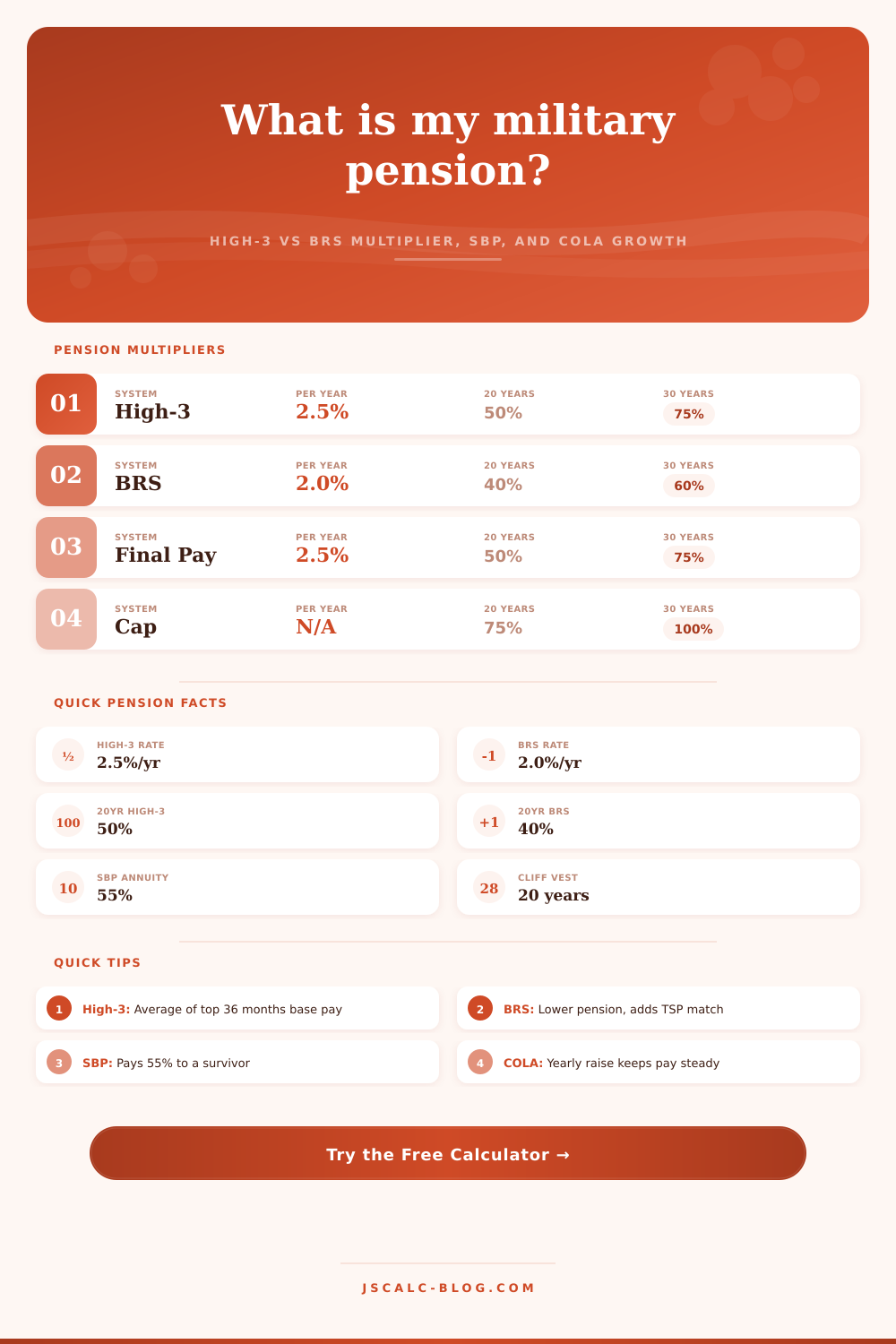
| Retirement System | Per-Year Rate | Who Qualifies | Extra Benefits |
|---|---|---|---|
| Final Pay (legacy) | 2.5% | Entered before Sep 1980 | Uses final month base pay |
| High-3 (High-36) | 2.5% | Entry 1980 to 2017 | Average of top 36 months |
| Blended (BRS) | 2.0% | Entry 2018 or opted in | TSP match plus continuation pay |
| Disability retire | 2.5% or rating | Medical separation | Greater of formula or % rating |
📊Years-to-Pension Percentage
| Years of Service | High-3 % | BRS % | Difference |
|---|---|---|---|
| Calculate above to highlight your service year. | |||
🗂High-3 vs BRS Comparison Grid
| Years | High-3 Mult | High-3 Monthly | BRS Mult | BRS Monthly | Monthly Gap |
|---|---|---|---|---|---|
| The comparison grid uses your entered base pay. | |||||
📈COLA Growth Projection
| Years After Retire | COLA Factor | Monthly Pension | Annual Pension | Growth vs Start |
|---|---|---|---|---|
| Projected inflation-adjusted pension appears here. | ||||
🛡Survivor Benefit Plan Reference
| SBP Election | Covered Base | Approx Premium | Survivor Annuity |
|---|---|---|---|
| Full base coverage | Full retired pay | 6.5% of base | 55% of covered base |
| Reduced base | Chosen dollar amount | 6.5% of chosen base | 55% of chosen base |
| Decline SBP | None | No premium | No annuity paid |
| Child only | Full retired pay | Lower cost | 55% while eligible |
⚙Full Formula Breakdown
📋Reference Values
| Item | Common Entry | How It Is Used | Effect on Pension |
|---|---|---|---|
| High-3 base pay | $4,000 to $12,000 mo | Multiplied by percentage | Directly scales monthly pay |
| Years of service | 20 to 40 years | Sets the multiplier | Each year adds 2.0% or 2.5% |
| Retirement system | High-3 or BRS | Chooses per-year rate | BRS is 20% lower pension |
| SBP election | Full, reduced, none | Sets survivor coverage | Premium trims the retiree check |
| COLA estimate | 1.5% to 3.5% yearly | Compounds each year | Keeps buying power steady |
💡Practical Retirement Tips
Military retirement is unlike civilian retirement. It doesn’t involve building up slowly over four decades with the hope that market cooperate. Rather than build wealth over time, you exchange decades of service for a defined benefit that begins immediately upon leaving active duty.
While the math is fixed, the options aren’t, if you understand what levers shift needle. Because most service members believes the pension will magically show up eventually, they fixate on next deployment or promotion. Such an assumption are risky, however: Military pensions depend on your date of entry service, as well as whether or not you elected into new retirement plans that favor upfront savings versus guaranteed income. Use the calculator above to see how the legacy High-36 average pay system compares to Blended Retirement System and to see where your money go.
How Military Retirement Works
It comes down to two multipliers: 5 percent of your top three dozen months of basic pay for each year of service. Twenty years gets you a monthly pension equal to half your base pay. That’s a serious floor, since it increases with inflation each year through cost of living raises. 0 percent per year. Each extra year mean one-tenth fewer dollars of guaranteed pension payout (vs. The previous system).
At a glance, it look like a penalty. But, it’s offset by ongoing cash flow from continuation pay bonuses while on active duty. It is also offset by automated Thrift Savings Plan contributions throughout your career. You’re trading long-term certainty, an asset which won’t arrive until decades later, for present-day money you can spend now (or invest elsewhere).
This means that you are by far your biggest variable. More than anyone realizes, what you put in determine what you get out of the system. A lot of guys wrongly base their retirement numbers based off the total amount they are paid (including cost of living or housing differentials). These do not continues after retirement. The only thing used for calculating the High-36 average is your basic pay. So if you have spent the last couple of years getting big money at sea, while you were stationed ashore for lower rates, higher rate becomes your new average. That number is now locked into place for life.
This is accounted for in the calculator with a box where you can plug in an estimate in either annual or monthly terms of what that baseline pay will be. Your best bet is to run down and pull up your pay stubs for the past several months to see exactly how much your true base pay was and just ignore all the other lines that won’t exist anymore. Get this one incorrect and you’ll falsely believe you’ve got it made…only to wake up to learn otherwise once transition date arrives.
Another piece that sometimes doesn’t get considered until it’s too late are survivor benefits. When you’re gone, the Survivor Benefit Plan provide 55 percent of your covered pension base to your spouse (at the cost of roughly 6.5 percent of your gross retired pay every month). While this sounds like a lot of money to be paying out from a tight budget, the alternative is leaving someone else with nothing in the event of your death. This is a personal choice, does your spouse need this benefit or is he/she already financially stable? Do they have life insurance for an event like this? You might opt for a lesser amount of base coverage to reduce the payment but still offer small level of security for your family. There isn’t a right answer here, just whatever fits into the bigger financial plan for your family.
But here is the best aspect of military pensions: Inflation Protection. Your monthly pension adjusts upwards each year, keeping pace with inflation. The adjustment rate may only be two and a half percent per year, but over a decade or two or three … that adds up! As medical bills and housing costs rise, you’ll still have stable purchasing power. It lets you plan for the future in a way that an uncertain investment portfolio just cannot do. Wall Street’s mood doesn’t matter; whatever you get now, you’ll continue getting, adjusted for economic reality.
That brings us to vesting. To get even a penny of a pension, you must have earned 20 years of creditable service. If you leave for any reason other than medical retirement or leaving due to certain disabilities, you will not recieve a partial payout even if you stay for 15 or 18 years. That cliff effect cost you hundreds of thousands of dollars over time and makes it critical to stay a month or two beyond a key date. It works because it is a powerful incentive to follow through on a commitment.
You should of understood the mechanics earlier. Once you understand the mechanics, what seems like a complex series of forms becomes a clear roadmap. You’re not simply marking off the days until freedom: you’re managing an asset that needs to be deliberately adjusted before the clock ticks down.