IVF Due Date Calculator
Estimate your due date (EDD) from an embryo transfer, egg retrieval, or frozen embryo transfer. Choose Day-3, Day-5, or Day-6 embryo age and see gestational age, trimester, and IVF milestone dates computed to the day.
🧬IVF Scenario Presets
📝Your IVF Details
Transfer methods use embryo age; retrieval counts fertilization day.
Transfer date, retrieval date, or FET date depending on method.
Used for FET and to confirm transfer offsets.
Sets gestational age, trimester, and days remaining.
Multiples often arrive earlier; shows an adjusted date too.
IVF dating is date-based, so cycle length does not change the EDD.
🔢IVF Dating Snapshot
📅Trimester Timeline
| Trimester | Weeks | Starts On | Ends On | Notes |
|---|---|---|---|---|
| Enter your IVF date above to see trimester dates. | ||||
🩺IVF Milestone Dates
| Milestone | Gestational Age | Estimated Date | What Happens |
|---|---|---|---|
| Milestone dates appear after calculation. | |||
🗂Transfer-Day to Due-Date Offsets
| Method | Embryo Age | Add to Date | Basis Day | GA at Event |
|---|---|---|---|---|
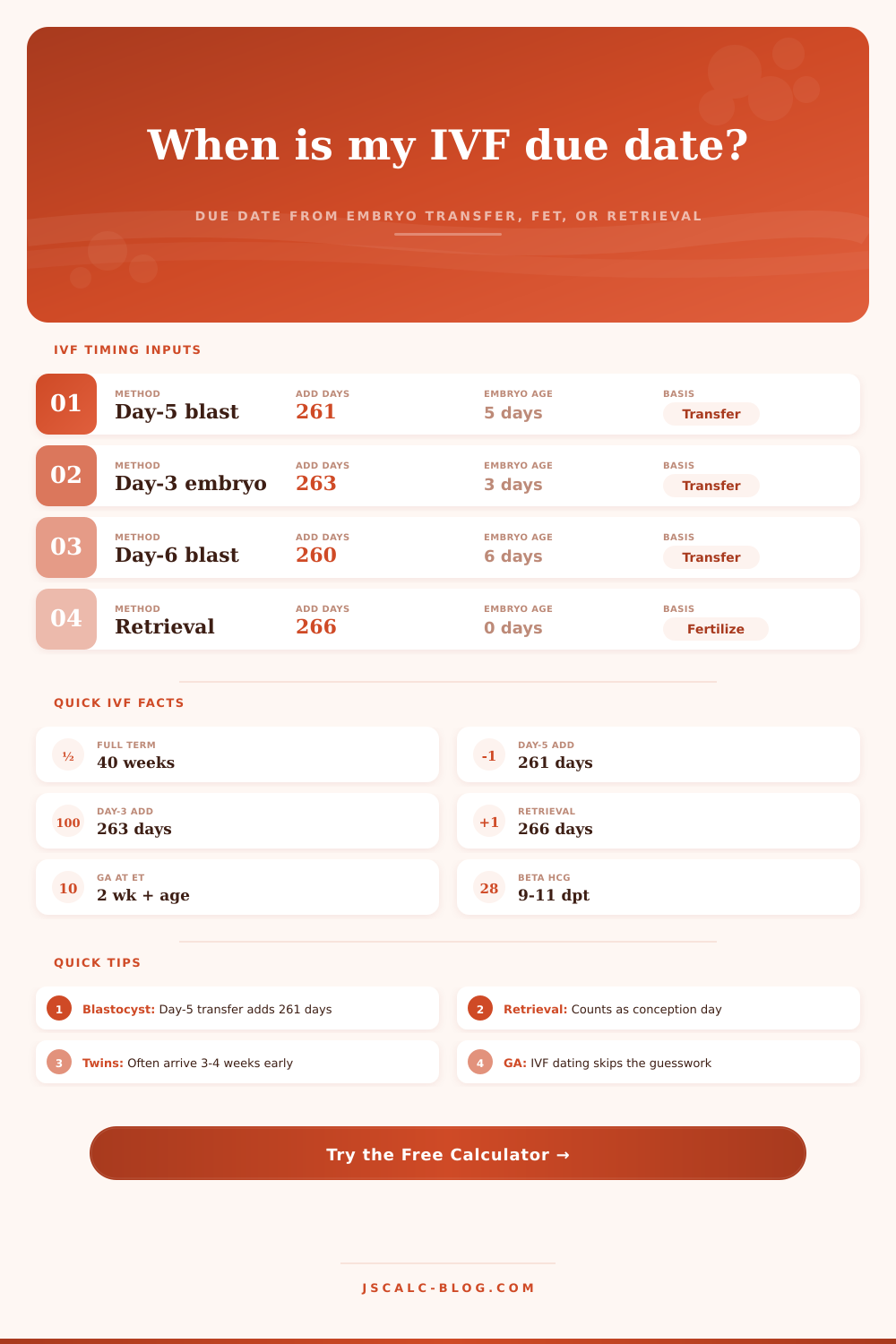
| Day-5 blastocyst transfer | 5 days | +261 days | Transfer date | 2w 5d |
| Day-3 embryo transfer | 3 days | +263 days | Transfer date | 2w 3d |
| Day-6 blastocyst transfer | 6 days | +260 days | Transfer date | 2w 6d |
| Egg retrieval | 0 days | +266 days | Fertilization | 2w 0d |
| FET Day-5 blastocyst | 5 days | +261 days | Transfer date | 2w 5d |
| FET Day-3 embryo | 3 days | +263 days | Transfer date | 2w 3d |
📊Gestational-Age Comparison Grid
| Scenario | Method | Embryo Age | Days Added | GA at Transfer | Full-Term GA |
|---|---|---|---|---|---|
| Standard blastocyst | Day-5 transfer | 5 days | +261 | 2w 5d | 40w 0d |
| Cleavage embryo | Day-3 transfer | 3 days | +263 | 2w 3d | 40w 0d |
| Slow blastocyst | Day-6 transfer | 6 days | +260 | 2w 6d | 40w 0d |
| Fresh from retrieval | Retrieval date | 0 days | +266 | 2w 0d | 40w 0d |
| Frozen transfer | FET Day-5 | 5 days | +261 | 2w 5d | 40w 0d |
| Frozen cleavage | FET Day-3 | 3 days | +263 | 2w 3d | 40w 0d |
| Twins (blast) | Day-5 transfer | 5 days | +261 | 2w 5d | ~37w target |
| Triplets (blast) | Day-5 transfer | 5 days | +261 | 2w 5d | ~33w target |
⚙Full Formula Breakdown
📋Reference Values
| Item | Typical Value | How It Is Used | Effect on Due Date |
|---|---|---|---|
| Full-term gestation | 40 weeks / 280 days | From LMP-equivalent to EDD | Defines the target date |
| Embryo age | 3, 5, or 6 days | Sets transfer offset | Older embryo, fewer days added |
| Beta hCG test | ~9-11 days post-transfer | Confirms pregnancy | Does not move the EDD |
| First ultrasound | ~6-7 weeks GA | Confirms heartbeat | May refine dating slightly |
| Multiples | Twins ~37, triplets ~33 wk | Adjusted delivery target | Often earlier than 40 weeks |
💡Practical IVF Timing Tips
This IVF due date calculator provides an informational estimate based on standard embryo-transfer and gestational-age dating. It is not medical advice. Your fertility clinic's dating from ultrasound measurements takes precedence. Always confirm your due date and milestone timing with your care team.
When most people become pregnant, they’re going to guess their ovulation date: They’ll remember feeling a symptom, then work back. But if you conceived via IVF, then there is no more guessing game. The lab recorded every single day. You have exact knowledge about when that embryo was created. This alters your due-date thinking (which we’ll get into) but also adds another layer of confusion that no conventional pregnancy handbook prepares you for.
Once you enter your embryo age and your transfer date, this calculator will do the math for you, sparing you from having to count down the days yourself and risk making an off-by-one mistake that shifts your entire timeline. The issue is that there’s an embryonic age, and then there’s a gestational age, which is what doctors use to count pregnancy. This is the age that doctors assume you became pregnant, meaning from a hypothetical first day of an assumed last menstrual period that assumes ovulation occurred on day fourteen. And with IVF, fertilization occur later in relation to that artificial starting point.
How to Calculate Your Due Date After IVF
That is why we’re talking about a Day-5 blastocyst. It means the embryo has been growing out of your body for five days at that point. This means that on the day you get transferred, you aren’t actualy one week pregnant; you are two weeks and five days pregnant, but everyone forgets that. To adjust for that lag, the calculator does that work for you. It adds the right number of days to your transfer date to reach a standard forty-week mark.
If you were harvesting eggs, instead of transferring them, fertilization would be day zero, and math changes based off that. Then there’s the question of whether you should transfer fresh or frozen embryos, which can introduce yet another reason for fretting over timing. The fear is that if you freeze the embryo, it will stop developing, but that isn’t true at all. When thawed, a frozen Day-5 blastocyst remains a five-day-old creature. Biology doesn’t care how cold the storage tank was; the calculator accounts for FET dates just as it would for fresh transfers.
That’s good news for patients whose cycles was interrupted by scheduling issues or other health concerns, and who needed to freeze an embryo. It won’t change your due date because your embryo has been chilling out for months in deep-freeze. That changes the equation significantly if you’re expecting multiples, both logistically and medically. Carrying twins? Triplets? It’s not typically a goal of forty weeks. Instead, there’s generally an expectation that the body will stretch out and deliver early enough to avoid complications. For twins, thirty-seven weeks is a more reasonable estimate, while triplets might aim as low as thirty-three.
Since this accounts for multiple pregnancies, it is important for things like nursery prep and leave arrangements, as well as mental preparation. Once you know roughly when to expect, you can start packing your bag or making child care plans… Rather than waiting until literally at the eleventh hour. Mentally, being able to see a time frame helps too.
With natural conception, when your cycle isn’t perfect, sometimes those ultrasound results gives you an earlier or later due date. And with IVF, you know from day one exactly what those milestone days will be. When you’ll hear your baby’s heartbeat, when you’ll find out its sex, when you’ll make it to the last appointment. No more second guessing about whether maybe you’re farther along then you realized… You get rid of all that ambient uncertainty. It gives you nothing but peace, mind over matter. It brings just comfort and health.
In the end, though, that’s what a due date really is, a statistical anchor, but not a hard stop. On average, only one in 20 babies will make it onto the estimated day. Knowing where we start, however, allows your care team to track development and ensure safe delivery. Those reference tables on the page spell it all out: they illustrate where each age of the embryo maps to certain gestational moments. If you’re past your first trimester, if you have a few more weeks to go, knowing those offsets puts you back in control of your information. No more guessing at when life began, because now you know exactly when it started growing towards you.