Hydraulic Piston Force Calculator
Work out both the push (extend) force on the full bore and the pull (retract) force on the smaller rod-side annulus of a hydraulic cylinder. Enter bore diameter, rod diameter and system pressure to get force in pounds and tons, the effective annulus area, and the differential bore-to-annulus ratio, or solve backward for the pressure a target force needs.
🔧Choose a Mode
🏗Real Cylinder Presets
📝Cylinder Inputs
Switches every input and result unit at once.
Inner cylinder diameter in inches, drives push force.
Piston rod diameter in inches, removed from the pull face.
Operating pressure at the cylinder port, in psi.
Multiplies both push and pull output force.
Which force the pressure solver should hit.
Force you need, in lbf, on the chosen stroke.
Controls rounding on every result value.
🔢Formula Snapshot
📊Push vs Pull by Rod Diameter (3 in Bore @ 2500 psi)
| Rod Diameter | Annulus Area | Pull Force | Pull as % of Push |
|---|---|---|---|
| 0.75 in | 6.626 in² | 16564 lbf | 93.8% |
| 1.00 in | 6.283 in² | 15708 lbf | 88.9% |
| 1.25 in | 5.841 in² | 14602 lbf | 82.6% |
| 1.375 in | 5.584 in² | 13959 lbf | 79.0% |
| 1.50 in | 5.301 in² | 13254 lbf | 75.0% |
| 1.75 in | 4.663 in² | 11658 lbf | 66.0% |
| 2.00 in | 3.927 in² | 9817 lbf | 55.6% |
| 2.25 in | 3.093 in² | 7731 lbf | 43.8% |
📏Bore and Rod Area Chart
| Diameter | Area (in²) | Area (cm²) | As Bore, Push @ 3000 psi |
|---|---|---|---|
| 1.0 in | 0.785 in² | 5.07 cm² | 2356 lbf |
| 1.5 in | 1.767 in² | 11.40 cm² | 5301 lbf |
| 2.0 in | 3.142 in² | 20.27 cm² | 9425 lbf |
| 2.5 in | 4.909 in² | 31.67 cm² | 14726 lbf |
| 3.0 in | 7.069 in² | 45.60 cm² | 21206 lbf |
| 4.0 in | 12.566 in² | 81.07 cm² | 37699 lbf |
| 5.0 in | 19.635 in² | 126.68 cm² | 58905 lbf |
| 6.0 in | 28.274 in² | 182.41 cm² | 84823 lbf |
📐Pressure and Force Unit Conversions
| Unit | Equals | In Base Unit | Note |
|---|---|---|---|
| 1 psi | 0.06895 bar | 6895 Pa | Pounds per square inch |
| 1 bar | 14.504 psi | 100000 Pa | Metric pressure |
| 1000 psi | 68.95 bar | 6.895 MPa | Common test rung |
| 1 lbf | 4.4482 N | 4.4482 N | Pound-force |
| 1 kN | 224.81 lbf | 1000 N | Kilonewton |
| 1 US ton | 2000 lbf | 8896 N | Short ton of force |
🗃Push and Pull Comparison Grid
| Bore / Rod | Push @ 2000 | Pull @ 2000 | Push @ 3000 | Pull @ 3000 | Ratio |
|---|---|---|---|---|---|
| 2 / 1 in | 6283 lbf | 4712 lbf | 9425 lbf | 7069 lbf | 1.33 : 1 |
| 2.5 / 1.25 in | 9817 lbf | 7363 lbf | 14726 lbf | 11045 lbf | 1.33 : 1 |
| 3 / 1.5 in | 14137 lbf | 10603 lbf | 21206 lbf | 15904 lbf | 1.33 : 1 |
| 3.5 / 1.5 in | 19242 lbf | 15708 lbf | 28863 lbf | 23562 lbf | 1.23 : 1 |
| 4 / 2 in | 25133 lbf | 18850 lbf | 37699 lbf | 28274 lbf | 1.33 : 1 |
| 5 / 2.5 in | 39270 lbf | 29452 lbf | 58905 lbf | 44179 lbf | 1.33 : 1 |
| 6 / 3 in | 56549 lbf | 42412 lbf | 84823 lbf | 63617 lbf | 1.33 : 1 |
| 4 / 1.75 in | 25133 lbf | 20321 lbf | 37699 lbf | 30481 lbf | 1.24 : 1 |
| 5 / 3 in | 39270 lbf | 25133 lbf | 58905 lbf | 37699 lbf | 1.56 : 1 |
| 8 / 4 in | 100531 lbf | 75398 lbf | 150796 lbf | 113097 lbf | 1.33 : 1 |
⚙Formula Breakdown
💡Push, Pull and Regeneration Tips
On the surface, a hydraulic cylinder appears quite simple: a piston rod in a metal barrel. However, on the inside there is some very particular rules of geometry at play which have an impact on the cylinder’s performance. The problem is that pushing and pulling aren’t symmetric actions. If you’re extending the cylinder by pressurizing one end (the cap), then all of the oil are pushing back against the full face of the piston. Then if you reverse the flow to retract the cylinder, part of that face is taken up by the rod. This reduces the effective surface area to a ring-like shape where the pressure must act. That smaller surface area result in a smaller pull force compared to the push force.
Plug in your pressure, rod and bore values into the hydraulic piston force calculator, and let it do the math so you don’t have to guess what percentage of strength you’re sacrificing during the retract stroke. Force equals pressure times area; it all boils down to simple geometry. That’s where most folks makes a mistake. They think the twenty-thousand pound cylinders pushes that much force out in both directions. Nope. It doesn’t.
How Size Changes Push and Pull Power
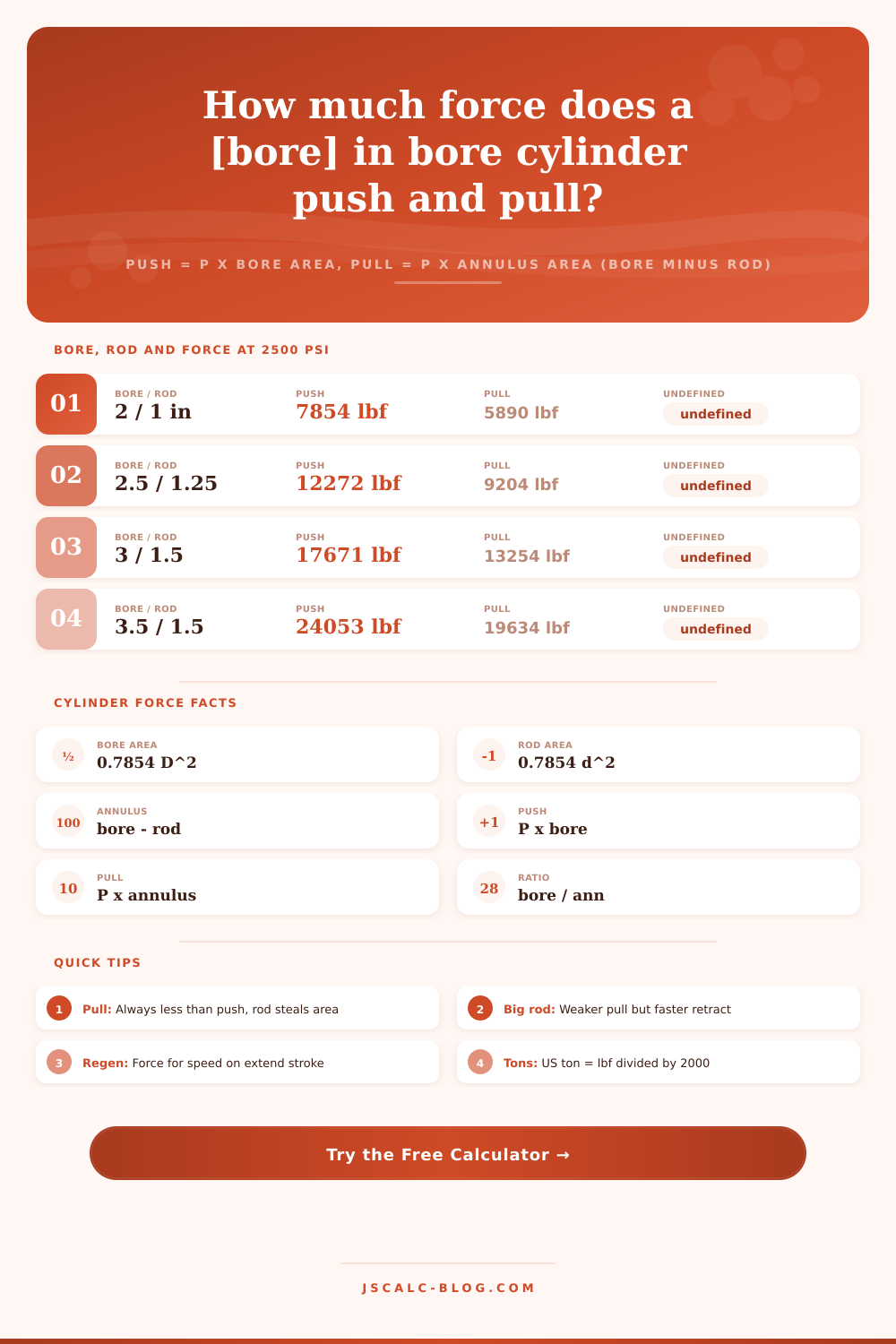
The calculator will break those two things apart. It first determines the bore area and removes the area of rod. Then it figures out what we call the effective annulus. With a three-inch bore and a one point five inch rod pushed against something at two-thousand five-hundred psi, you end up with approximately seventeen-thousand six-hundred pounds of pushing force. On the pull side though, that same combination reduce to around thirteen-thousand two-hundred-fifty-four-pounds. There’s no flaw in the hardware; it’s simply the nature of circles.
This is where design becomes interesting: choosing the proper rod diameter. The thicker rod mean the cylinder can resist side loads and buckling better. That’s why they use such robust rods on heavy machinery such as log splitters or excavators. This prevents bending under load. But each inch of steel that you add to the rod removes area from the annulus which directly decreases your pull strength. And here’s how pull force plummets as rod size increases different than the bore. Refer to the table on this page.
So you must decide which is most important for your application? Do you want to lift a heavy load that pulls back down when it retracts such as a dump trailer bed? In that case you want a thinner rod to keep that retract power. Or do you want to push something like a log or press metal in a shop press? In those cases, you aren’t using any of that retract power. A larger rod won’t cost you nothing on the working stroke because all the work is being done on the extension.
This geometry tradeoff have a speed element as well. Using the same amount of pump flow, how much faster does the cylinder retract versus how fast it extends? That’s called the differential ratio and is what the calculator gives you. If you have a bigger rod on your machine, then that creates a smaller annulus which requires less volume of oil to fill the gap. So if you put a large rod on a heavy duty cylinder, it’ll retract much faster than it extend. And that’s typically good because in most cases the machine needs raw power to extend and get the job done. But it benefits from speed on the return stroke, back to the start position. You can see the speed effects immediately by looking at the force numbers and the ratio the calculator gives you.
There’s also a subtler but very real place where efficiency comes into play: Your seals are going to create friction, which will chew up some percentage of the force available to you. A new low-friction seal might reduce the loss by just three percent compared to theoretical output. If the seals is worn from being in a dirty environment, they may cause a loss of 15 percent or more. This is something you can account for mechanically with the tool, making your estimates reflect what happens on the shop floor instead of what you read about in a text book vacuum. Plug in your system pressure and pick an efficiency factor and the numbers comes down accordingly. It’s nothing big, but it makes a difference when you’re on the cusp of knowing if your cylinder can handle a certain amount of lift.
This leads into regeneration. On some systems, they also regenerate oil and send it back to the cap side of the system on extension. They cancel out the annulus area so that only the rod area generate pressure. It sounds counterintuitive because your extend force is dramatically reduced. But at the same time the cylinder moves so much faster and with the same sized pump. It is a great mode for getting in quickly and then engaging a load. Understanding these modes helps you design circuits that trade force for speed deliberately rather than by accident.
In short, hydraulics are a study in compromises between speed, force and structure. You can’t have it all on one system. Increasing your bore increases pushing power, which requires a greater flow of oil. Increasing your rod size gives you more strength, but it reduces pulling power and slows down how much volume the piston need to extend. Plug those values into the calculator and you’ve got a safe playground to play around with those variables without any fear of welding something incorrectly.
Use this starting point: What’s your maximum pressure? Next, what kind of rod do you need? Experiment with that number and see how the other numbers move. Before you ever pick up a book on fluid power or get a custom cylinder made, this turns math and shapes into real-world decisions. Actually, it should of been easier to calculate before.