Drag Force Calculator
Compute aerodynamic and hydrodynamic drag from the drag equation Fd = 0.5 x rho x v squared x Cd x A. Enter your speed, choose a fluid, pick a shape to set the drag coefficient, and set the frontal area to get drag force in newtons and pounds, the power needed to overcome it, and the dynamic pressure of the flow.
🏎Real-World Drag Presets
🔧Drag Inputs
Speed of the object relative to the fluid.
Converted to m/s inside the drag equation.
Denser fluids like water produce far more drag.
Auto-filled by the fluid; edit for Custom.
Shape choice fills the drag coefficient below.
Dimensionless shape factor; edit for Custom.
Projected area facing the flow.
Converted to m² before computing drag.
🔢Formula Snapshot
📑Drag Coefficient by Shape
| Object | Drag Coefficient Cd | Notes |
|---|---|---|
| Streamlined teardrop | 0.04 | Lowest practical shape drag |
| Airfoil / wing | 0.045 | Chord-aligned, thin section |
| Smooth sphere, high Re | 0.10 | Above the drag crisis |
| Dimpled golf ball | 0.24 | Dimples trip the boundary layer |
| Sports car | 0.28 | Low nose, smooth underbody |
| Modern sedan | 0.30 | Typical passenger car |
| Bullet | 0.30 | Pointed, spin-stabilized |
| SUV / pickup | 0.40 | Tall, blunt front |
| Sphere | 0.47 | Classic subcritical value |
| Motorcycle + rider | 0.60 | Highly rider-dependent |
| Cyclist, racing tuck | 0.70 | Aero bars, low back |
| Semi truck | 0.80 | Boxy tractor-trailer |
| Long cylinder | 0.82 | Crossflow over the axis |
| Cyclist, upright | 0.90 | Hands on the tops |
| Cube, face-on | 1.05 | Sharp-edged bluff body |
| Skydiver, belly-flat | 1.20 | Spread-eagle free fall |
| Flat plate, perpendicular | 1.28 | Full-face flow separation |
🌊Fluid Density Chart
| Fluid / Altitude | Density rho (kg/m³) | Relative to Sea-Level Air | Note |
|---|---|---|---|
| Air, 2000 m altitude | 1.007 | 0.82x | Thinner mountain air |
| Air, hot 35 C | 1.146 | 0.94x | Warm day, less dense |
| Air, sea level 15 C | 1.225 | 1.00x | Standard reference |
| Air, cold 0 C | 1.293 | 1.06x | Denser winter air |
| Fresh water | 997 | 814x | Roughly 800 times air |
| Seawater | 1025 | 837x | Salt raises density |
📏Speed Unit Conversions
| mph | km/h | m/s | Context |
|---|---|---|---|
| 10 mph | 16.1 km/h | 4.5 m/s | Brisk jog |
| 25 mph | 40.2 km/h | 11.2 m/s | Road cyclist |
| 40 mph | 64.4 km/h | 17.9 m/s | City driving |
| 60 mph | 96.6 km/h | 26.8 m/s | Highway cruise |
| 70 mph | 112.7 km/h | 31.3 m/s | Freeway limit |
| 120 mph | 193.1 km/h | 53.6 m/s | Skydiver terminal |
📈Drag Force vs Speed Comparison Grid
| Object (Cd × A in air) | 20 mph | 40 mph | 60 mph | 80 mph | 100 mph |
|---|---|---|---|---|---|
| Cyclist tuck (0.63) | 31 N | 123 N | 278 N | 494 N | 771 N |
| Sedan (0.66) | 32 N | 129 N | 291 N | 517 N | 808 N |
| Sports car (0.62) | 30 N | 121 N | 273 N | 486 N | 759 N |
| SUV (1.00) | 49 N | 196 N | 440 N | 783 N | 1224 N |
| Motorcycle (0.60) | 29 N | 117 N | 264 N | 470 N | 734 N |
| Sphere 0.1 m² (0.047) | 2 N | 9 N | 21 N | 37 N | 58 N |
| Flat plate 1 m² (1.28) | 63 N | 251 N | 564 N | 1003 N | 1567 N |
| Semi truck (8.0) | 392 N | 1567 N | 3525 N | 6267 N | 9792 N |
| Skydiver (0.84) | 41 N | 165 N | 370 N | 658 N | 1028 N |
| Golf ball (0.0011) | 0.05 N | 0.2 N | 0.5 N | 0.9 N | 1.3 N |
⚙Formula Breakdown
💡Drag Reduction Tips
Cycling into a headwind feels like you’re battling fatigue. No, it’s not. That’s drag. For every watt you generate while cycling there’s an equal and opposite pull of force pushing back against your chest.
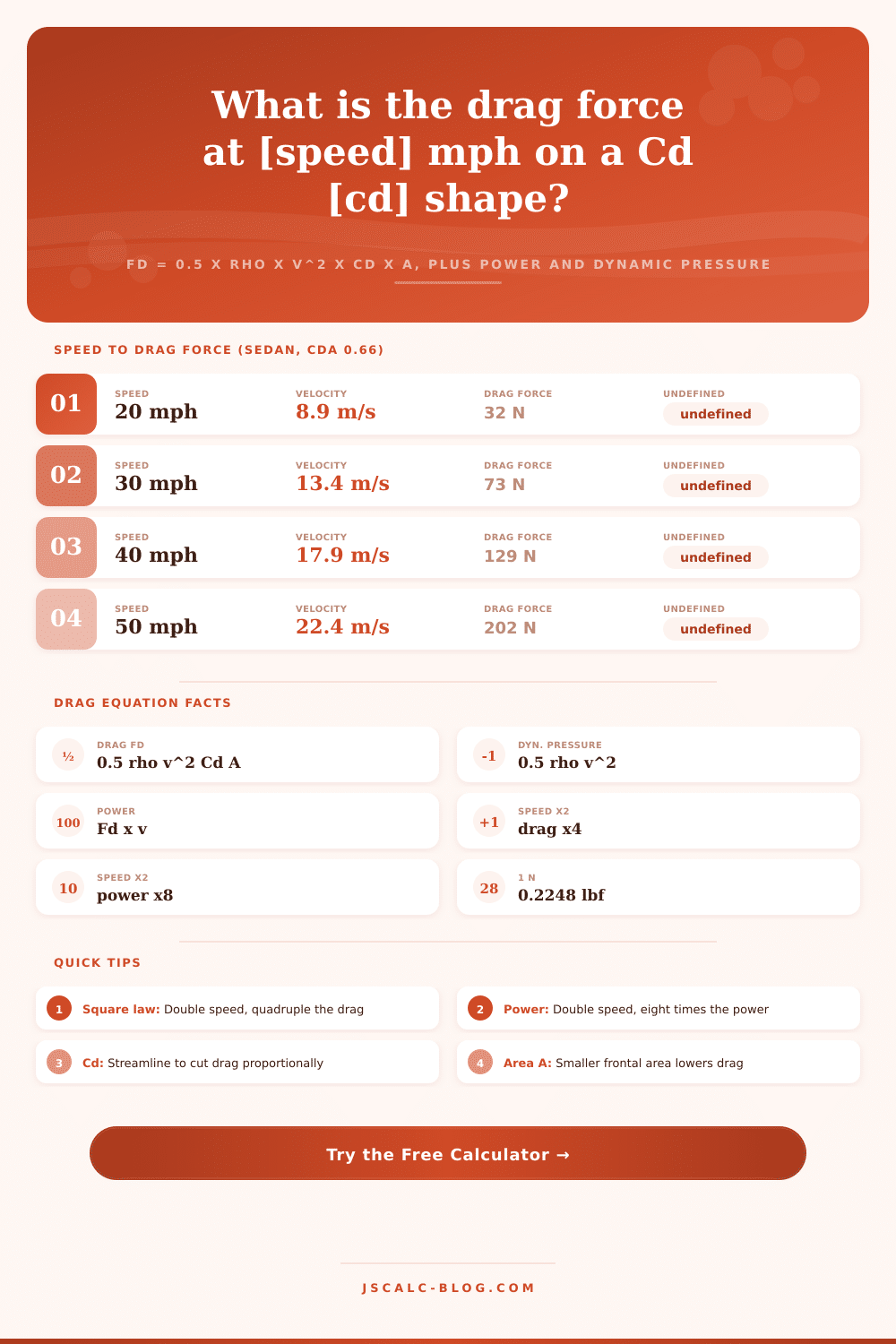
To account for this resisting force, we has something called the drag equation. Four variables, frontal area, a shape coefficient, velocity squared, and fluid density, capture the drag force. Plug those values into the calculator up top; let the computer do the math. The result is drag expressed in pounds and newtons. It also shows how much power it takes to overcome that drag.
Understanding Air Resistance While Cycling
It makes abstract aerodynamic concepts come to livig by turning them into an energy budget. Those four variables is multiplied to produce drag force. The half in that equation is just a property of physics that deals with kinetic energy. That’s the stuff that tells you how many gram of water or air are being pushed aside every second.
Water is around 800 times denser than air. That’s why swimming feels more difficult than cycling on pavement. That’s also why it gets harder as you swim fasterer.
Velocity appears in the equation squared. This is where most people make there mistake. Double the speed and don’t expect to double the drag; instead, look for quadrupling.
Shape coefficient, or Cd, describes how cleanly something moves through the air. A flat plate pointing into wind approaches 1.28. A teardrop shapes up near 0.04. Finally, frontal area represent what the fluid sees, the outline of thing.
Splitting the equation into two conceptual pieces can help. One part is called dynamic pressure, which is group of terms including density times velocity squared. No matter what shape the fluid is moving through, this is the pressure it exert while in motion. In pascals, this number alone appears on the calculator’s result card.
Then there is drag force which is simply dynamic pressure times area times your shape factor. Because velocity squared is a part of it, dynamic pressure increase sharply as speed increases. That’s why highway driving uses so much more fuel than city cruising. The higher speed mean the air pushes back quadratically harder. Every additional mile per hour come with an exponentially increasing cost in energy consumption.
And it’s not just the drag force, but also its ability to grow. Drag increase as the square of a vehicle’s velocity. Since you have to do work against it, we multiply drag force by velocity one more time to get the rate of doing work, or power. With that cubic increase, a vehicle must generate eight times the amount of power if it doubles its speed. So holding 30 mph on a bike require far more watts than holding 15 mph does. The calculator provides those numbers in both horsepower and watts, so it’s obvious how demanding it all gets.
A car at 70 mph may be seeing 396 newtons of drag. To overcome that and continue going at the same speed take approximately 12,400 watts (or 16ish horsepower) just fighting the air.
Drag coefficient matter more than you might think. You don’t need to remember the value as the calculator has presets for real world objects. A sports car is about 0.28, an SUV climbs into the 0.40 range due to a blunted nose, and a semi truck reach 0.80 because it is basically a box on wheels. Worst offenders are blunt shapes such as flat plates. Streamlining reduces drag in proportion to what was there before. At some speed, if you decrease your Cd from 1.0 to 0.5, you reduce drag by half. How readily does the fluid separate around the object and form the low pressure wake behind it, that’s the shape.
Units get mixed up and real problems occur (that’s no fun). You can enter speed in mph or km/h or m/s. Area is entered in feet or square meters. All are converted to SI units for calculation. Air density is assumed based off ambient temperature/altitude. There is an option for water (fresh or seawater). Less dense hot air mean a little less drag on a warm day. And thinner air from altitude results in lower resistance too.
Coefficient isn’t everything; frontal area is key too. Half the size of your silhouette means half the drag. That’s what tucking in does for cyclists. They reduce their frontal area and drag coefficient simultaneously.
Whether you’re shooting a projectile or driving your car down the road, drag is drag, and you can use it to understand everything from fuel consumption to projectile trajectories. Knowing that drag increases as the square of velocity explain why planes fly. It also explains why cars get aerodynamic shapes and why runners try to minimize their silhouette on a start line. And this thing calculates for you on-the-fly. Tweak a variable. See what happens to the rest. Find out that a small change in shape makes a big difference at higher velocities.
When you ‘get’ those relationships, air resistance isn’t such an opponent anymore; instead, it’s a variable you can manage. Now when you feel yourself pushing against that wall of wind, you should of known exactly what it’s costing you to move forward.