Hydraulic Cylinder Force Calculator
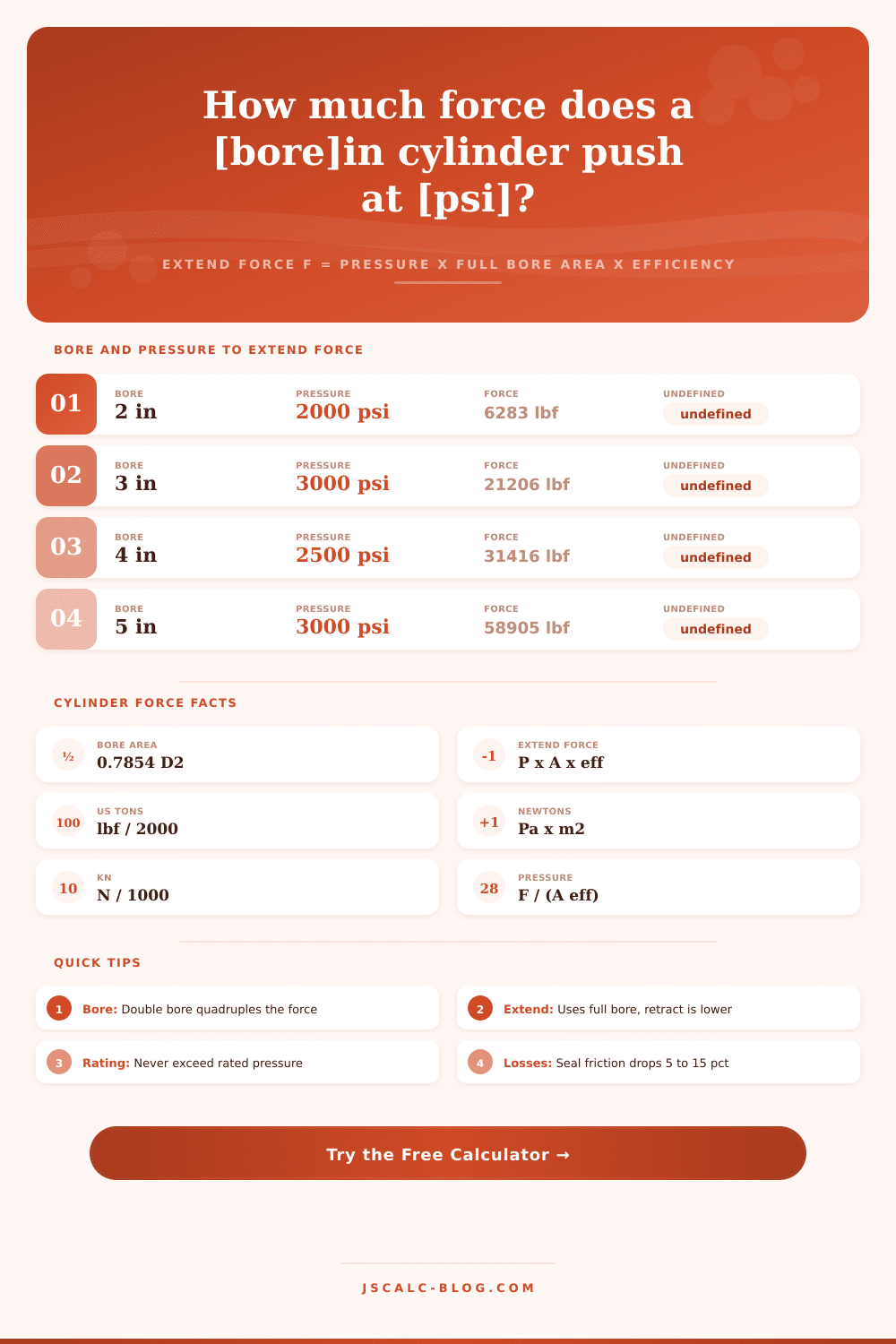
Find the extend (push) force of a hydraulic cylinder from the full bore area with F = pressure x bore area x efficiency. Enter bore and system pressure in Imperial or Metric, read the force in pounds, US tons, Newtons, and kN, or flip to back-solve the pressure you need to hit a target force with any number of cylinders in parallel.
🔧Choose a Mode
🎯Real Cylinder Presets
📝Cylinder Inputs
Sets bore and pressure units; both systems are always shown.
Inside diameter of the barrel; drives the full piston area.
Working pressure applied to the cap (blind) end on extend.
Seal and friction losses; drops usable force below the ideal.
Identical cylinders sharing the load; multiplies total force.
Force you must reach; the tool solves the pressure needed.
Controls rounding on every result card and row.
🔢Formula Snapshot
📏Bore Area Chart
| Bore (in) | Area (in²) | Bore (mm) | Area (cm²) |
|---|---|---|---|
| 1.5 | 1.767 | 38.1 | 11.40 |
| 2 | 3.142 | 50.8 | 20.27 |
| 2.5 | 4.909 | 63.5 | 31.67 |
| 3 | 7.069 | 76.2 | 45.60 |
| 3.5 | 9.621 | 88.9 | 62.07 |
| 4 | 12.566 | 101.6 | 81.07 |
| 5 | 19.635 | 127.0 | 126.68 |
| 6 | 28.274 | 152.4 | 182.41 |
| 8 | 50.265 | 203.2 | 324.29 |
| 10 | 78.540 | 254.0 | 506.71 |
📊Pressure and Force Unit Conversions
| Convert | Multiply By | To Get | Example |
|---|---|---|---|
| psi | 0.06895 | bar | 3000 psi = 206.8 bar |
| bar | 14.5038 | psi | 200 bar = 2901 psi |
| psi | 6894.76 | Pascal | 1 psi = 6895 Pa |
| lbf | 4.44822 | Newton | 1000 lbf = 4448 N |
| Newton | 0.224809 | lbf | 10000 N = 2248 lbf |
| lbf | 0.0005 | US ton | 2000 lbf = 1 ton |
⚙Typical System Pressures by Application
| Application | Typical Pressure | Common Bore | Note |
|---|---|---|---|
| Bottle jack | 7000-10000 psi | 1.5-2 in | Small ram, very high pressure |
| Log splitter | 2500-3000 psi | 4-4.5 in | High force, moderate speed |
| Dump trailer | 2500-3000 psi | 3-4 in | Telescopic or single stage |
| Farm loader | 2200-2800 psi | 2.5-3.5 in | Tractor open-center system |
| Skid steer | 3000-3500 psi | 2.5-3 in | Lift and tilt circuits |
| Excavator | 4500-5500 psi | 4-8 in | Boom, arm, and bucket |
| Shop press | 2500-3000 psi | 4-6 in | Bench or H-frame press |
| Industrial press | 2000-3000 psi | 8-12 in | Large tonnage forming |
🗃Extend Force Comparison Grid (lbf, 100% eff)
| Bore | 1500 psi | 2000 psi | 2500 psi | 3000 psi | 3500 psi |
|---|---|---|---|---|---|
| 2 in | 4712 | 6283 | 7854 | 9425 | 10996 |
| 2.5 in | 7363 | 9817 | 12272 | 14726 | 17181 |
| 3 in | 10603 | 14137 | 17671 | 21206 | 24740 |
| 3.5 in | 14431 | 19242 | 24052 | 28863 | 33673 |
| 4 in | 18850 | 25133 | 31416 | 37699 | 43982 |
| 5 in | 29452 | 39270 | 49087 | 58905 | 68722 |
| 6 in | 42412 | 56549 | 70686 | 84823 | 98960 |
⚙Formula Breakdown
💡Cylinder Sizing Tips
When you look at cylinder, there comes one such moment of uncertainty. There’s three-thousand psi on the pressure gauge, but what does that equate to in terms of meat? Is that enough oomph to heave loader bucket into air, or is it going to give out halfway to full power?
It’s a matter of relationship, something that sounds easy until you try to perform the mathematical equation in your brain. The solution: Let this tool does the work. Force are calculated by multiplying pressure, piston area, and efficiency. That’s one clean equation for extension force. And it makes sense: Force equals pressure times piston area times efficiency.
How to Calculate Cylinder Force
But it’s the geometry that trips folks up all the time. Remember, since the piston face is a circle, the area increases as the square of bore diameter. So strength doesn’t just double when you double the bore; it quadruples. You can hold a two inch cylinder and think “hefty,” then swap out that cylinder for a four inch cylinder, use the same pressure and now you have four times the pushing power! The calculator takes care of the squaring for you so you don’t need to remember your geometric formulas.
The biggest error I see with most operators is they chase pressure without verifying their bore size. They believe that if they crank their relief valve up, then they will increase their tonnage. In reality, going with a bigger cylinder is generaly cheaper in the long term and safer. Every time your relief valve opens you are putting stress on all of the seals, fittings and hoses in system. A larger bore will allow you to achieve the load capacity you desire while keeping everything in a safe operating range. This may seem like a little design decision, but it will matter when it comes to longevity of the whole system.
In real world, nothing runs at one hundred percent efficiency. Back pressure from return line fights against the stroke. Seals drag against the rod and bushing friction increases as time goes by. That’s why tuning the efficiency isn’t simply a matter of technicalities, it’s necessary to plan accurately. While new equipment may run at ninety-five percent, heavy side loads or worn out seals can decrease that number to eighty-five percent or less. Dialing in this loss allows you to predict the actual force you’ll experience on job site using the tool.
Rather than starting with the pump, sometimes you start with the load. For instance, let’s say that you have a concrete slab to bust out, and you know it will take twenty thousand pounds. Rather than guessing, you flip the equation and ask how much pressure is needed for your cylinder. It will save hours of trial and error in fitting rams to available power units. The user inputs the desired amount of force and the calculator informs them whether they are good to go or need to upgrade their component.
It also cleans up well with parallel cylinders… Something common in many machines where multiple ram share a load. (For example, an excavator boom has two arms.) As long as they’re properly synchronized and rated to handle pressure, two equal cylinders will have double the output of one cylinder; the force simply adds up linearally. In the breakdown view, it lets you see not just the combined but also individual forces. That’s how you can check that nothing’s getting overworked.
Before committing to a design, I like a quick sanity check and that’s what the built-in reference tables on the page do for you. From lower pressure farm loader applications to higher psi bottle jacks, you can get a sense of what is normal operating pressure so your calculations are grounded in reality different than theory. Remember, there’s always more force in extend than retract because the rod occupies space on the pull side of system. Because typically the maximum effort occurs during the push stroke, that’s what the calculator concentrates on. If you keep this in mind, you won’t get frustrated by how much weaker the machine appears to be while pulling a load compared with pushing one.
You should of used this earlier! The bottom line on sizing a hydraulics system has more to do with matching pressure to surface area than it does to raw horsepower. That’s where this tool gets rid of the guesswork and allows you to concentrate on getting the heavy stuff done rather than arguing over the math.