Pound-Mass to Pound-Force Calculator
Convert pound-mass to pound-force with F = m × g / gc, where gc = 32.174 lbm ft / lbf s² is the gravitational constant. Set gravity by planet or enter your own local g, then read the weight in pound-force, newtons, and kilogram-force alongside the invariant mass in kilograms. Remember: lbm is mass and stays fixed, while lbf is weight and changes with gravity.
⚖Choose a Mode
🎯Real Gravity Presets
📝Calculator Inputs
The amount of matter. This stays constant everywhere.
Used in back-solve mode to recover mass from weight.
Picking a body fills the local gravity g for you.
Acceleration of gravity in the unit chosen at right.
Standard g is 32.174 ft/s² = 9.80665 m/s².
Fixed unit bridge 32.174 lbm ft / lbf s², not gravity.
Controls rounding on every result card and row.
🔢Formula Snapshot
🌎Surface Gravity by Planet or Location
| Location | g (m/s²) | g (ft/s²) | 1 lbm Weighs |
|---|---|---|---|
| Earth, standard | 9.80665 | 32.174 | 1.000 lbf |
| Earth, equator | 9.780 | 32.087 | 0.997 lbf |
| Earth, poles | 9.832 | 32.258 | 1.003 lbf |
| Everest summit | 9.771 | 32.057 | 0.996 lbf |
| Moon | 1.625 | 5.331 | 0.166 lbf |
| Mars | 3.721 | 12.208 | 0.379 lbf |
| Mercury | 3.700 | 12.139 | 0.377 lbf |
| Venus | 8.870 | 29.101 | 0.904 lbf |
| Jupiter | 24.790 | 81.332 | 2.528 lbf |
| Saturn | 10.440 | 34.252 | 1.065 lbf |
| Sun, surface | 274.00 | 898.90 | 27.94 lbf |
📏Pound-Mass and Pound-Force Conversions
| Unit | Equals | In SI | Note |
|---|---|---|---|
| 1 lbm | 0.45359237 kg | 0.4536 kg | Pound-mass, exact |
| 1 kg | 2.20462 lbm | 1 kg | Kilogram of mass |
| 1 lbf | 4.4482216 N | 4.4482 N | Pound-force |
| 1 N | 0.224809 lbf | 1 N | Newton of force |
| 1 lbf | 0.45359 kgf | 4.4482 N | Kilogram-force |
| 1 kgf | 2.20462 lbf | 9.80665 N | Weight of 1 kg |
🔄Mass Versus Weight Quick Reference
| Property | Pound-Mass (lbm) | Pound-Force (lbf) | Key Idea |
|---|---|---|---|
| What it measures | Amount of matter | Force of gravity | Mass vs weight |
| Changes with gravity | No, constant | Yes, scales with g | lbf follows g |
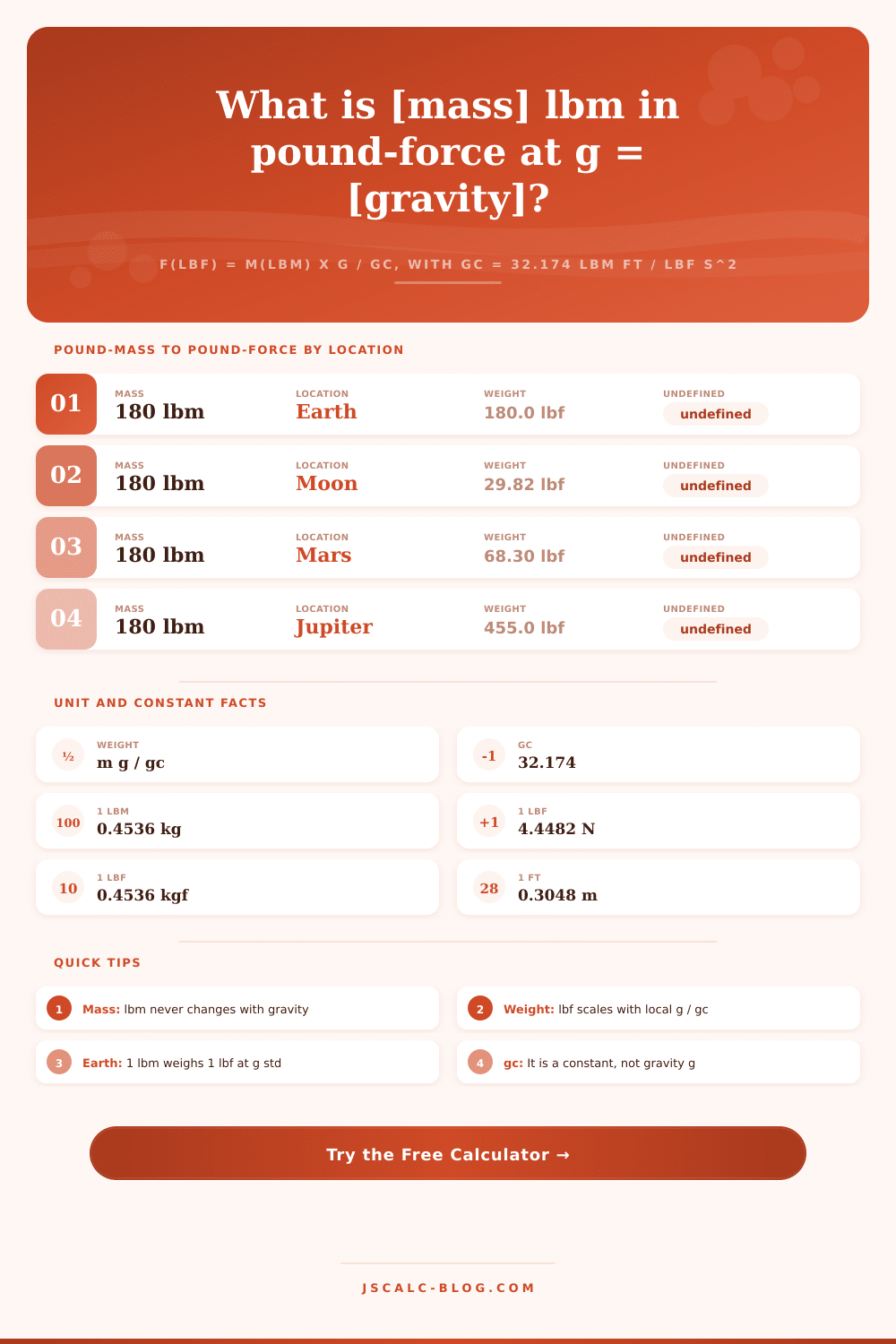
| On the Moon | 180 lbm stays 180 | Drops to 29.82 lbf | Same mass, less weight |
| SI counterpart | Kilogram (kg) | Newton (N) | Distinct base units |
| Uses gc | Defines gc bridge | F = m g / gc | gc = 32.174 |
| At Earth standard g | 1 lbm | Equals 1.000 lbf | Numeric 1:1 tie |
🗃Weight Across Worlds Comparison Grid
| Mass (lbm) | Earth (lbf) | Moon (lbf) | Mars (lbf) | Jupiter (lbf) | Earth (N) |
|---|---|---|---|---|---|
| 1 | 1.000 | 0.166 | 0.379 | 2.528 | 4.448 |
| 10 | 10.00 | 1.657 | 3.794 | 25.28 | 44.48 |
| 50 | 50.00 | 8.285 | 18.97 | 126.4 | 222.4 |
| 100 | 100.0 | 16.57 | 37.94 | 252.8 | 444.8 |
| 150 | 150.0 | 24.85 | 56.91 | 379.2 | 667.2 |
| 200 | 200.0 | 33.14 | 75.88 | 505.6 | 889.6 |
| 500 | 500.0 | 82.85 | 189.7 | 1264 | 2224 |
⚙Formula Breakdown
💡Engineering Units Tips
I bet you never give any thought to what you weigh when you step onto a bathroom scale. The scale spits out a number and you simply take it for granted.
But this simplicity masks an important distinction: matter and force. Your body consist of a certain amount of matter. How strongly gravity pulls on that matter is measured by pound-force. How much matter there is in your body are measured by pound-mass. These two quantities is often confused. After all, they both go by the name pound in day-to-day America, leading to confusion in the worlds of physics and engineering.
Mass and Weight Are Not the Same
The calculator divides them. Using the true value of gravitational constant, it converts pound-mass into pound-force so you can see how one quantity change while the other stay the same.
In the US customary system, however, it mashes mass and force together. Something the metric system doesn’t do. In the metric system there’s mass, which is measured in kilograms, and there’s force, which is measured in newtons. They’re different things. In the US customary system, pounds could be mass or it could be force. Sometimes you know which one. But sometimes you don’t. And when building rockets or structures, that ambiguity are problematic. Not so much at the store.
When you put your numbers into the calculator, it figures out what to do with them. It wipes away all uncertainty about which number goes where. It demonstrates that no matter where you are in solar system, mass never changes. Only weight, which is based off local gravity.
This simple tool has a simple formula that many misunderstand. The formula is force = (mass)*(acceleration due to gravity)/gc. Standard units include constant, gc. This constant equals 32.174, making one pound-mass the same as one pound-force on Earth’s surface. This is simply a coincidence of definition and not a universal law.
Many people confuse this constant with gravity. They are different, and the constant doesn’t vary from place to place; it only aligns the numbers on Earth’s surface. The tool separate the two so you don’t get your units wrong when cancelling out in non-standard environments.
An astronaut with a 180-pound bodyweight on Earth has 180 lbm of mass. When transported to the Moon, he still has 180 lbm of mass. He did not shed any atoms. But he does weighs only about 30 lbf (because the Moon’s gravity is lower). The calculator lets you choose various planets to illustrate this. The same mass create different forces on Jupiter versus Mars, etc.
When engineers report how much cargo is aboard a spacecraft, it’s always expressed in terms of mass units. Why? Because mass doesn’t change; it stays the same. Whether or not you’re on Earth, it affects your fuel calculation and inertia. Weight. That’s simply a local condition.
If you’re working with certain altitudes or elevations, you can also manually enter custom gravity values into the tool. Yes, gravity does actualy decrease a little the farther out you get from the center of the earth, which means that at the top of Everest, you weigh a bit less then you do at sea level.
You can manually enter gravitational acceleration in either meters or feet per second squared. It will then provide results in both kilograms (alongside your initial mass) and in newtons, pounds-force, and kilogram-force. That way you can cross reference results from multiple sources on this screen, to ensure you’re not accidentally comparing things like pound-force against pound-mass, for example.
But what if you already have one of those (force) and want to calculate the other (mass)? For that case, there’s a back-solve mode too. Here it reverses the equation, dividing force by local gravity to get the matter content. This can be used to check sensor data or interpret scale readings in variable environments.
Those results is presented clearly in the interface. It shows that values change from world to world, but the kilogram value stay the same. That’s the anchor. Mass is the real measure of matter. Weight is just the context given by gravity. That’s important to keep in mind, so we don’t start designing rockets based solely on how much they weigh, rather than how heavy they actualy are.
This also applies when working with spring, for example. The device forces us to split them apart. To realize they aren’t the same thing. Gravity transforms mass into weight, but it doesn’t change one into the other. Instead, it multiplies. And it does so on every object that enters its gravitational field.
When you hop on the scale next, remember that the value will change if you are on another planet, but your mass stays the same. You should of used a calculator earlier to see this.