HSR DPS Calculator
Estimate Honkai: Star Rail hit damage from total ATK, skill multiplier, crit rate and crit damage, elemental DMG bonus, DEF shred, enemy level, RES penetration, and vulnerability using the accurate multiplicative damage model.
🌟Real Build Presets
📝Damage Inputs
Final ATK including relics, cone, and team buffs.
Ability scaling, e.g. 250% at max level.
Sum of DMG% type buffs on this hit.
Combined DEF reduction and DEF ignore.
After RES PEN. Negative means weakness.
Debuffs that raise DMG the enemy takes.
Unbroken enemies take a 10% DMG reduction on some hits.
Used for total rotation damage estimate.
🔢Damage Line Snapshot
🎯Crit Ratio Guidance (1 : 2)
| Crit Rate | Ideal Crit DMG | Ratio | Crit Avg Mult | Notes |
|---|---|---|---|---|
| 50% | 100% | 1 : 2 | 1.50× | Early relic floor |
| 60% | 120% | 1 : 2 | 1.72× | Solid mid game |
| 70% | 140% | 1 : 2 | 1.98× | Common target |
| 70% | 180% | 1 : 2.6 | 2.26× | Crit DMG cone bonus |
| 80% | 160% | 1 : 2 | 2.28× | Well-tuned build |
| 90% | 200% | 1 : 2.2 | 2.80× | Endgame ceiling |
| 100% | 240% | 1 : 2.4 | 3.40× | Guaranteed crit |
📦DMG Bonus Type Reference
| Source | Typical Value | Line | Stacks With | Note |
|---|---|---|---|---|
| Body relic main | +38.8% Elem | DMG bonus | All DMG% | Matches your element |
| Planar orb main | +38.8% Elem | DMG bonus | All DMG% | Or ATK% orb instead |
| 4pc set effect | +10% to 24% | DMG bonus | All DMG% | Often conditional |
| Light cone | +18% to 40% | DMG bonus / ATK | All DMG% | Read the passive |
| Support buff | +12% to 48% | DMG bonus | All DMG% | Team DMG boosts |
| Trace passive | +8% to 28% | DMG bonus | All DMG% | Ability-type bonus |
🛡DEF Shred Effect
| DEF Reduction | DEF Mult (Lv80 vs 85) | DMG vs 0% Shred | Typical Source | Note |
|---|---|---|---|---|
| 0% | 0.656× | Baseline | None | Full enemy DEF |
| 10% | 0.681× | +3.8% | Trace / cone | Small gain |
| 20% | 0.707× | +7.8% | Support debuff | Noticeable |
| 28% | 0.730× | +11.2% | Silver Wolf style | Strong shred |
| 40% | 0.766× | +16.8% | Stacked debuffs | Large gain |
| 52% | 0.804× | +22.6% | Shred + ignore | Near ceiling |
🧪RES and Vulnerability Reference
| Enemy RES | RES Mult | Vulnerability | Vuln Mult | Combined |
|---|---|---|---|---|
| -20% (weak) | 1.20× | 0% | 1.00× | 1.20× |
| 0% | 1.00× | 0% | 1.00× | 1.00× |
| 0% | 1.00× | 10% | 1.10× | 1.10× |
| 20% | 0.80× | 0% | 1.00× | 0.80× |
| 20% | 0.80× | 18% | 1.18× | 0.94× |
| 40% (resist) | 0.60× | 0% | 1.00× | 0.60× |
🗂Build Comparison Grid
| Build | ATK | Skill % | Crit R / D | DMG Bonus | DEF Shred | RES / Vuln |
|---|---|---|---|---|---|---|
| Hypercarry DPS | 3600 | 280% | 75 / 190 | 78% | 20% | 0% / 14% |
| Crit Build | 3200 | 250% | 90 / 220 | 60% | 0% | 0% / 0% |
| DoT Build | 4000 | 210% | 10 / 60 | 85% | 0% | 0% / 10% |
| Ultimate Damage | 3400 | 420% | 72 / 175 | 70% | 10% | 0% / 0% |
| Follow-Up | 3300 | 200% | 78 / 165 | 72% | 0% | 0% / 12% |
| Break Effect | 3000 | 180% | 5 / 50 | 40% | 0% | 0% / 0% |
| DEF Shred | 3100 | 250% | 68 / 150 | 62% | 45% | 0% / 0% |
| Vulnerability | 3250 | 250% | 70 / 170 | 65% | 0% | 0% / 30% |
⚙Full Formula Breakdown
📋Input Reference Values
| Input | Common Range | How It Is Used | Damage Effect |
|---|---|---|---|
| Total ATK | 2600 to 4200 | Base = ATK × skill% | Linear with base damage |
| Skill multiplier | 120% to 460% | Scales base damage | Linear per hit |
| Crit rate | 50% to 100% | Feeds crit average | Higher expected damage |
| Crit damage | 100% to 260% | Feeds crit average | Bigger crit hits |
| DMG bonus | 38% to 120% | 1 + bonus% line | Direct multiplier |
| DEF shred + ignore | 0% to 55% | Lowers enemy DEF | Raises DEF multiplier |
| Enemy level | 80 to 95 | DEF mult denominator | Higher level cuts damage |
| RES / vulnerability | -20% to 40% / 0% to 33% | Own multiplier lines | Scale final damage |
💡Practical HSR Damage Tips
If you find Honkai: Star Rail’s 20% defense shred feels like a bigger improvement then its 10% boost to attack, that might stem from how you think about damage stats. They’re just numbers, right? In reality, they’re calculated via complex multiplicative lines rather than additive pools, that makes it hard for players to find signal from noise, which is where a serious DPS calculator enters the picture.
Attack is the first stat on any character sheet so when new players look at it, they tend to think that’s the “biggest” stat. Why? Because it’s simple: it adds linearly to your base multiplier. In reality, though, there are diminishing returns once your total attack reach a certain point. The calculator do all this math for you, showing how every stat affect your eventual hit value. Plug in your numbers and observe as things change.
How Stats Multiply Your Damage
Beyond attack, the next line to understand is the skill multiplier. The skill multiplier is a percentage that represent how much of your attack will be converted to damage pre-buffs and pre-resistances. If you have high attack but then use an ability that has a lower scaling coefficient, it doesn’t matter as much. People tend to forget about this when comparing characters blindfolded. Take into account what the raw stat is paired with and which move you plan on using in battle.
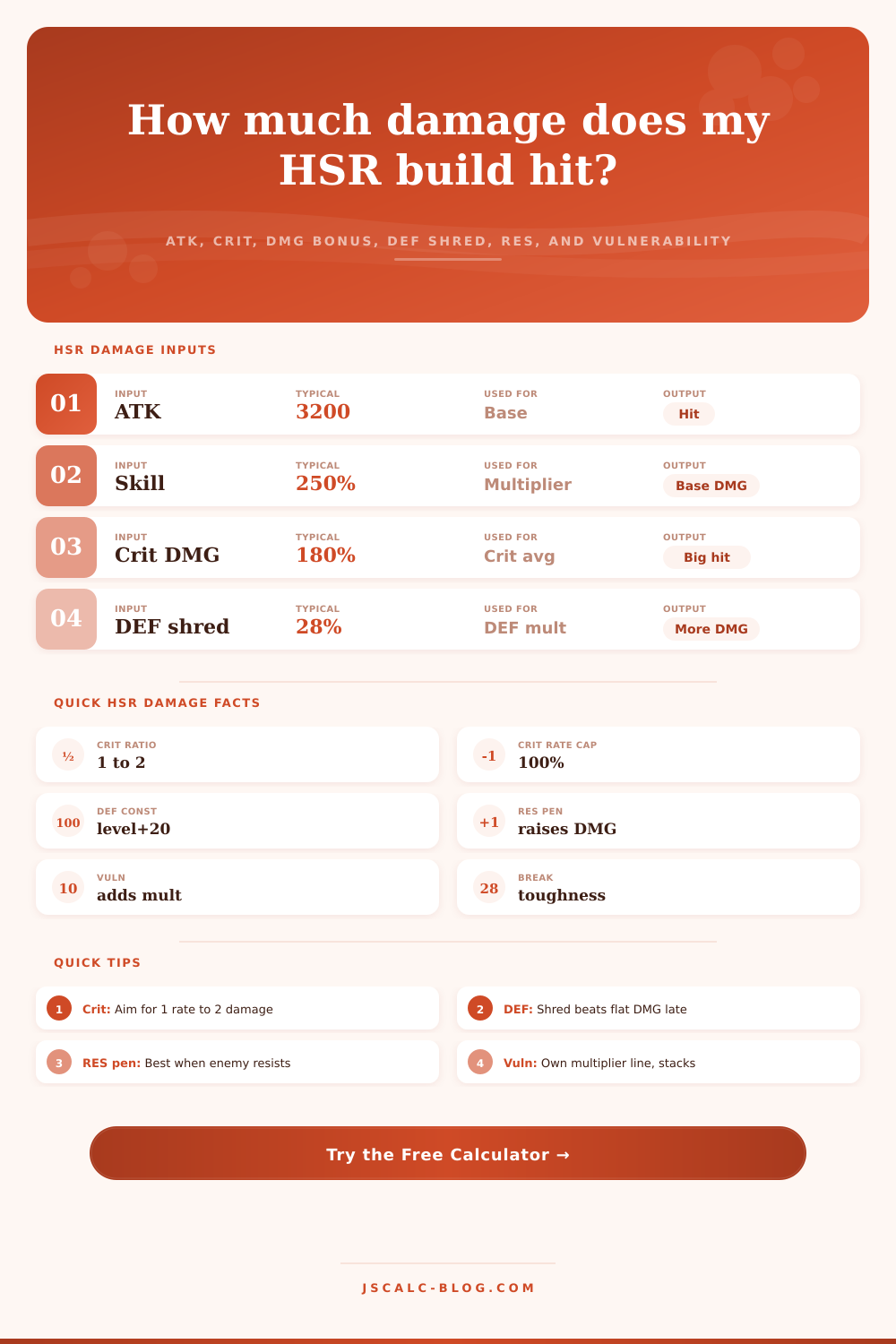
Until you nail the crit equation it can feel more like a lottery. Generally, the golden rule is that crit rate should of be half of your crit damage. If you increase both stats by five percent, you will see an equal increase in your average expected damage as long as you keep the ratio the same. This means that you’re not using all of the possible damage if you have, say, ninety percent crit rate with only eighty percent crit damage. As you move the sliders around when deciding how to roll relics, the tool visualizes this trade off.
The most misinterpreted stat is probably defense shred, since it decreases the amount of damage absorbed and doesn’t add damage straight to target. By the end game, enemies sport huge amounts of defense which will split your damage in half if unadjusted for. Cutting down their defense by 20% may seem minor, but it actualy multiplies your damage much higher than a comparable raw attack buff at higher levels. It’s less about hitting them harder and more about taking away the protection that prevents your punch from hurting them.
Likewise, vulnerability buffs and elemental damage bonuses are multiplicative, too. These also gets added together in their respective lines. Whatever amount of crit or attack you have, the total amount get multiplied by however many multipliers is there in your build. This is where people frequently err: going all-out on a stat that’s maxed out but neglecting an additional line of multipliers that’s sitting at 0. Ten percent of one hundred percent of damage isn’t as good as ten percent of no percent of vulnerability. Having many different multiplier lines tends to be better than focusing on one stat.
Resistance penetration works inversely to defense shred, negating the enemy’s ability to resist your specific element. If an enemy is highly resistant to an element you deal without a teammate such as Yukong or Silver Wolf applying their vulnerability debuff, your damage will drop through the floor. You can plug in enemy resistance values, along with any support buffs from other players, into the calculator, which shows just how much a character’s performance rely on their party composition.
To get the most out of your builds in Honkai: Star Rail, think less in terms of numbers and more in layers. Your goal isn’t just to find highest number on a relic. You want to string together all those elements; attack, scaling, crit chance, elemental amplification, defense mitigation, and resistance handling, into a unified plan. If you can understand how each piece fits into the greater whole, the road to increased damage reveals itself. That understanding of multipliers will help improve your build, while the calculator helps reinforce that learning through the feedback loop. Continue experimenting with various combo until the math fit your playstyle. Know that balancing a mix of multipliers tends to perform better over time than stuffing a bunch of raw statistcs.