Hours to Minutes Converter
Convert decimal hours, hours:minutes text, workdays, or workweeks into exact and rounded minutes using minutes = hours × 60.
⚡Quick Presets
🔢Converter Inputs
Examples: 0.25, 1.5, 7.75, 40.
Accepts 2:30, 02:30, 2h 30m, or 90m.
Extra minutes can be more than 59; they are normalized.
Used only for workday and workweek modes.
📊Conversion Results
🧭Live Comparison Grid
📌Conversion Factor Cards
📐Formula Method
📋Reference Tables
| Hours | Minutes | HH:MM | Common use |
|---|---|---|---|
| 0.1 | 6 | 0:06 | Time tracking tenth |
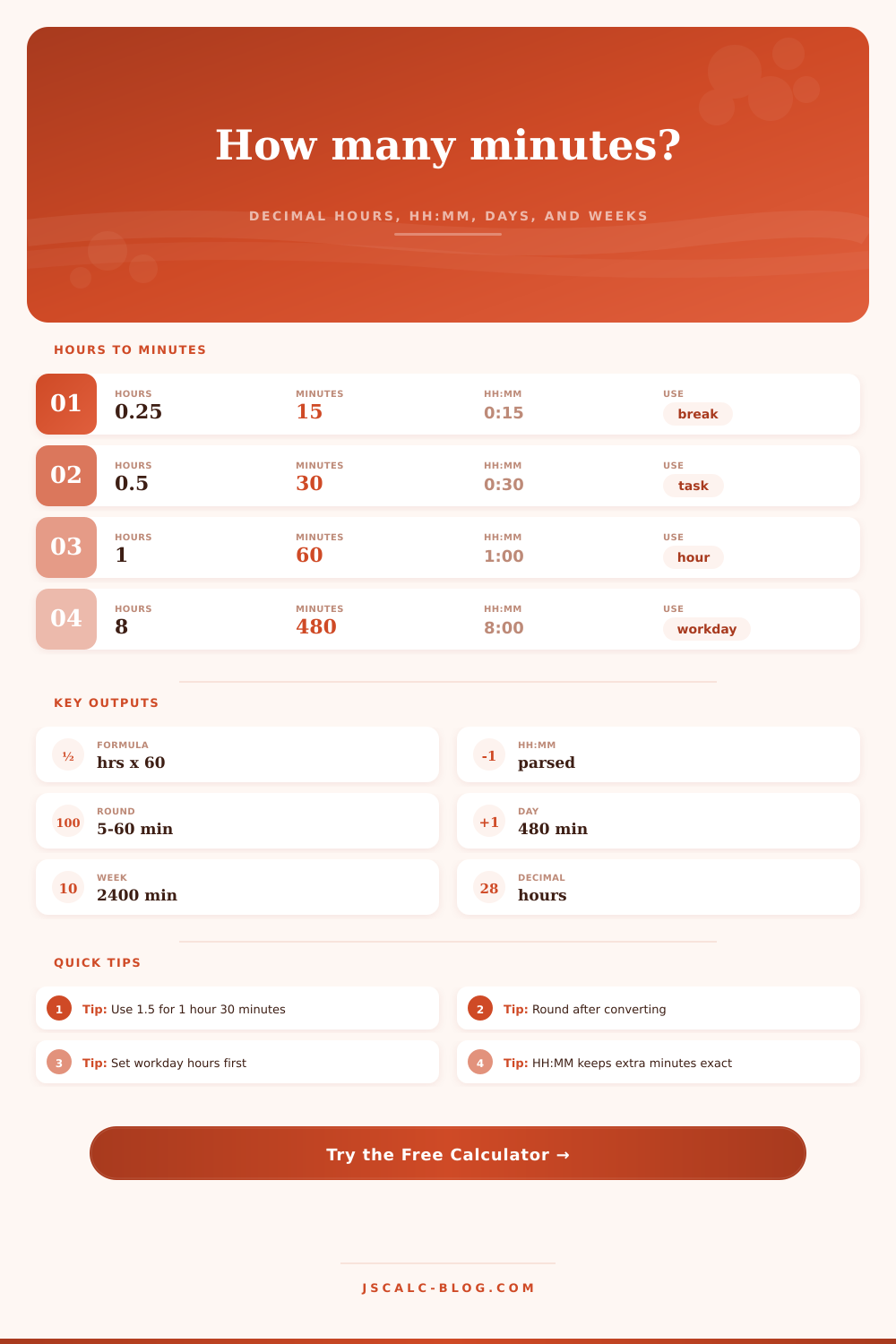
| 0.25 | 15 | 0:15 | Short break |
| 0.5 | 30 | 0:30 | Half hour |
| 0.75 | 45 | 0:45 | Class block |
| 1 | 60 | 1:00 | One hour |
| 1.5 | 90 | 1:30 | Workshop |
| 2 | 120 | 2:00 | Focus session |
| 8 | 480 | 8:00 | Workday |
| Decimal | Minutes | Fraction | Read as |
|---|---|---|---|
| 0.0167 | 1 | 1/60 hr | One minute |
| 0.0833 | 5 | 1/12 hr | Five minutes |
| 0.1667 | 10 | 1/6 hr | Ten minutes |
| 0.3333 | 20 | 1/3 hr | Twenty minutes |
| 0.6667 | 40 | 2/3 hr | Forty minutes |
| 1.25 | 75 | 1 1/4 hr | One hour fifteen |
| 1.75 | 105 | 1 3/4 hr | One hour forty-five |
| 2.5 | 150 | 2 1/2 hr | Two hours thirty |
| Input style | Example | Hours used | Minutes |
|---|---|---|---|
| Decimal hours | 3.25 | 3.25 | 195 |
| HH:MM | 3:15 | 3.25 | 195 |
| Text duration | 3h 15m | 3.25 | 195 |
| Minutes text | 195m | 3.25 | 195 |
| Parts | 3 hr + 15 min | 3.25 | 195 |
| Workday | 1 x 7.5 hr | 7.5 | 450 |
| Workweek | 5 x 8 hr | 40 | 2400 |
| With breaks | 5 x 8 hr - 30 | 37.5 | 2250 |
| Rounding | Exact | Nearest | Use case |
|---|---|---|---|
| 1 minute | 83.4 | 83 | Exact logs |
| 5 minutes | 83.4 | 85 | Scheduling |
| 6 minutes | 83.4 | 84 | Tenth-hour billing |
| 10 minutes | 83.4 | 80 | Planning blocks |
| 15 minutes | 83.4 | 90 | Quarter-hour time |
| 30 minutes | 83.4 | 90 | Calendar blocks |
| 60 minutes | 83.4 | 60 | Whole hours |
| No rounding | 83.4 | 83.4 | Formula check |
💡Converter Tips
There are 60 minutes in an hour. Easy stuff right? But what happen when you want to break your hour down further for scheduling or billing? What about trying to squeeze in a meeting prior to lunch?
Time can be flexible. But even with time flexibility, math around time isn’t flexible. Translating hours to minutes is easy enough until the stress hit and you need to get it accuratey. Decimal hours are hard for most of us because we’re hard-wired to think about time in terms of clocks, not fractions.
How to Convert Decimal Hours to Minutes
When you look at your timesheet entry of 1.5 hours, you thinks “Oh yeah, that’s right, 90 minutes.” Good for you. But when you look at 1.25 hours, what do you see? Twenty-five minutes? Wrong! That’s seventy-five minutes. How come? Because, in the world of decimals, hour itself counts as a whole. The.25 is a fraction of an hour, specifically one-quarter of an hour. Your brain doesn’t work that way but the calculator does, and it saves you from making dumb math mistakes.
Payroll systems talks in decimals, not mixed fractions. There’s one more wrinkle: Workday calculations. Not all time spent on an eight-hour shift counts as billable time. If you have a half-hour unpaid break, then you’ve only worked four hundred and fifty minutes. But that number add up fast if you’re trying to keep tabs on your output week to week. You can account for break minutes with the tool, and it’ll show you how much time you’re actualy spending being productive. And that will highlight the difference between your company’s theoretical capacity and its actual output. At a cost to the business.
And then it gets complicated with rounding. Maybe you round up when scheduling to allow a bit more of a buffer between bookings? Or maybe you round down in your billing because of some type of compliance with labor laws? The converter allows you to specify the rounding increment… If you want to round to the nearest five minutes like most scheduling do, you can do that. If you’re doing some big-picture planning and need a block of time in tenths of hours (like 10 minutes), you could do that too. It depends on what kind of business you’re in. If you’re a marketing consultant, you may bill out by the half hour, but a surgeon require minute accuracy.
What’s easy to overlook is that time management works on unit as small as minutes. Seconds aren’t small enough to manage most tasks. An hour isn’t detailed enough for planning your day. A minute, however, find the sweet spot between flexibility and precision. Translating a 40-hour work week into two-thousand-four-hundred minutes reframes your workload from an abstract idea into a measurable resource. Those minutes can be applied clearly towards meetings and project.
Consistency, however, is where this gets valuable. Remove the confusion by always converting it the same way. If you say a project will require 0.75 hours, your client understands exactly what you mean. There is no misunderstanding. There is no lack of trust.
Next time you find yourself staring at a decimal hour on clock, don’t fret, the math is easy. Just figure out which piece of the clock you’re viewing.