Horsepower Calculator by Parts
Estimate how much crank horsepower your intake airflow and fuel injectors can actually support. The lower of the two limits caps your build, so match air and fuel to the target number.
🏎Real Build Presets
🔧Part Inputs
Carb rating or throttle body / head flow at test pressure.
Street builds stay near 80–85% to keep control.
Lower BSFC means the fuel makes more power per pound.
🔢Formula Snapshot
⚙Full Formula Breakdown
📊Injector cc to HP Comparison
| Injector cc/min | lb/hr each | 8-cyl total at 85% | HP at 0.50 BSFC | HP at 0.60 BSFC |
|---|---|---|---|---|
| 250 cc | 24.1 | 163.9 | 328 | 273 |
| 340 cc | 32.8 | 223.1 | 446 | 372 |
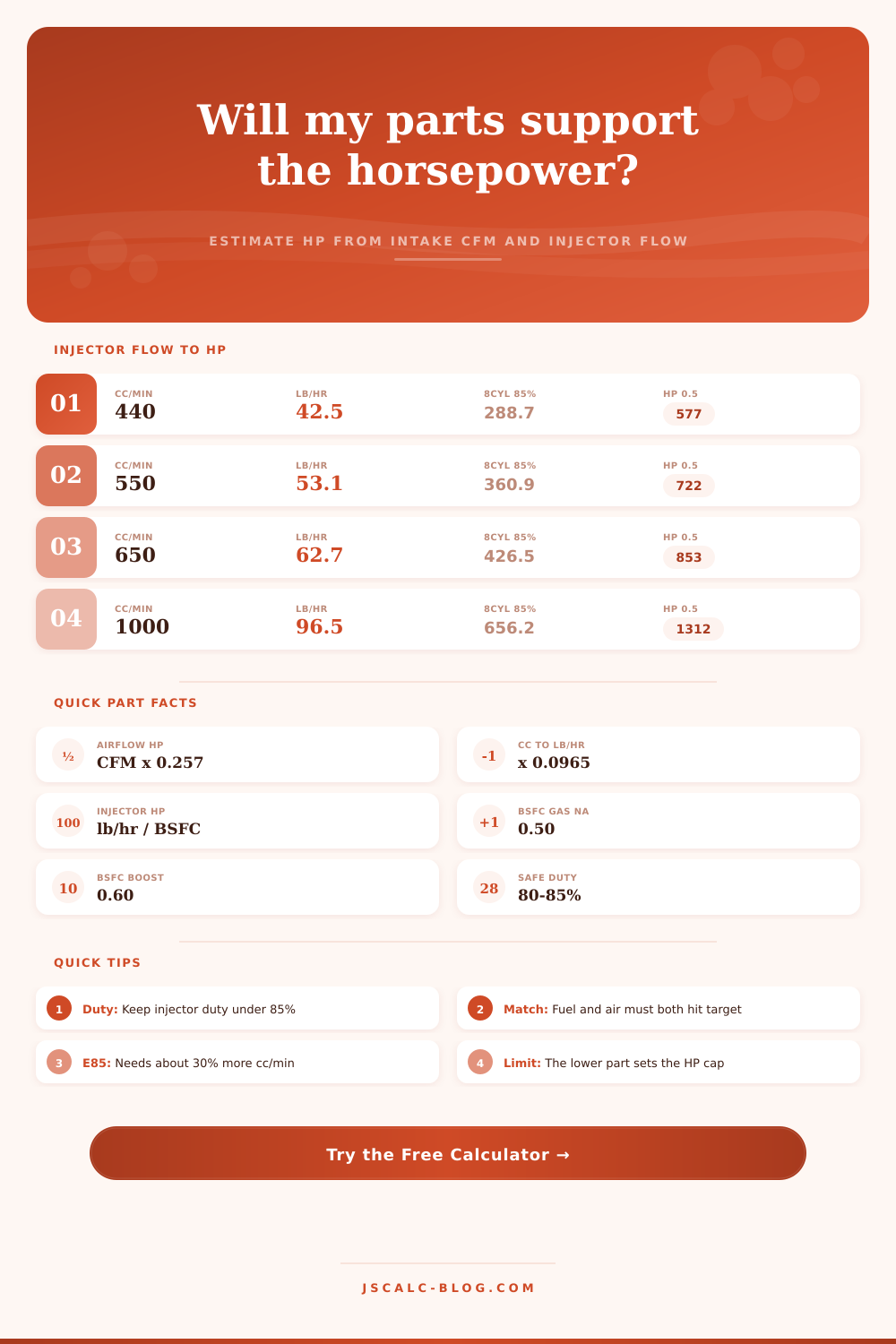
| 440 cc | 42.5 | 288.7 | 577 | 481 |
| 550 cc | 53.1 | 360.9 | 722 | 602 |
| 650 cc | 62.7 | 426.5 | 853 | 711 |
| 750 cc | 72.4 | 492.2 | 984 | 820 |
| 850 cc | 82.0 | 557.8 | 1116 | 930 |
| 1000 cc | 96.5 | 656.2 | 1312 | 1094 |
| 1300 cc | 125.5 | 853.1 | 1706 | 1422 |
| 1600 cc | 154.4 | 1049.9 | 2100 | 1750 |
Values use gasoline density 0.0965 lb/cc, 8 injectors, and 85% duty. Divide totals by 2 for a 4-cylinder or scale by injector count.
💨CFM to Horsepower Guide
| Intake CFM | NA HP (× 0.257) | Divide by 1.46 | Typical Use |
|---|---|---|---|
| 390 CFM | 100 hp | 267 hp | Small 2-barrel carb |
| 500 CFM | 129 hp | 342 hp | Economy small block |
| 600 CFM | 154 hp | 411 hp | Mild small block V8 |
| 650 CFM | 167 hp | 445 hp | Street 350 build |
| 750 CFM | 193 hp | 514 hp | Performance carb V8 |
| 850 CFM | 218 hp | 582 hp | Big cam, larger cube |
| 1000 CFM | 257 hp | 685 hp | Race carb / big block |
The 0.257 factor is a conservative NA estimate. The CFM / 1.46 column trends higher and is common for peak flow-bench math.
📋BSFC and Duty Reference
| Setup | Typical BSFC | Safe Duty | Notes |
|---|---|---|---|
| NA gasoline | 0.45 – 0.50 | 80 – 85% | Efficient, well tuned engine |
| Turbo gasoline | 0.55 – 0.65 | 80 – 85% | Richer under boost for safety |
| Supercharged | 0.58 – 0.65 | 80 – 85% | Heat load raises fuel demand |
| Nitrous | 0.55 – 0.60 | 80 – 85% | Extra fuel enrichment on spray |
| E85 blends | 0.60 – 0.70 | 80 – 85% | Needs about 30% more flow |
💡Practical Part Tips
When building a high-horsepower car you drop serious coin on horsepower and don’t get anywhere near what you expect. You purchase big injectors to push more power out of motor but then your intake manifold have little runners so it’s choked down. Or maybe you put a huge throttle body in there to get air into the thing but your fuel system can’t catch up with it. One piece of the puzzle limits the whole thing and the engine run lean, knocks, or flatlines at wide-open throttle.
It is less about what sounds cool on paper and more about what will become a bottleneck and hurt performance in the track. You don’t get more horsepower from one thing… It’s a combination of both fuel and air. For example, if you have five-hundred horsepower injectors but an intake that can handle eight-hundred horsepower, then you won’t be able to go past five-hundred horsepower. The weakest link limit the total amount. Upgrade until you figure out what piece of equipment is restricting you.
How to Match Air and Fuel for More Power
All you need to do is plug in specs on your injectors and the number of cfm you want to pull through them. Then press the button and the calculator takes care of the rest. No more guessing if all your stuff match.
Most builders look at CFM as if it were a direct measure of power, but it isn’t quite that simple. That’s not the complete story. Intake air is potential energy waiting to be used. It has to be converted to mass and then it need to be paired up with molecules of fuel. That’s where the tool comes into play. It converts air to mass and pairs it with the right amount of fuel, while considering how a naturaly aspirated engine breathes when running under load.
So that’s airflow. Now let’s talk about fuel delivery. Injectors don’t work in a vacuum. They also has limits. Specifically, each has a duty cycle which is the amount of time it is open as a percentage. If you run an injector with a one-hundred-percent duty cycle, then it’s open all the time. If you push the throttle more or go uphill, you won’t be able to get a reaction from engine computer. To safely use an injector it must be kept below eighty-five percent duty cycle. Using the calculator you can define what this limit is and observe how many horsepower your injectors will handle before running dry.
Your fuel choice is another factor that plays into this. For example, E85 and other ethanol-based fuels contain less energy than gas and must be fed at higher volumes to get same amount of power. Ethanol absorbs heat. That’s great because it doesn’t knock as much, but it requires almost 30 percent more injector flow. Switching fuels without upgrading can cause a huge decrease in estimated horsepower. Because the tool factors in those density changes, you won’t accidently starve the motor by neglecting to account for fuel type.
There are other variables such as brake specific fuel consumption (BSFC). That’s the amount of fuel in pounds that an engine burns to create one horsepower over an hour. Turbocharged tends to be around 60% less efficient and hotter, which means it will burn at least.6 lb/hr per hp while a NA is typically.5lb/hr. So even if two engines has the same injectors they won’t have equal power output. The calculator takes this into account and corrects for efficiency differences so what you see on paper is what realy happens.
Assembling an engine is like putting together a chain; it is only as strong as its weakest link. Whether the weak part is your fuel pressure regulator, injector capacity, or your throttle body isn’t important. The key is knowing where the weakness is so you don’t should of go spending some money fixing it. These are numbers you want to know before firing up engine in order to find the air/fuel balance.