Camshaft Horsepower Calculator
Estimate the peak-horsepower RPM, the usable power band, and a volumetric-efficiency airflow horsepower figure from cam duration at .050, lobe separation angle, valve lift, and displacement. This is an educational model, not a dyno pull.
🔧Real Camshaft Presets
📝Cam & Engine Inputs
Advertised duration is larger. Use the .050 number for the RPM model.
Tighter 106-108 = choppier idle, more mid-range. Wider 112-114 = smoother.
Stock ~80-88, ported ~90-100, race/boost 100-125.
🔢Model Snapshot
These are the constants used by the empirical model below. Real peak RPM also depends on heads, intake, bore/stroke, and exhaust, so treat every number as a starting estimate rather than a guaranteed dyno result.
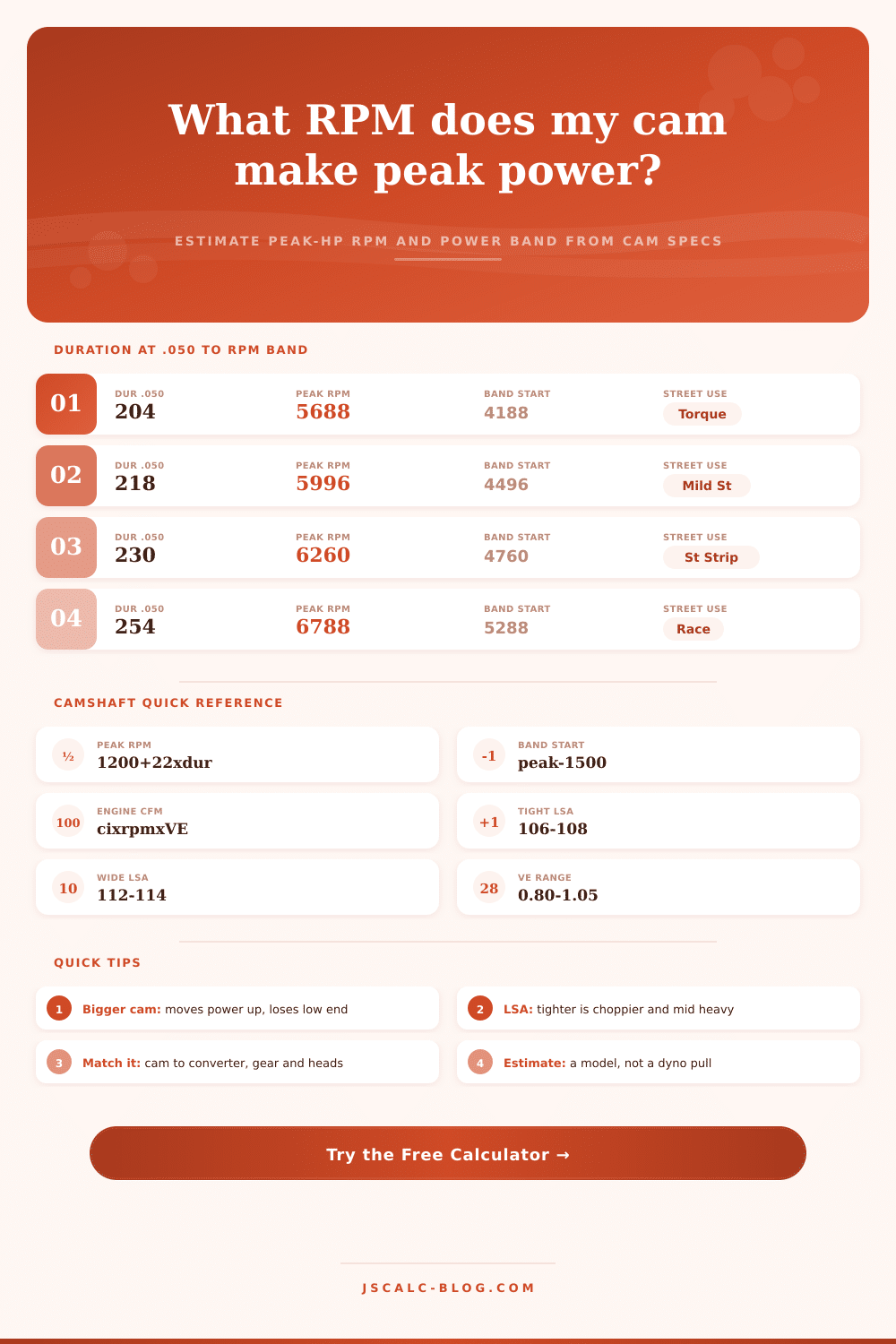
📈Duration to RPM Band Guide
| Intake .050 | Peak-HP RPM | Band Start | Idle | Best Use |
|---|---|---|---|---|
| 200° | 5,600 | 4,100 | Smooth | Stock / economy |
| 210° | 5,820 | 4,320 | Smooth | Towing / RV torque |
| 218° | 6,000 | 4,500 | Slight lope | Mild street |
| 224° | 6,130 | 4,630 | Noticeable | Street performance |
| 230° | 6,260 | 4,760 | Choppy | Street / strip |
| 236° | 6,390 | 4,890 | Rough | Weekend bracket |
| 244° | 6,570 | 5,070 | Very rough | Serious strip |
| 254° | 6,790 | 5,290 | Race only | Drag / circle |
| 260° | 6,920 | 5,420 | Race only | Peak-RPM race |
🔄Lobe Separation Angle Effect Guide
| LSA | Overlap | Idle Vacuum | Idle Character | Power Trait | Typical Use |
|---|---|---|---|---|---|
| 106° | High | Low | Very choppy | Sharp mid-range hit | Small NA drag |
| 108° | High | Low | Choppy lope | Strong mid, peaky | Street strip NA |
| 110° | Medium | Fair | Moderate lope | Balanced spread | All-around street |
| 112° | Lower | Good | Mild lope | Broad, smoother | Daily / mild boost |
| 114° | Low | High | Near stock | Wide, gentle | Towing / big boost |
| 116° | Very low | High | Smooth | Very broad | Turbo / diesel-like |
🏁Cam Type by Use
| Cam Type | Int .050 | LSA | Lift | RPM Band | Best Match |
|---|---|---|---|---|---|
| Stock replacement | 195-205° | 112-114° | .400-.440 | 1,000-5,000 | Stock converter, tall gear |
| RV / torque | 204-212° | 110-112° | .440-.480 | 1,500-5,200 | Truck, tow, 3.08-3.42 |
| Mild street | 214-220° | 110-112° | .480-.520 | 2,200-5,800 | 2,200 stall, 3.42-3.73 |
| Street / strip | 222-232° | 108-110° | .520-.560 | 3,000-6,300 | 3,000 stall, 3.73-4.10 |
| Bracket race | 234-244° | 108-110° | .560-.620 | 3,800-6,800 | 3,800 stall, 4.10-4.56 |
| Solid roller race | 250-262° | 106-110° | .620-.750 | 4,500-7,500 | Loose stall, deep gear |
| Boost / turbo | 216-228° | 112-116° | .500-.580 | 2,500-6,500 | Wide LSA, less overlap |
💨Volumetric Efficiency by Build
| Build Level | VE % | Heads / Intake | Notes |
|---|---|---|---|
| Worn / stock economy | 75-82% | Stock, restrictive | Low peak airflow |
| Healthy stock | 82-88% | Stock ports, good seal | Typical daily driver |
| Ported / bolt-on | 88-95% | Ported heads, better intake | Well-matched street |
| Race NA | 95-105% | CNC heads, single plane | Tuned runners help |
| Boosted street | 100-115% | Forced induction | Manifold pressure adds air |
| Big boost race | 115-130% | High-PSI turbo | Density well above 1 atm |
🗂Camshaft Comparison Grid
| Cam | Int .050 | LSA | Peak RPM | Band Start | Idle | Use Case |
|---|---|---|---|---|---|---|
| Stock 350 | 195° | 112° | 5,490 | 3,990 | Smooth | Daily commuter |
| RV Torque 204 | 204° | 112° | 5,690 | 4,190 | Smooth | Tow / haul |
| Mild Street 218 | 218° | 110° | 6,000 | 4,500 | Light lope | Cruiser + fun |
| Street Strip 224 | 224° | 110° | 6,130 | 4,630 | Noticeable | Weekend warrior |
| Pro Touring 230 | 230° | 110° | 6,260 | 4,760 | Choppy | Corners + strip |
| Big Block 236 | 236° | 110° | 6,390 | 4,890 | Rough | Big-inch torque |
| Turbo 218 Wide | 218° | 114° | 6,000 | 4,500 | Mild | Boosted street |
| Drag 260 Tight | 260° | 106° | 6,920 | 5,420 | Race only | All-out drag |
| Solid Roller 254 | 254° | 108° | 6,790 | 5,290 | Race only | High-RPM race |
⚙Full Model Breakdown
Dimensional check: displacement (in³) × RPM (rev/min) ÷ 3456 yields cubic feet per minute of air; multiplying by the empirical 0.72 HP-per-CFM factor returns horsepower. Values are held to realistic ranges but remain estimates.
💡Camshaft Selection Tips
Nothing happened. Well, sorta…something did happen, but it wasn’t the rush of power you were expecting. You turn the key and engine coughs, idles like a dog, and when you hit throttle, it sputters out again. A camshaft mismatch cost more money than folks realize because they chose specs by sound instead of science. That big cam sounds fast in the catalog, but that catalog doesn’t know what’s behind you, the rear gear ratio or your daily commute. Before you go tearing apart an engine block, find out where power really lives.
So what does this all mean? Raw metal specs aren’t very useful; we need to put them into terms that apply to us; specifically in terms of RPM bands. For example, intake duration at.050 inch lift means much more then advertised duration. That.050 number represent the length of time the valve remains open sufficiently to actualy let air flow. A fairly basic formula used by the calculator above take a base RPM and multiplies it by a factor of each degree of duration. You end up with a target peak horsepower RPM. It then computes a power band typically spanning about 1500 RPM below that peak. If you’re not regularly running higher than that bottom number, engine’s going to feel sluggish (that’s you, if you do a lot of your driving around town).
How to Pick the Right Camshaft for Your Engine
It’s some pretty straightforward math, but results is fixed. That power have different characteristics depending based off lobe separation angle. A tight angle, say 106 or 108 degrees, will has more overlap between the intake and exhaust valves, resulting in a sharper hit on the mid-range as well as a rougher idle. This is good for a drag car that must jump off the line.
A wider angle. Such as 112 or 114 degrees; smooths out the idle while broadening the power curve. If you’re towing a trailer or driving the car in traffic, that’s important. You’ll be giving away some peak numbers but gaining in usability. The calculator will adjust for this shift, moving estimated peak up or down slightly according to relationship between cylinder pressure and valve timing.
Airflow horsepower depend on both valve lift and displacement. Greater valve lift means greater air movement…but only if the duration support it. You can’t have a huge amount of lift on a short-duration cam; the valve would close before the cylinder could inhale enough air to make good use of that big puff. Volumetric efficiency factors in how well your intake manifold and heads is able to actualy move air. Stock heads may have an 80 percent efficiency rating, whereas ported race heads may reach 100 percent or higher with forced induction. It’s what keeps you from daydreaming about 600 hp when your cylinder head can really only support 400.
The other half of the package gets ignored to much by many builders. A camshaft doesn’t exist in a vacuum. It has to works with your rear axle gear ratio and torque converter stall speed. For example, if you install a race-type cam that likes higher RPM’s into a truck with tall gears, its power band will be located way up the rev range where it won’t be able to get the tires to turn fast enough to get engine turning those RPMs. That means you’ll never see those numbers on the dyno because you can’t get the engine to turn those RPMs necessary to unlock them.
The tool include reference tables that show typical uses for various duration ranges and help you visualize how they would work together. Anything beyond 240 degrees is generally reserved for racing while 218-degrees is about as good as you’re going to get for mild street performance. Cam choice is a compromise. You want enough duration to make power where you drive, but not so much that you lose vacuum and drivability everywhere else. A longer duration cam is easier to bolt on than to cut down. So take some time with the input. Plug in your actual numbers, consider the RPM band you get, and honestly ask yourself if you can really hit those RPMs in regular driving conditions. If not, back off. You should of checked this before installing.
We’re not trying to spec out a moddern monster for the mag cover here. We’re trying to create an engine that pulls ass when we need it and doesn’t run away from home when we don’t. That’s where the real horsepower is.