Boat Fuel Economy Calculator
Estimate marine fuel burn in gallons per hour, nautical miles per gallon, cruising range from your tank with reserve, and the fuel needed for a planned trip using real gas and diesel burn rates.
⚓Boat & Trip Presets
🛥Engine & Fuel Inputs
Used in estimate mode. Add both engines for twins.
Applied to the WOT burn in estimate mode.
Used in direct mode. Estimate mode overwrites this.
🧮Formula Snapshot
⛽Estimated GPH at Wide Open Throttle
| Engine HP | Gas WOT GPH | Diesel WOT GPH | Gas at 60% | Diesel at 60% |
|---|---|---|---|---|
| 40 HP | 3.3 GPH | 2.2 GPH | 2.0 GPH | 1.3 GPH |
| 90 HP | 7.5 GPH | 5.0 GPH | 4.5 GPH | 3.0 GPH |
| 150 HP | 12.4 GPH | 8.3 GPH | 7.5 GPH | 5.0 GPH |
| 250 HP | 20.7 GPH | 13.8 GPH | 12.4 GPH | 8.3 GPH |
| 300 HP | 24.9 GPH | 16.5 GPH | 14.9 GPH | 9.9 GPH |
| 450 HP | 37.4 GPH | 24.8 GPH | 22.4 GPH | 14.9 GPH |
| 600 HP | 49.8 GPH | 33.0 GPH | 29.9 GPH | 19.8 GPH |
| 700 HP | 58.1 GPH | 38.5 GPH | 34.9 GPH | 23.1 GPH |
🚤Typical Nautical MPG by Boat Type
| Boat Type | Cruise Speed | Cruise Burn | Nautical MPG |
|---|---|---|---|
| Pontoon 90HP | 18 kt | 4.5 GPH | 4.0 nmpg |
| Bass boat 150HP | 30 kt | 7.5 GPH | 4.0 nmpg |
| Center console 300HP | 25 kt | 15 GPH | 1.7 nmpg |
| Cruiser twin diesel | 22 kt | 28 GPH | 0.8 nmpg |
| Trawler single diesel | 8 kt | 3.5 GPH | 2.3 nmpg |
| Sailboat aux diesel | 6 kt | 0.8 GPH | 7.5 nmpg |
| Ski boat at WOT | 40 kt | 28 GPH | 1.4 nmpg |
| Offshore twin outboard | 28 kt | 42 GPH | 0.7 nmpg |
📈Speed vs Burn vs Range (100 Gallon Tank)
| Speed (kt) | Gas GPH | Nautical MPG | Range Full 100 gal | Range 1/3 Reserve |
|---|---|---|---|---|
| 6 kt | 3 GPH | 2.00 nmpg | 200 nm | 133 nm |
| 10 kt | 5 GPH | 2.00 nmpg | 200 nm | 133 nm |
| 18 kt | 9 GPH | 2.00 nmpg | 200 nm | 133 nm |
| 22 kt | 13 GPH | 1.69 nmpg | 169 nm | 113 nm |
| 25 kt | 15 GPH | 1.67 nmpg | 167 nm | 111 nm |
| 28 kt | 19 GPH | 1.47 nmpg | 147 nm | 98 nm |
| 32 kt | 24 GPH | 1.33 nmpg | 133 nm | 89 nm |
| 36 kt | 31 GPH | 1.16 nmpg | 116 nm | 77 nm |
| 40 kt | 40 GPH | 1.00 nmpg | 100 nm | 67 nm |
🗂The One-Third Fuel Rule
| Tank Size | 1/3 Outbound | 1/3 Return | 1/3 Reserve |
|---|---|---|---|
| 40 gal | 13.3 gal | 13.3 gal | 13.3 gal |
| 60 gal | 20 gal | 20 gal | 20 gal |
| 100 gal | 33.3 gal | 33.3 gal | 33.3 gal |
| 150 gal | 50 gal | 50 gal | 50 gal |
| 200 gal | 66.7 gal | 66.7 gal | 66.7 gal |
| 300 gal | 100 gal | 100 gal | 100 gal |
⚙Full Formula Breakdown
📋Marine Fuel Reference Values
| Item | Common Range | How It Is Used | Effect on Range |
|---|---|---|---|
| Gas WOT factor | 0.08 to 0.09 per HP | HP × factor = WOT GPH | Higher factor lowers range |
| Diesel WOT factor | 0.05 to 0.06 per HP | HP × factor = WOT GPH | Lower burn extends range |
| Cruise throttle | 45% to 85% of WOT | Scales the WOT burn | Lower throttle often best nmpg |
| Reserve rule | 10% up to 1/3 tank | Cuts usable fuel | More reserve, shorter safe leg |
| Sea state / load | 10% to 30% penalty | Raises real-world burn | Chop and weight cut range |
💡Practical Fuel Planning Tips
I’ve heard it time and time again: Most boater ignore fuel until it’s time to run out of it. It is time to pull up on a dock and wait for a tow. In most cases, it was a case of poor math, it was not a case of bad luck.
Know how your boat consumes fuel. See the relationship of speed, horsepower and distance. The above calculator will do the math for you. Knowing what those numbers mean, however, will keep you safe.
How to Save Fuel on Your Boat
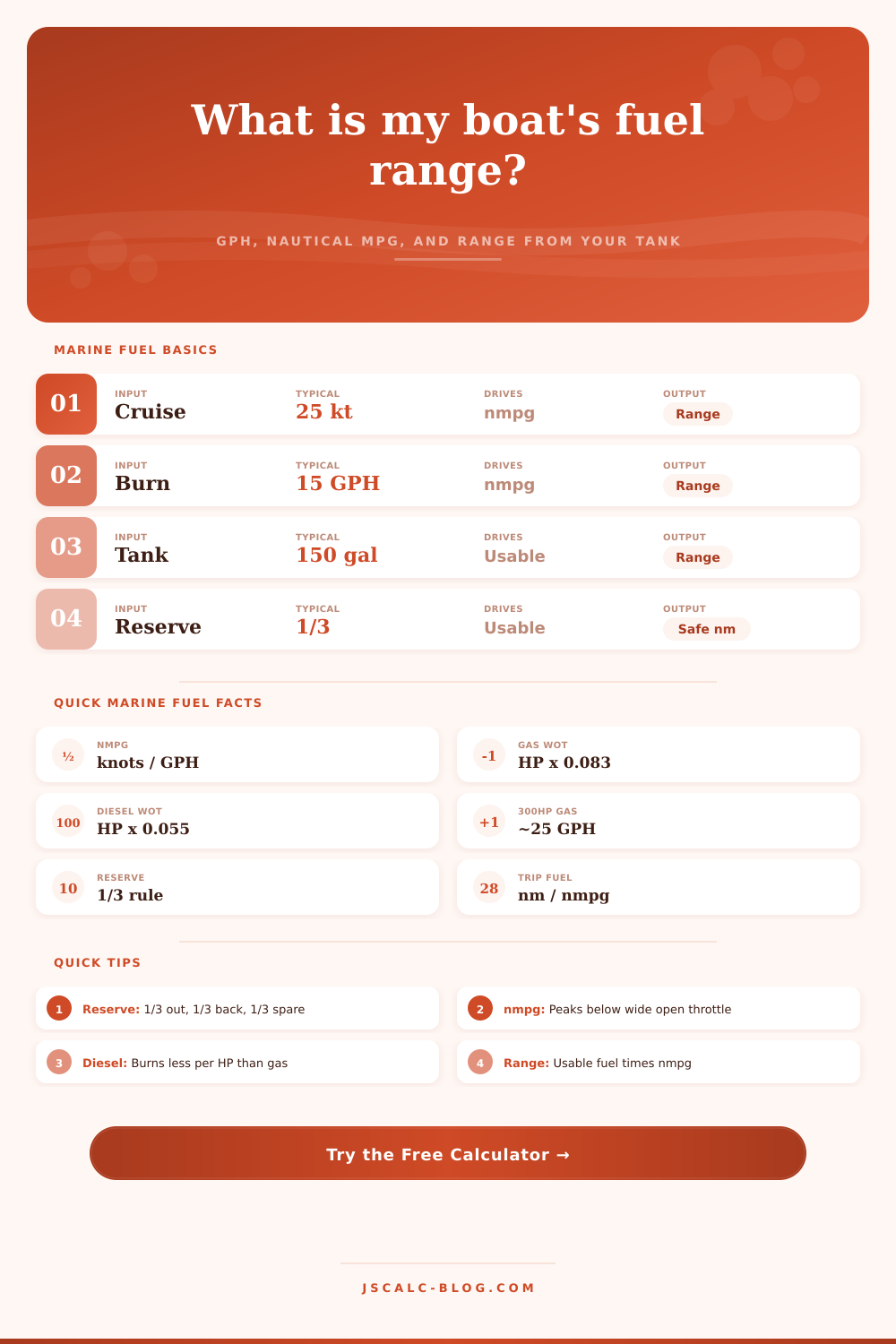
The key metric is nautical miles per gallon. It is not like car mileage. This one factors time into equation, not just distance. To obtain it, simply divide your cruising speed in knots by the gallons per hour consume. Generally the faster the boat, the lower its nmpg number. That’s because it takes work from engine to overcome planing resistance.
On the other hand, the slower the trawler, the higher its nmpg numbers tend to be. It move slow and steady, with minimal fuel consumption. The trick is knowing which number applies to your trip. If you’re racing the tide, maybe the higher fuel cost was more worth the increased speed. But if reaching your destination comfortabley is the goal, efficiency will win out.
That said, it’s all about fuel. Diesel engines are more fuel efficient than gasoline motors on a horsepower to fuel ratio. That means they uses less fuel per horsepower. The formula takes into account common industry multipliers. For example, at wide open throttle, the multiplier is lower for diesel and higher for gas. In other words, diesel engine are more energy-efficient. They’re also more dense and more energy efficient. If you’ve got a center console with a gas engine, you’ll get to bottom of your tank sooner. She will use less fuel than a similar diesel-powered cruiser. But that’s no knock against your ride. It’s simply the way physics works.
People often become lazy when it comes to reserve fuel planning. The old rule of thirds: one third for the outbound trip, another for the return, and the last third is reserved for unexpected current changes or emergencies. Using this method, you can adjust that percentage based off your comfort level. If you’re near shore and not going far then you might go real tight at ten percent. If you’re going off into more open water, then you might keep that number high at thirty three percent. There’s no rescue option out here. Things can get ugly quick. That will cause higher fuel consumption than you thought possible in calm waters.
Efficiency is also hugely dependent upon hull design. At speed, planing hulls ride atop the water. As they transition from displacement mode, they creates a lot of drag. Displacement hulls remains in the water and encounter constant resistance, regardless of small changes in speed. A ski boat may burn a lot of gas simply to attain plane. An eight-knot trawler might run for hours on a tiny amount of diesel under its own auxiliary power.
The tool comes complete with reference tables that show the difference between various boat types. This highlights the fact that a ski boat running forty knots will never be more efficient per mile than a trawler running eight. But what is my break-even speed? That’s when you should throttle down, and here’s why: dropping a couple of knots makes a dramatic difference in fuel burn. And it doesn’t take that long. Your sweet spot is different for every boat, and it’s typically far below wide open. With the estimator, you can test various throttle settings to see how easing off the gas impacts range. It translate theoretical engine information into decisions you can use.
At sunset you’ll be able to make practical decisions about where you will end up. It’s all about managing expectations. When it comes to gas mileage there is no such thing as a way to see the future. A stiff head wind pops up out of nowhere. That rough water has a heavy swell. It grab a hold of your bow and pushes you around, increasing drag. Those factors are always going to add penalty to your best case scenario. And that’s ok. It isn’t about nailing the numbers. It’s about staying well inside those numbers.
Understanding the interaction between horsepower, speed, and reserve means that you’ve stopped guessing and started planning. You should of planned better. You show up with fuel in the tank for the swim and plenty left over. You don’t have to sweat the tow truck.