Go Kart Gear Ratio Calculator
Work out chain-drive gear ratio from your clutch or engine sprocket and axle sprocket, then find axle RPM, speed at any engine RPM, top speed at redline, and the sprocket teeth needed to hit a target speed.
🏎Real Kart Presets
🔧Drivetrain Inputs
The small sprocket on the clutch or crank output.
The large sprocket bolted to the rear axle.
Loaded rolling diameter of the driven tire.
Used when tire method is circumference.
Only used in the find-sprocket mode.
🔢Formula Snapshot
📊Ratio by Sprocket Combo
| Clutch (driver) | Axle (driven) | Gear Ratio | Axle RPM | Speed at RPM | Character |
|---|---|---|---|---|---|
| Enter values above to build the sprocket combo table. | |||||
🎯Speed vs Ratio (Your Engine RPM)
| Gear Ratio | Axle RPM | Speed | Top Speed | Relative Torque | Best For |
|---|---|---|---|---|---|
| The speed-vs-ratio sweep appears after calculation. | |||||
🛞Tire Diameter to Circumference
| Tire Diameter (in) | Circumference (in) | Rev per Mile | Rev per 100 ft | Typical Use |
|---|---|---|---|---|
| 6.0 in (Kid Kart) | 18.85 in | 3361 | 63.7 | Micro / kid kart |
| 8.0 in | 25.13 in | 2521 | 47.7 | Slick front / small rear |
| 10.0 in | 31.42 in | 2016 | 38.2 | Common rear slick |
| 11.0 in | 34.56 in | 1833 | 34.7 | Predator / racing rear |
| 13.0 in | 40.84 in | 1551 | 29.4 | Large off-road rear |
| 15.0 in | 47.12 in | 1344 | 25.5 | Trail / mini-bike rear |
🛠Sprocket Tuning Guide
| Change | Ratio Effect | Top Speed | Acceleration | Hill / Torque | When To Use |
|---|---|---|---|---|---|
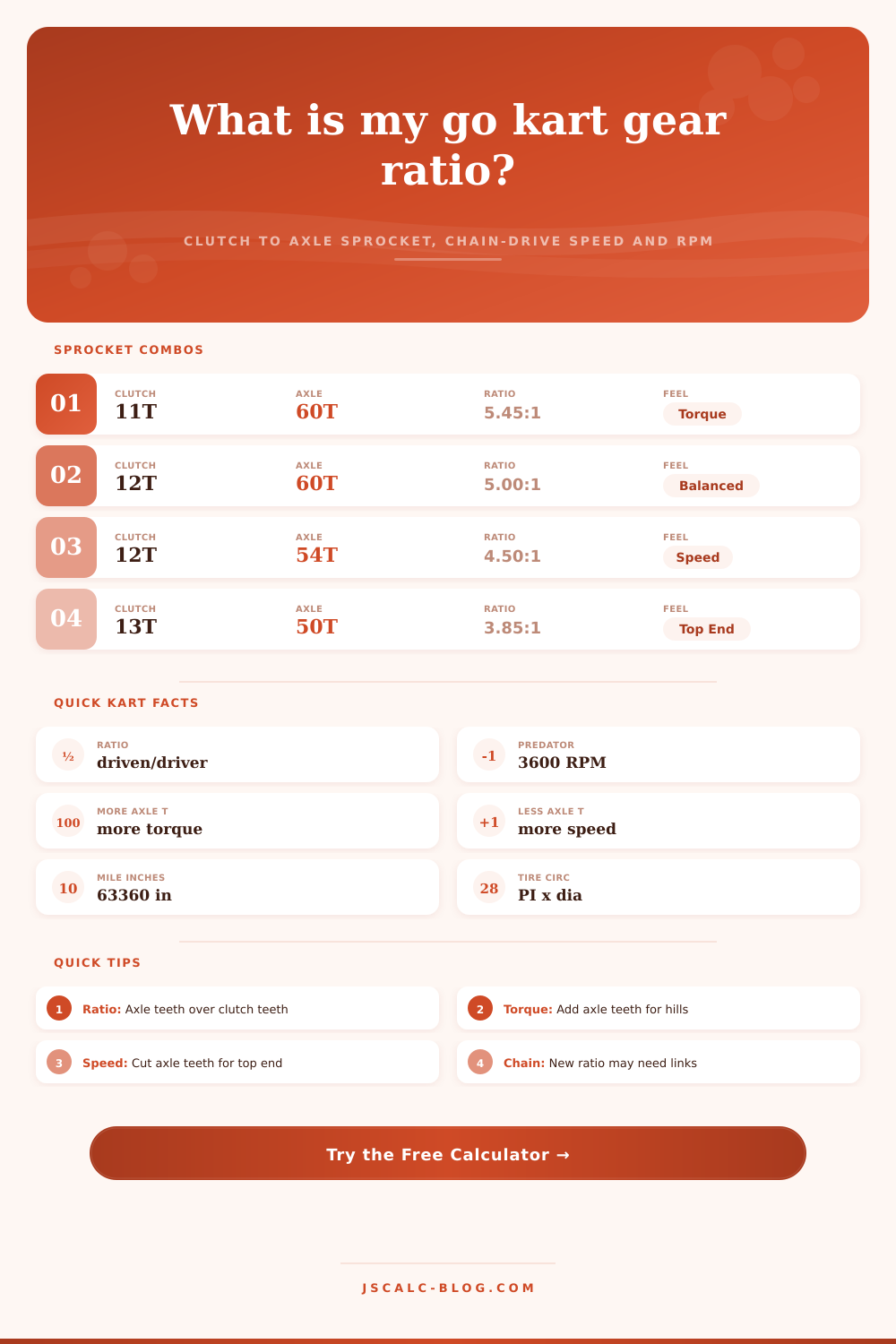
| Add axle teeth (bigger driven) | Higher (numerically) | Lower | Quicker | Stronger | Hills, dirt, tight tracks |
| Remove axle teeth (smaller driven) | Lower | Higher | Slower off line | Weaker | Long straights, top end |
| Add clutch teeth (bigger driver) | Lower | Higher | Slower off line | Weaker | Raise speed without axle swap |
| Remove clutch teeth (smaller driver) | Higher | Lower | Quicker | Stronger | Add bite for launches |
| Taller tire (bigger diameter) | No ratio change | Higher | Slower off line | Weaker at wheel | Gain speed, no sprocket swap |
| Shorter tire (smaller diameter) | No ratio change | Lower | Quicker | Stronger at wheel | Add grunt on a budget |
🗂Popular Kart Comparison Grid
| Build | Clutch T | Axle T | Ratio | Tire | Redline | Typical Top |
|---|---|---|---|---|---|---|
| Predator 212 trail | 12 | 60 | 5.00:1 | 11 in | 3600 RPM | ~24 mph |
| Predator 212 built | 13 | 54 | 4.15:1 | 11 in | 5000 RPM | ~40 mph |
| Racing 11/60 sprint | 11 | 60 | 5.45:1 | 10 in | 6000 RPM | ~35 mph |
| Dirt oval torque | 11 | 66 | 6.00:1 | 11 in | 6000 RPM | ~30 mph |
| Kid kart | 10 | 72 | 7.20:1 | 6 in | 7000 RPM | ~18 mph |
| Top speed pull | 14 | 48 | 3.43:1 | 13 in | 5500 RPM | ~55 mph |
⚙Full Formula Breakdown
📋Reference Values
| Item | Common Entry | How It Is Used | Effect On Result |
|---|---|---|---|
| Clutch sprocket | 10 to 14 teeth | Driver in ratio = driven / driver | More teeth lowers ratio, raises speed |
| Axle sprocket | 48 to 72 teeth | Driven in ratio = driven / driver | More teeth raises ratio and torque |
| Engine RPM | 3600 stock, 5000+ built | Feeds axle RPM = RPM / ratio | Higher RPM means more speed |
| Tire diameter | 6 to 15 inches | Circumference = PI × diameter | Bigger tire adds speed per axle turn |
| Max RPM | 3600 to 7000 | Used only for the top speed card | Sets theoretical redline speed |
💡Practical Kart Tips
The majority of folks who construct their own go-kart assume engine size alone determine how fast it goes. If they have the money for the biggest, they get it and assume it will run faster then anything else because of its size. In reality, more often than not, this just isn’t true. You can have a small engine but with proper gearing; it’ll outperform a large one.
The gear ratio converts horsepower to traction. It converts raw power into usable top end speed or acceleration, whichever you desire. Enter in your tire size and sprocket teeth count, and the calculator will do the work for you; no Pi or conversion factor calculations for you! And it won’t stop there: it’ll not only give you a number, but it’ll break down precisely what that ratio equates to in terms of your theoretical top speed at redline as well as your axle revolutions per minute.
How Gear Ratio Affects Go-Kart Speed
That’s where the real tuning comes into play, because switching out a single tooth on a sprocket can drastically change the character of your machine. The trick is making the right choice by understanding the tradeoff. Torque comes from a bigger numerical ratio. That means fewer teeth on the clutch or more teeth on the axle. You’ll be able to get up steep hills without stalling and quickly get off corners and onto the gas.
The downside is you won’t have as much top end because your engine reach its rev limit sooner. The opposite happens with a lower numerical ratio that lets the kart reach higher speeds on long straightaways but feels sluggish starting from a stop. Decide what track needs instead of what you want the kart to do.
One other factor that’s relatively silent and yet important to this formula is tire size. Tire diameter is not a constant like many builders assume. Rather, it is one of several variables you can alter. The bigger the diameter, the further the go kart travels on every axle turn. That will effectively increase top speed while requiring no sprocket changes. At the cost of acceleration, the same amount of torque from your engine must now push more weight through a longer distance. If finding unique sprocket combinations proves difficult or chain length limits options, it may be simpler to play with tire size.
As you begin swapping out the gear ratio, that’s where this gets tricky with chain length. The tooth count changes on one sprocket or the other and now there’s a slight difference in center distance from your engine to your axle. That means adding or subtracting links on your drive chain for correct tension. Too tight and it’ll bend shafts or tear up teeth under load. Too loose and it will just whip around and throw gears out of alignment at full bore acceleration. Anytime you make a swap always check the chain play. It doesn’t matter what the ratio was on paper; if mechanical connection isn’t right, it won’t work.
Many guys think they’re running max on their stock engines such as a Predator 212 because that’s all they’re set up to do. When you take the governor off, the engine will rev much higher and that changes the whole equation of speed. You need enough gear ratio to turn those extra RPMs into forward motion instead of just spinning air. The tool lays it out with common setup examples where you can see what your stock config looks like compared to built setups without having to guess blind.
Because there are no perfect tracks, and no flat surfaces without corners and bumps, the fastest gear ratio on paper isn’t always the best. While chasing a high number on a dyno won’t work, neither will an overly aggressive gearing that can kill momentum on the imperfect bits. Begin with a balanced ratio to your conditions, test and adjust accordingly, bogged down on the corners? Running out of speed on the straights? Gear selection is a repeating process where feel matter more than formula alone.
So really it’s about finding that sweet spot of power delivery and tire bite. Keep those shoes on the ground, let the engine get on the pipe as much as possible. The calculator will provide the numbers, but your foot will confirm whether or not they’re correct. Dial into a final drive ratio that makes the kart fast, but not stressed; eager, but not twitchy. That is the point at which mechanical stress meets racing fun.