FF14 DPS Calculator
Estimate potency per second (PPS), the expected damage multiplier from critical hits and direct hits, your GCD from skill or spell speed, and an estimated damage-per-second figure for any FFXIV rotation window.
⚔Rotation Presets
📝Rotation & Stat Inputs
Sum of every GCD and oGCD potency in the window.
Total crit multiplier, for example 164 means +64% on a crit.
Speed above the base 420 shortens the effective GCD.
Battle Litany, chain, or trait buffs stacked as a percent.
🔢Formula Snapshot
📊Potency to Damage Reference
| Ability Potency | Share of Rotation | Est. Base Hit | With Crit Avg | With Crit + DH |
|---|---|---|---|---|
| Enter values above to see the potency to damage reference. | ||||
🎯Crit & Direct Hit Contribution
| Source | Rate | Bonus Per Proc | Avg Multiplier | DPS Effect |
|---|---|---|---|---|
| The crit and direct hit contribution appears after calculation. | ||||
⏱GCD by Skill Speed
| Base GCD | 2.50 s | 2.45 s | 2.40 s | 2.35 s | Casts / 30s |
|---|---|---|---|---|---|
| Standard weaponskill | 12.0 | 12.2 | 12.5 | 12.7 | ~12–13 |
| Slower cast (2.80s) | 10.7 | 10.9 | 11.1 | 11.3 | ~10–11 |
| Very slow (3.00s) | 10.0 | 10.2 | 10.4 | 10.6 | ~10 |
| Fast melee (2.30s) | 13.0 | 13.2 | 13.5 | 13.8 | ~13–14 |
| oGCD weave slots | 2 per GCD | 2 | 2 | 2 | double weave |
| Auto-attack cadence | ~3.0s | ~3.0s | ~3.0s | ~3.0s | added dmg |
🗂Rotation PPS Comparison Grid
| Rotation Style | Total Potency | Duration | PPS | Crit / DH | Notes |
|---|---|---|---|---|---|
| Opener burst | 7,800 | 30 s | 260 | 24% / 26% | All raid buffs stacked |
| Melee sustained | 6,600 | 30 s | 220 | 23% / 25% | Positionals hit clean |
| Caster sustained | 6,300 | 30 s | 210 | 25% / 22% | No cast clipping |
| Ranged phys | 5,900 | 30 s | 197 | 22% / 28% | Full uptime, mobile |
| Two-minute window | 25,200 | 120 s | 210 | 24% / 26% | Full buff cycle avg |
| Downtime segment | 3,200 | 20 s | 160 | 22% / 24% | Mechanic movement |
⚙Full Formula Breakdown
📋Reference Values
| Input | Common Range | How It Is Used | Effect on DPS |
|---|---|---|---|
| Total potency | 3,000 to 30,000 | Divided by duration for PPS | Directly scales PPS and DPS |
| Crit chance | 18% to 30% | Weights the crit multiplier | Raises expected multiplier |
| Crit damage | 160% to 175% | Bonus applied on a crit | Deepens each crit hit |
| Direct hit | 15% to 45% | Adds flat 25% per proc | Steady multiplier gain |
| Skill speed | 420 to 900+ | Shortens effective GCD | More casts per window |
💡Practical FF14 DPS Tips
When you’re pulling your first boss in a raid and seeing green on everyone else’s damage meters when yours shows in red, you check your rotation. Did you do everything right positionally? Did you make sure to never drop a GCD? Where’d all my damge go?
In most cases it wasn’t because you didn’t play well. It was because you were measuring the wrong thing. Many Final Fantasy XIV player focus on their raw DPS numbers. Raw DPS is volatile. That number moves based off random chance. It also change with temporary buffs and gear swaps.
Why You Should Check PPS Instead of DPS
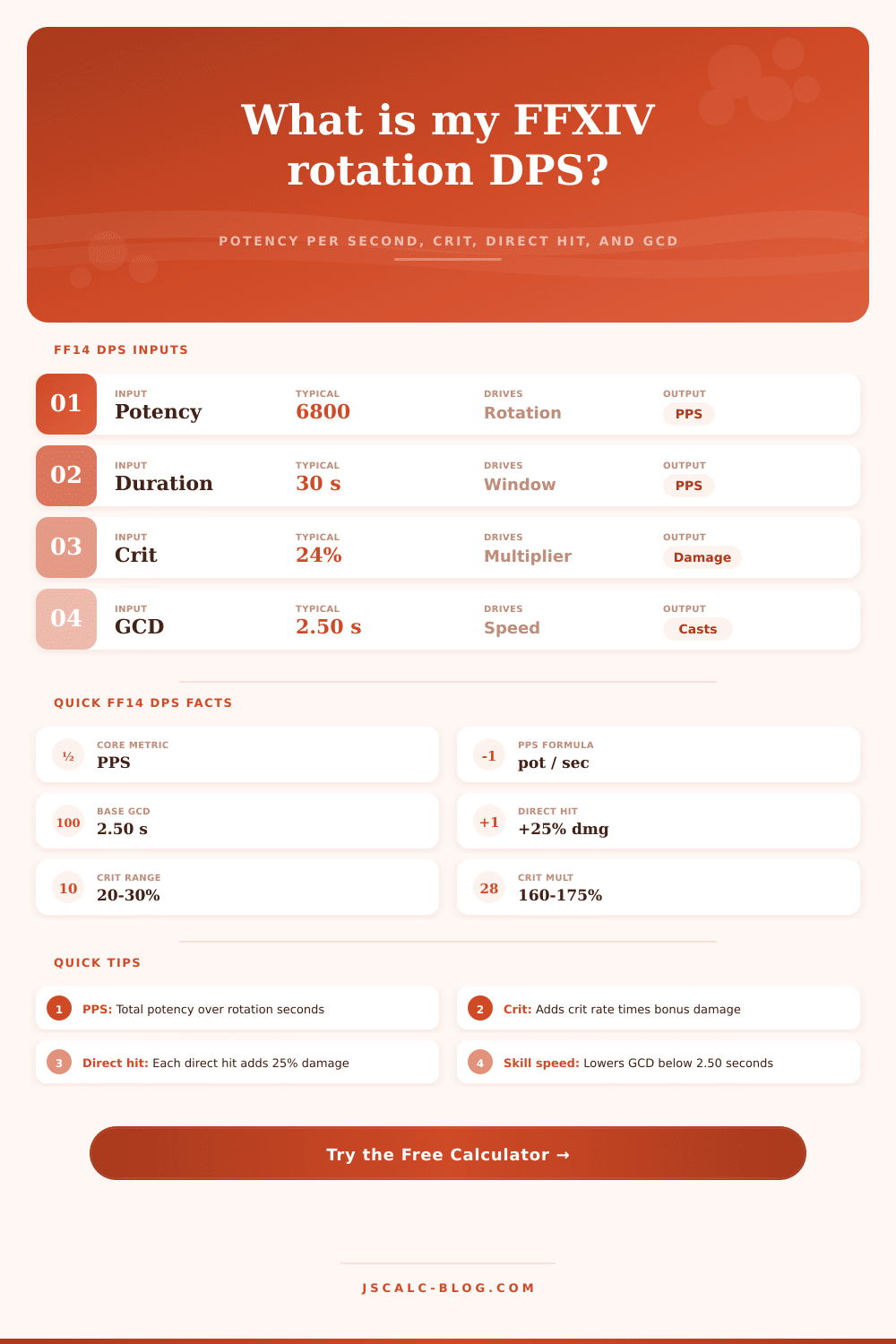
Potency per second is what anchors your number. It will tell you how efficiently you performed your rotation regardless of whether or not you rolled crits. After entering your total potency and window duration, the calculator above does math for you. No more dividing numbers by hand on a stress-filled progression night.
When used correctly, PPS will completly change the way you judge improvement. With 6800 potency across 30 seconds, your PPS come out to approximately 227. That’s your current level of efficiency. Now assume you’re able to fit additional oGCDs into that same window and increase your total potency to 7200. Your PPS increases. It’s just basic arithmetic; yet it’s a deeply insightful change in perspective. Instead of blindly chasing arbitrary milestones of DPS, you’re now maximizing density of your rotation. Progression become an engineering problem rather then a guessing game.
So you’ve got that baseline efficiency nailed. Now we’re talking variance. That’s where the dice roll come in, with direct hits and critical hits. Direct hits give you a flat boost of twenty-five percent. Critical hits multiply damage by a factor, which is currently about 1.64 times in endgame gear. The tool takes all that probability into account when it calculates its expected multiplier.
And this is key: It accounts for the fact that some pulls will be super-lucky, others super-unlucky. You’ll get four crits-in-a-row on one pull; you might miss three in a row the next time. But over the course of ten minutes of combat, those extremes even out. If you know your effective multiplier, you can estimate how much damage you should of see during a typical fight. It makes chaos logs predictable.
This gets complicated with speed stats, which change the underlying beat of battle. Spell speed and skill speed will make your global cooldown less than the default two-point-five seconds. Saving milliseconds may not seem significant, but if you consider that you’re saving them every few minutes during a three-minute long fight, then those milliseconds adds up to another spell or weapon skill you gained. That’s what makes speed feel so powerful on melee jobs. Sure, you hit harder, but now you hit more too.
But there’s diminishing returns to speed. If you get too much speed added, then your GCD won’t be shortened enough to squeeze in one more ability. Knowing when you cross that line are important. How to do this? That’s where the real art of damage optimization comes into play. You can go for pure crit and get some flashy high number rolls on the right gear. However, if you lack direct hit procs to boost your DPS consistently by a flat amount, you will find yourself chasing crits without seeing change in your PPS. Going for nothing but speed means you’re wasting potency windows and clipping abilities.
Great players aren’t just maximizing a single stat. They examine how things works together. Maybe a little less crit is worthwhile when it brings a bit more speed, enough to time your weaves perfectly. It’s not all about the numbers, it’s about flow.
In conclusion: knowing the skill order is not enough to play well. The ability to understand the mechanics behind the damage, and what factors into it, is the key. Knowing how your global cooldowns interact with speed and why PPS trumps raw DPS helps you take control instead of reacting to bad luck. Instead of freaking out when a raid mechanic happen, you can analyze what will be lost in potency when you move around, and by how much.
Knowing how engine under the hood works gives you confidence. And once you see the numbers for what they are, that’s when the game changes.