Torque to Horsepower Calculator
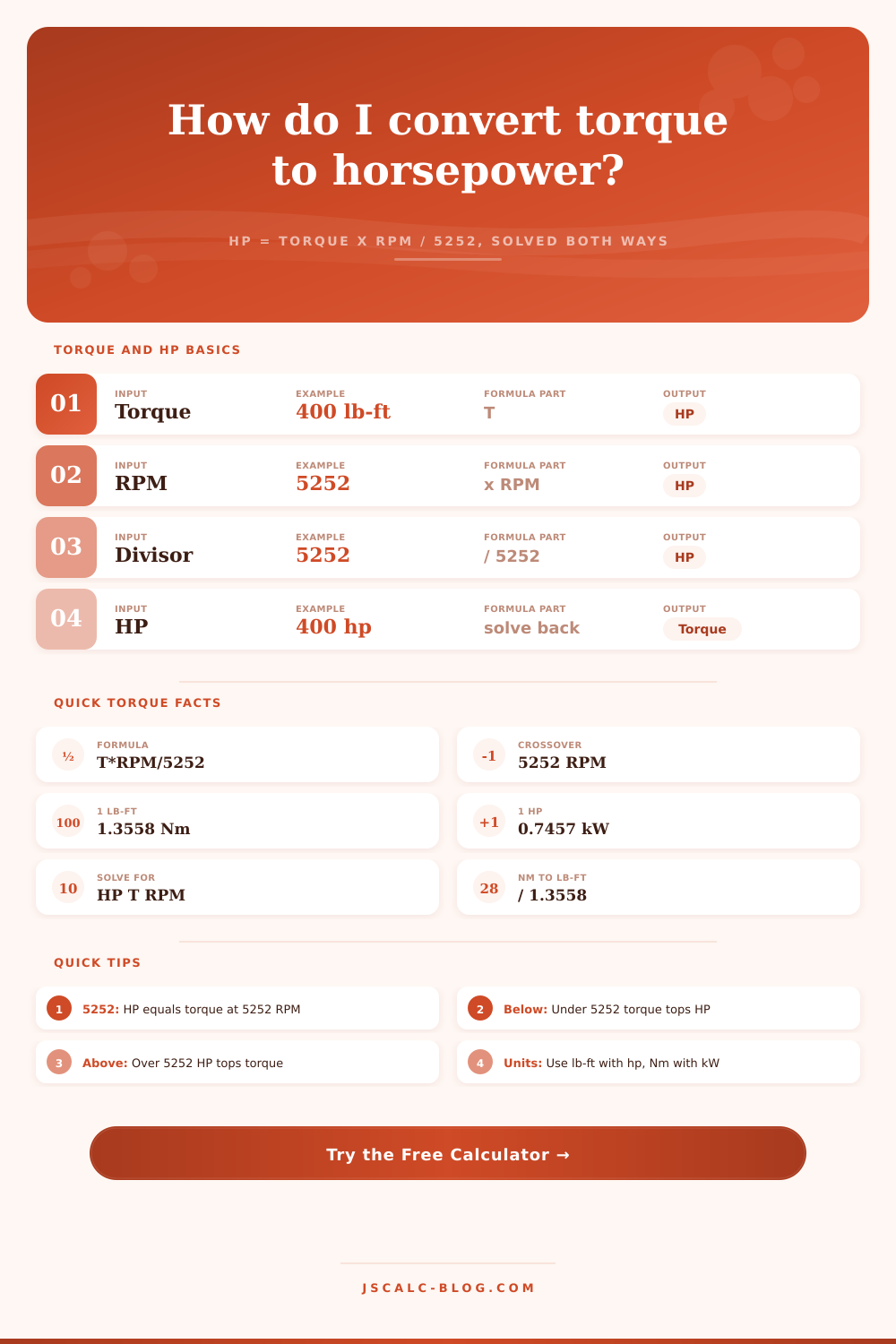
Convert torque to horsepower with the engine formula HP = Torque × RPM / 5252. Solve for horsepower, torque, or RPM in either direction, with automatic Nm and kW conversions and the 5252 RPM crossover explained.
🏎Real Engine Presets
🔧Torque, RPM & Power Inputs
Twisting force at the crankshaft. Enter in the selected unit.
Revolutions per minute where this torque is measured.
Mechanical power output in the selected unit.
Estimates wheel horsepower from the crank figure.
🔢The Formula at a Glance
📊Horsepower by Torque and RPM
| Torque (lb-ft) | 2000 RPM | 3000 RPM | 4000 RPM | 5252 RPM | 6000 RPM | 7000 RPM |
|---|---|---|---|---|---|---|
| 100 | 38 | 57 | 76 | 100 | 114 | 133 |
| 200 | 76 | 114 | 152 | 200 | 229 | 267 |
| 300 | 114 | 171 | 229 | 300 | 343 | 400 |
| 400 | 152 | 229 | 305 | 400 | 457 | 533 |
| 500 | 190 | 286 | 381 | 500 | 571 | 666 |
| 600 | 228 | 343 | 457 | 600 | 686 | 800 |
| 800 | 305 | 457 | 609 | 800 | 914 | 1066 |
Bold column: at 5252 RPM horsepower equals the torque number exactly. That is the crossover point where the two curves meet on every dyno chart.
🔄The 5252 RPM Crossover Explained
| Engine Speed | Relationship | At 300 lb-ft | What It Means |
|---|---|---|---|
| Below 5252 RPM | Torque > HP | 171 HP at 3000 | Torque number reads higher than HP |
| Exactly 5252 RPM | Torque = HP | 300 HP at 5252 | The curves cross, values are equal |
| Above 5252 RPM | HP > Torque | 400 HP at 7000 | HP number climbs past the torque number |
| Why 5252 | 33000 / (2π) | Constant, not a limit | Comes from ft-lb per minute in one HP |
5252 is not a redline or an engine setting. It falls out of the math: 1 horsepower is 33,000 ft-lb per minute, and dividing by 2π radians per revolution gives 5252.
🔄Unit Conversions Used
| From | To | Multiply By | Quick Example |
|---|---|---|---|
| Newton-meters | Pound-feet | ÷ 1.35582 | 542 Nm = 400 lb-ft |
| Pound-feet | Newton-meters | × 1.35582 | 400 lb-ft = 542 Nm |
| Kilowatts | Horsepower | ÷ 0.7457 | 224 kW = 300 hp |
| Horsepower | Kilowatts | × 0.7457 | 300 hp = 224 kW |
| Metric PS | Horsepower | × 0.98632 | 300 PS = 296 hp |
🗂Engine Torque and HP Examples
| Engine Type | Peak Torque | Torque RPM | Peak HP | HP RPM | Character |
|---|---|---|---|---|---|
| Small 4-cylinder | 130 lb-ft | 4000 | 158 hp | 6000 | Revs to make power |
| Turbo 4-cylinder | 295 lb-ft | 3000 | 255 hp | 5500 | Flat torque band |
| V6 performance | 270 lb-ft | 4800 | 335 hp | 6500 | Balanced curve |
| V8 muscle | 420 lb-ft | 4600 | 460 hp | 6000 | Torque plus revs |
| Diesel pickup | 800 lb-ft | 1600 | 400 hp | 2800 | Low-end torque |
| Sport bike | 85 lb-ft | 9000 | 190 hp | 11500 | High-RPM power |
| Electric motor | 330 lb-ft | 0 | 280 hp | 6100 | Instant torque |
Figures are typical illustrative values. Peak torque and peak HP occur at different RPM, which is why an engine feels strong in one range and free-revving in another.
⚙Full Formula Breakdown
📋Reference Values
| Quantity | Value | How It Is Used | Notes |
|---|---|---|---|
| The 5252 constant | 5252.11 | Divisor in HP formula | Rounded to 5252 in practice |
| lb-ft to Nm | × 1.35582 | Convert imperial torque | 1 lb-ft equals 1.35582 Nm |
| hp to kW | × 0.7457 | Convert mechanical power | Uses SAE / mechanical HP |
| ft-lb per HP-minute | 33,000 | Basis of 5252 | James Watt’s definition |
| Radians per rev | 6.2832 | 2π in the derivation | Links rotation to work |
💡Practical Torque and HP Tips
At some point in your life, I’m sure you’ve had an argument with someone over horsepower vs. Torque. Probably it was beside one of those cars that sounds really cool and doesn’t drive like you thought it would. And who can blame you? When we talk casually about them, they seem to get used interchangeably. But they’re describing entirely different types of physical reality.
Torque is the twisting force required to get something started working. Horsepower is the rate at which that thing is doing work. Yes, they’re related, but understanding the distinction will help you make sense of why a sports car seems eager right from idle to redline, or why a diesel truck seems slow until you punch it down into second gear and pull like a freight train.
Understanding Horsepower and Torque
This page has a calculator that takes care of all the math for you. You don’t need to remember all the constants, which allows you to focus on what the number means about the way thing drives.
Revolutions per minute. RPM is the key ingredient here; the entire equation depends on it and relationship between these two players. Power is torque times revolutions per minute, so you can’t discuss one without discussing the other. For instance, an engine with huge torque at low RPM’s like those found in a big-truck motor may not be able to rev high enough to get horsepower all that impressive. The race car motor may have poor low-end torque numbers, but it screams to eight thousand RPM, producing outrageous amounts of horsepower as a result.
Plug in your own variables into the calculator above and let it do the math for you. No longer will you wonder if your motor sounds louder than it realy is, or if you’re making more power then you previously thought. You’ll know exactly when two lines intersect on a dyno sheet.
The only constant in all this engine talk? The number 5252 RPM. You’ll never find it anywhere else in engineering, and it’s the dividing line for everything we’ve discussed so far regarding engine performance. Why does it exist? A horsepower equals thirty three-thousand foot pounds of work per minute, which if you divide by two pi radians per revolution, you get 5252. It’s not a mechanical limitation; it’s simply a mathematical artifact.
But in every dyno chart you’ll ever view, 5252 RPM is a mathematical artifact, your torque figure will always exceed your horsepower figure below 5252 RPM (the engine isn’t spinning fast enough to take advantage of its force). On the other hand, above 5252 RPM, horsepower begins to dominate and the reverse occurs. So when you think about it, muscle cars is strong in the midrange, whereas high-revving vehicles become alive up at the top end.
The physics are all fine, but even more importantly, knowing how to mix units is equally vital… Getting them wrong makes for some awkward moments. For example, while most US-based fans operate on a horsepower/pound-foot scale, the rest of the world tends to measure things in kilowatts (kW) and Newton-meters (Nm). While the app takes care of that for you behind the scenes, it’s still nice to understand the conversion and why it matters.
For instance: one pound-foot = approximately 1.36 Newton-meters; so if you’ve got an engine producing 400 lb-ft, that’s roughly equivalent to 542 Nm. If you enter that into a calculation expecting pound-feet without converting, you’ll end up with nearly thirty-six percent less horsepower than what you actualy have. Small detail, sure, but it completely blows away the apples-to-apples comparison.
The interface includes handy reference tables to lay everything out so that you don’t need to pull out another calculator when switching between metric and imperial. The other place they measure it matters, too, because dyno sheets typically display crankshaft horsepower, which is what engine produces. But even then some of that power gets lost to drag from the drive train. Frictions from axles, transmissions, and differentials steals away some horsepower by the time it hits the wheels. All-wheel-drive systems can lose as much as fifteen percent, while ten percent is common for a rear-wheel-drive car.
The calculator lets you guesstimate how much power goes missing so you have a slightly better feel for what happens when you accelerate instead of just abstract numbers on paper. It turns horsepower into something tangible you can relate to from the driver’s seat.
In the end though, we’re talking apples and oranges here. They do different things in the driving experience, so there’s no right answer. Horsepower makes you go fast around a track corner or down the highway. Torque gets you off the driveway and shoves mass around. To really be quick at all speeds, you want both.
When some dude brags on his car next, check the RPM at which peak power occurs versus the RPM at which peak torque occur. That gap will tell you more about what this car can do that any headline number ever would. It takes a dry math problem and makes it into a story of how the thing pushes against the ground.