Terminal Velocity Calculator
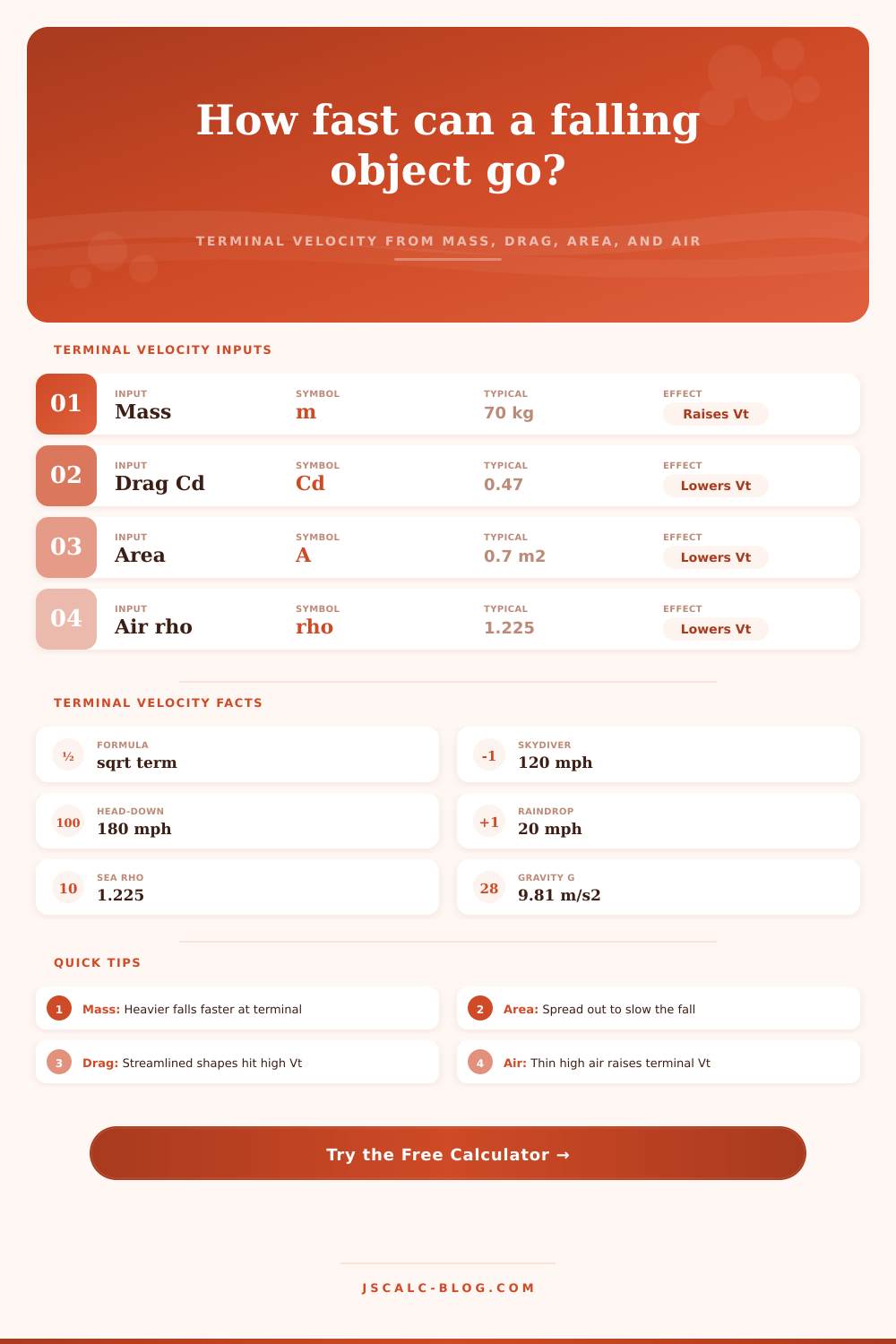
Find the maximum falling speed of any object once air resistance balances gravity. Enter mass, drag coefficient, cross-sectional area, and air density to solve Vt = √(2mg / rho×A×Cd) in m/s, mph, and km/h.
🪂Real Falling Object Presets
📝Object & Fluid Inputs
Used when the method is direct area. Frontal area facing the airflow.
Used when the method is from a circle. A = π(d/2)².
Dimensionless. Auto-filled by the shape unless set to custom.
Used when the fluid is set to air by altitude.
Sea-level air is 1.225. Water is about 1000.
🔢Formula Snapshot
📐Drag Coefficient Reference by Shape
| Shape | Drag Coefficient Cd | Airflow Facing | Notes |
|---|---|---|---|
| Streamlined teardrop | 0.04 | Point first | Lowest practical drag |
| Dimpled golf ball | 0.25 | Any | Dimples cut wake drag |
| Smooth sphere (fast) | 0.42 | Any | Above the drag crisis |
| Smooth sphere (slow) | 0.47 | Any | Standard textbook value |
| Falling cat spread | 0.50 | Belly down | Legs and tail spread out |
| Skydiver head-down | 0.70 | Head first | Small frontal area |
| Skydiver belly-to-earth | 1.00 | Belly down | Arched stable arch |
| Cube face-on | 1.05 | Flat face | Sharp edges shed vortices |
| Flat plate face-on | 1.28 | Full face | Highest common drag |
🌍Air Density by Altitude
| Altitude | Air Density (kg/m³) | Approx Temp | Vt vs Sea Level |
|---|---|---|---|
| 0 m sea level | 1.225 | 15 °C | Baseline |
| 1,000 m | 1.112 | 8.5 °C | +5% faster |
| 2,000 m | 1.007 | 2 °C | +10% faster |
| 3,000 m | 0.909 | -4.5 °C | +16% faster |
| 5,000 m | 0.736 | -17.5 °C | +29% faster |
| 8,000 m | 0.526 | -37 °C | +53% faster |
| 10,000 m | 0.414 | -50 °C | +72% faster |
💧Fluid Density Reference
| Fluid | Density (kg/m³) | Relative to Air | Effect on Fall |
|---|---|---|---|
| Air sea level | 1.225 | 1× | Fast terminal speed |
| Air at 10 km | 0.414 | 0.34× | Even faster fall |
| Fresh water | 1000 | 816× | Very slow sinking |
| Sea water | 1025 | 837× | Slightly slower still |
| Honey (thick) | 1420 | 1159× | Crawling descent |
| Glycerin | 1260 | 1029× | Slow, used in demos |
📊Terminal Velocity of Common Objects
| Object | Mass | Cd | Area | Vt (m/s) | Vt (mph) |
|---|---|---|---|---|---|
| Skydiver belly | 75 kg | 1.0 | 0.70 m² | ~55 | ~122 |
| Skydiver head-down | 75 kg | 0.7 | 0.20 m² | ~124 | ~277 |
| Human no chute | 80 kg | 1.1 | 0.55 m² | ~62 | ~139 |
| Baseball | 0.145 kg | 0.35 | 0.0042 m² | ~34 | ~76 |
| Golf ball | 0.046 kg | 0.25 | 0.00143 m² | ~32 | ~72 |
| Bowling ball | 6.35 kg | 0.47 | 0.0366 m² | ~76 | ~171 |
| Ping pong ball | 0.0027 kg | 0.47 | 0.00125 m² | ~9 | ~20 |
| Large raindrop | 0.00003 kg | 0.60 | 0.0000079 m² | ~9 | ~20 |
| Falling cat | 4 kg | 0.50 | 0.09 m² | ~27 | ~60 |
⚙Full Formula Breakdown
💡Practical Terminal Velocity Tips
When gravity and air resistance equal each other out then an object reaches a point where it doesn’t accelerate anymore. That’s what happens in a skydiver falling through the air after jumping out of a plane. There is a force pulling the skydiver downward (gravity), but the skydiver never gets faster and faster. The reason is that air is pushing back on the skydiver’s body. Eventually, that push is as strong as the pull of the earth. At that point, the two forces are even and the speed no longer changes. That means there is no more acceleration. We call that terminal velocity.
It isn’t a limit on how quickly something moves in a vacuum. It’s a balance between the resistance that surrounding air puts on the object and its own weight. The page has a calculator that computes it for you. All you have to do is put in the air density, cross-sectional area, drag coefficient, and mass. It will turn those abstract numbers into real world speeds expressed in either meters per second or miles per hour.
What Is Terminal Velocity
The common wisdom is that heavy things always fall faster then light ones. In a vacuum, yes. But in our atmosphere, this isn’t exactly true. A rock falls fast; a feather take time to drift down. Does gravity pull on every ounce of the rock’s weight? Yes. No. It has a certain density, which lets it plow through air molecule more easily.
How streamlined something is depends on its shape: That’s known as the drag coefficient. For a sphere, which side is facing into wind doesn’t matter. It’s 47 regardless. A flat plate has much higher resistance because it creates a large wake behind it. Why do skydivers hurtle toward earth at roughly 120 mph when they’re belly-to-earth? And why can the same guy or gal going head-down exceeds 180 mph? They do this by reducing their drag coefficient and changing their frontal area. He shows oncoming air less surface, lowering his air resistance. It has a list of values for common shapes on the page (reference table). The value is 25. Keeping that in mind, what does that small change do? It causes ball to maintain its speed for a greater distance, which allows it to go further.
And just like with overall shape, surface texture also matters. Though most folks consider only area and weight when considering it, air density is also a big part of the mix. Most people are only thinking about how dense the air is down at sea level, but the truth is, the air up there gets really thin. In fact, the air at 10,000 meters is less than a third as dense as it is at ground level. So an object dropped from high altitude actualy accelerates much faster before encountering the denser air closer to the surface. This is why high-altitude jumpers such as Felix Baumgartner reached supersonic speeds. At first, he was falling through air that provided very little resistance, so gravity could do all the work without any opposition.
Think about what fluid the object will fall into when estimating its terminal velocity. Air is around 800 times less dense than water. Swimming in water is like moving through a thick soup compared to flying through air. In water, it’s like moving through a thick soup. Terminal velocity for a human body is reached almost immediately when they fall in water. They travel at a mere few meters per second. When that same human falls in air, it can take many seconds before reaching a high speed.
The calculator figures out fluid properties and units automatically; no more hand-error calculations. Simply enter your object’s shape parameters and the approximate mass. If you’re analyzing an object that is falling or building a parachute, getting the cross-sectional area correct is crucial. It’s not the total surface area of the object. Only the area projected toward direction the object moves counts. For example, a person tucking into a sprinter position downhill has far less effective area than a skydiver who spreads their arms and legs out.
This is the Astronomy Picture of the Day. Finally, terminal velocity is about balance. Nature balances out when it has no more speed to add to the mix. Knowing these forces allows us to understand motion through our atmosphere better. Whether you’re trying to determine where to safely drop an experimental payload or just curious as to why rain doesn’t hurt, this information will help. Density, area, drag, and mass play off one another in all of the falls that we see. If you know how they balance each other, you get closer to understanding the difference between a deadly plunge and a gentle drift. While gravity might always stay the same, resistance is something we could of adjust and shape based off the correct data.