Fraction Exponent Calculator
Solve rational exponents such as x^(m/n) by taking the nth root then raising to the mth power, or raise a fraction (a/b)^n. Get exact fractions, radical form, decimals, and full step-by-step working.
🎯Worked Example Presets
📝Enter Your Expression
Choose whether the exponent is a fraction, or the base is a fraction.
Negative x is allowed only with an odd root n.
n is the root index: 2 = square root, 3 = cube root.
Used in fraction base mode. Negative flips the fraction.
🔢Rule Snapshot
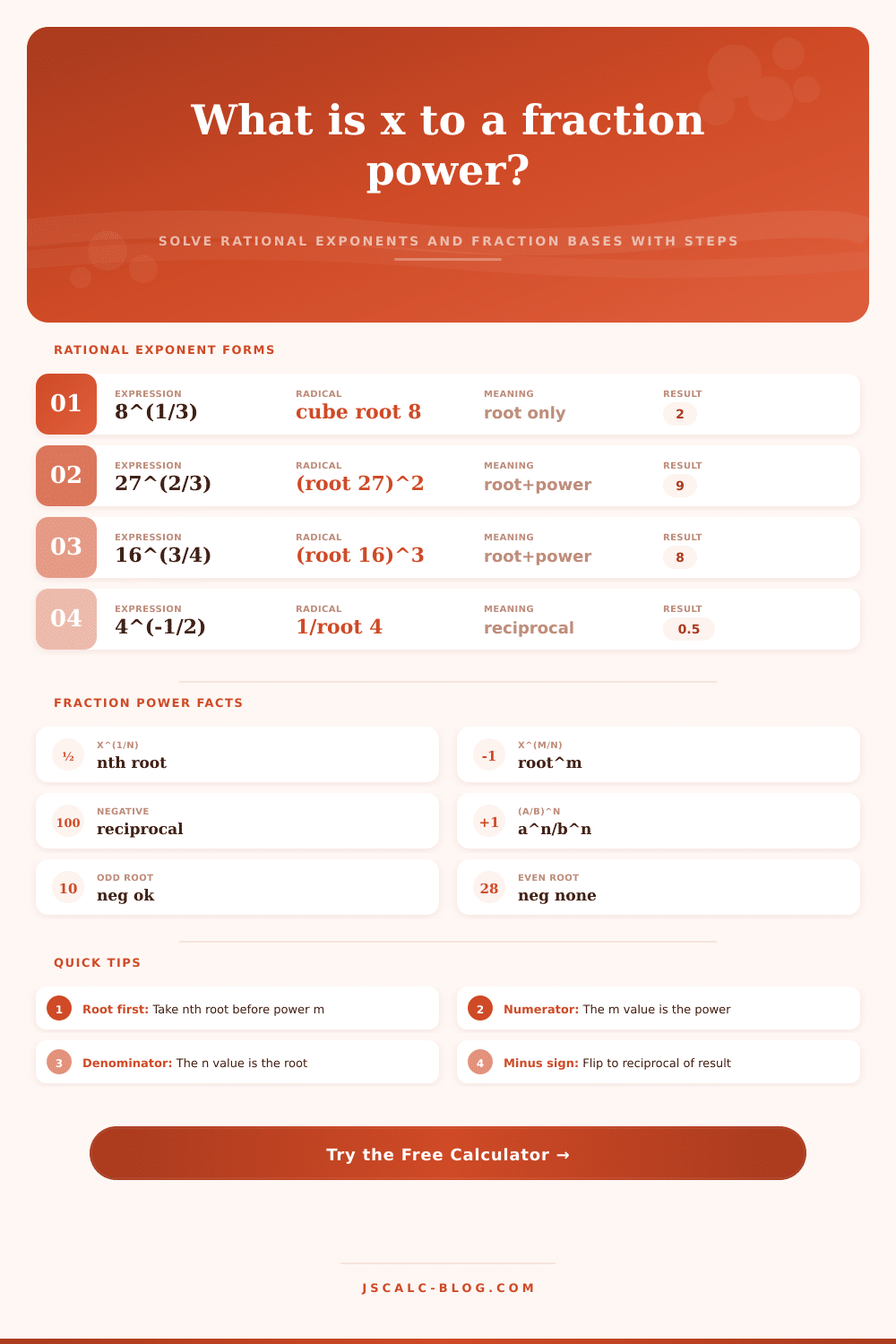
📐Rational Exponent to Radical Form
| Fraction Power | Radical Form | Read As | Rule |
|---|---|---|---|
| x^(1/2) | √x | Square root of x | Root only, m = 1 |
| x^(1/3) | cube root of x | Cube root of x | Root only, m = 1 |
| x^(1/n) | nth root of x | nth root of x | Denominator is the root |
| x^(2/3) | (cube root x)^2 | Cube root, then square | Root n = 3, power m = 2 |
| x^(3/2) | (√x)^3 | Square root, then cube | Root n = 2, power m = 3 |
| x^(m/n) | (nth root x)^m | Root n, then power m | General rational exponent |
| x^(-1/n) | 1 / (nth root x) | Reciprocal of nth root | Negative flips to 1 over |
📊Perfect Powers and Roots Reference
| Number | Square n^2 | Cube n^3 | √ (1/2) | Cube Root (1/3) |
|---|---|---|---|---|
| 2 | 4 | 8 | 1.41421 | 1.25992 |
| 3 | 9 | 27 | 1.73205 | 1.44225 |
| 4 | 16 | 64 | 2 | 1.58740 |
| 5 | 25 | 125 | 2.23607 | 1.70998 |
| 8 | 64 | 512 | 2.82843 | 2 |
| 9 | 81 | 729 | 3 | 2.08008 |
| 16 | 256 | 4096 | 4 | 2.51984 |
| 27 | 729 | 19683 | 5.19615 | 3 |
🗂Fraction Power Examples
| Fraction Base | Expanded | Exact Result | Decimal |
|---|---|---|---|
| (1/2)^2 | 1^2 / 2^2 | 1/4 | 0.25 |
| (2/3)^2 | 2^2 / 3^2 | 4/9 | 0.44444 |
| (3/4)^2 | 3^2 / 4^2 | 9/16 | 0.5625 |
| (3/4)^4 | 3^4 / 4^4 | 81/256 | 0.31641 |
| (2/3)^3 | 2^3 / 3^3 | 8/27 | 0.29630 |
| (1/2)^-3 | 2^3 / 1^3 | 8/1 | 8 |
| (5/2)^-2 | 2^2 / 5^2 | 4/25 | 0.16 |
⚙Laws of Rational Exponents
📋Rational Exponent Comparison Grid
| Expression | Root Step | Power Step | Radical Form | Exact | Decimal |
|---|---|---|---|---|---|
| 8^(1/3) | cube root 8 = 2 | 2^1 = 2 | cube root 8 | 2 | 2 |
| 27^(2/3) | cube root 27 = 3 | 3^2 = 9 | (cube root 27)^2 | 9 | 9 |
| 16^(3/4) | 4th root 16 = 2 | 2^3 = 8 | (4th root 16)^3 | 8 | 8 |
| 32^(2/5) | 5th root 32 = 2 | 2^2 = 4 | (5th root 32)^2 | 4 | 4 |
| 9^(3/2) | √9 = 3 | 3^3 = 27 | (√9)^3 | 27 | 27 |
| 4^(1/2) | √4 = 2 | 2^1 = 2 | √4 | 2 | 2 |
| 4^(-1/2) | √4 = 2 | 1 / 2^1 | 1 / √4 | 1/2 | 0.5 |
| 125^(1/3) | cube root 125 = 5 | 5^1 = 5 | cube root 125 | 5 | 5 |
💡Fraction Exponent Tips
On paper, rational exponents can be intimidating. They seem like a math teacher’s evil plot to make their students miserable so they’d just go home already.
In truth, they’re a fairly clean method for describing anything that scales geometrically, whether it’s growth, decay, etc. The secret is largely understanding what you’re realy measuring when you see those superscripts and fraction bars. More than memorizing formulas, it’s about identifying the structure behind them.
Why Rational Exponents Are Easy
If you look at something like 27 raised to the power of two-thirds, I bet your brain thinks: “Oh, I have to multiply 27 by itself two times and then I guess divide answer by three.” Wrong. The fraction tells you what root to take first. (The number in the denominator.) If that’s a two-third power, it means cube root. Then, whatever result of the root is, you raise it to next power. That’s the number in the numerator. You’d take the cube root of 27, which equal 3. Then you raise that answer to second power and get 9.
Why? Because taking the root makes numbers stay small and under control. The calculator does the same thing by processing the numbers in that order. But if they did it any other way, the numbers would explode into giant digits halfway through the calculation, before you got to final answer. Most errors occur here at the numerator/denominator distinction. It feels to many as if those words is arbitrarily attached. They aren’t. The top number scales the root; the bottom number describe its shape.
This is especially true when working with negative bases. For example, you cannot take square root of a negative number. Only a positive number can have even root. Odd roots deal with negatives no problem, but you know from math class that there’s no real number that are squared to equal a negative number. That’s what the tool flags immediately for you without wasting your time following ghosts in the algebra.
The same kind of thinking apply to fraction bases, except you have to think just a little bit different. Raising a fraction such as two-thirds to any power shrinks (or expands) top and bottom equally. The sign of that power determines whether the fraction flips over or not, which is its reciprocal. That part is commonly unintuitive because at first glance a negative exponent doesn’t look like it would produce a negative result. Instead, it is large when base is small, or small when base is large.
That reciprocal property shows up from physics’ signal attenuation to calculating compound interest. Understanding that directionality save you from accidentally flipping signs. The tool’s reference tables also provide common roots and perfect powers to help with your benchmarking. 16? It’s also 2 to the fourth power. Need 16 to the three-fourths power? That would of be 2 cubed (aka 8), so boom. No need to pull out the calculator at every turn.
Recognizing this stuff builds that intuition, turning rational exponents from ideas into familiar landmarks. So why is it relevant beyond the classroom? Fractional powers are more descriptive than whole numbers in many cases. Real-world quantities like sound intensity use roots in their equations. Gravitational force does, too. Even biological scaling use fractions as well as roots. It’s not about finding x. It’s about expressing how things in the real world scale.
If you’re an engineer verifying a safety factor, or if you’re a student preparing for an exam, understanding these operations make them less scary. This leads to less anxiety. Breaking it down step by step explains how we get from input to output and helps turn a scary-looking expression into a sequence of straightforward arithmetic steps.
But this is what I love about rational exponents: they make sense. If you get used to thinking “numerator = power” and “denominator = root”, then the rest follows naturaly. You no longer have to guess; instead, you see the pattern. And then you’re back to the original premise that these symbols aren’t meant to bewilder us. They’re simply a shorthand for expressing change. As long as we become fluent speakers of that language, the math stops being a wall and begins to appear as a window.