Flip Holding Cost Calculator
Estimate the monthly carry, loan interest, total holding cost, delay buffer, and daily burn rate for a house flip before the project reaches resale.
🏚Flip Holding Cost Presets
📝Holding Cost Inputs
Use acquisition-to-sale timing before extra delay.
Permit, inspection, listing, appraisal, or closing cushion.
Power, gas, water, sewer, trash, and jobsite service.
Lawn, snow, cleaning, pest, security, and minor upkeep.
Software, storage, monitoring, minimum service fees, or admin carry.
Use the balance charged interest during the hold.
Entered as APR; calculator converts to a monthly rate.
📊Current Flip Carry Snapshot
⚙Formula Breakdown
📋Holding Cost Line Item Table
| Line item | Calculator input | Monthly treatment | Total treatment | Flip note |
|---|---|---|---|---|
| Property tax | Tax per month | Flat monthly carry | Tax input × months | Use the post-purchase assessed estimate if reassessment is likely. |
| Insurance | Insurance per month | Flat monthly carry | Insurance input × months | Builder risk or vacant property coverage may differ from a homeowner policy. |
| Utilities | Utilities per month | Flat monthly carry | Utilities input × months | Active rehab often raises power, water, and heat usage. |
| HOA dues | HOA per month | Flat monthly carry | HOA input × months | Include transfer timing, special dues, or condo assessments when recurring. |
| Maintenance | Maintenance per month | Flat monthly carry | Maintenance input × months | Yard, snow, security, cleaning, and pest control keep the property marketable. |
| Loan interest | Loan balance and APR | Balance × APR / 12 | Monthly interest × months | This calculator uses simple monthly interest on the entered balance. |
| Other monthly | Other monthly costs | Flat monthly carry | Other input × months | Use this for monitoring, storage, minimum service, admin, or recurring lender fees. |
🏡Preset Benchmark Table
| Preset | Total months | Taxes | Insurance | Utilities | HOA | Loan | Rate | Monthly burn | Total hold |
|---|
⏱Delay Sensitivity Table
| Scenario | Total months | Extra days | Monthly burn | Total holding cost | Daily burn |
|---|
📈Daily Burn Interpretation Table
| Daily burn | Monthly carry | Typical signal | Review first | Planning use |
|---|---|---|---|---|
| Under $75/day | Under $2.3k/mo | Light carry | Small recurring items | Good for quick cosmetic flips and thin-margin checks. |
| $75 to $150/day | $2.3k to $4.6k/mo | Moderate carry | Interest and utilities | Use in weekly schedule meetings and listing timing decisions. |
| $150 to $250/day | $4.6k to $7.6k/mo | Heavy carry | Loan rate and delay risk | Stress-test permits, inspections, appraisals, and buyer financing. |
| $250 to $400/day | $7.6k to $12.2k/mo | Very heavy carry | Exit timing | Price reductions or faster close terms may beat extra holding days. |
| Over $400/day | Over $12.2k/mo | High exposure | Loan structure | Model every delay as a direct draw on profit. |
💡Practical Holding Cost Tips
This is a house flip calculator for holding costs. Materials aren’t usually the biggest expense during a house flip. Time is. Sure, have a great design plan and the best contractor money can buy. But wait two additional months for a permit revision/appraisal and those days silently eat away at your profit margin. That’s why we created this flip holding cost calculator… To shed some light on this hidden drain.
Once you know how much money it eats each day and how much it add up to in total, you’ll be able to understand exactly what happens when timeline slips. Most investors gets laser-focused on their renovation budgets and acquisition costs. Which is fine. They’re obvious expenses. Holding costs are the silent bleed that grows with every day the house sit empty or unfinished.
Why Time Costs You Money in House Flipping
The key? You must understand exactly what you are measuring before you sign a purchase agreement. Plug in your estimated hold duration, as well as your loan balance, the calculator above does all the number crunching for you. It saves you from guessing about how much interest will accrue during a stalled inspection.
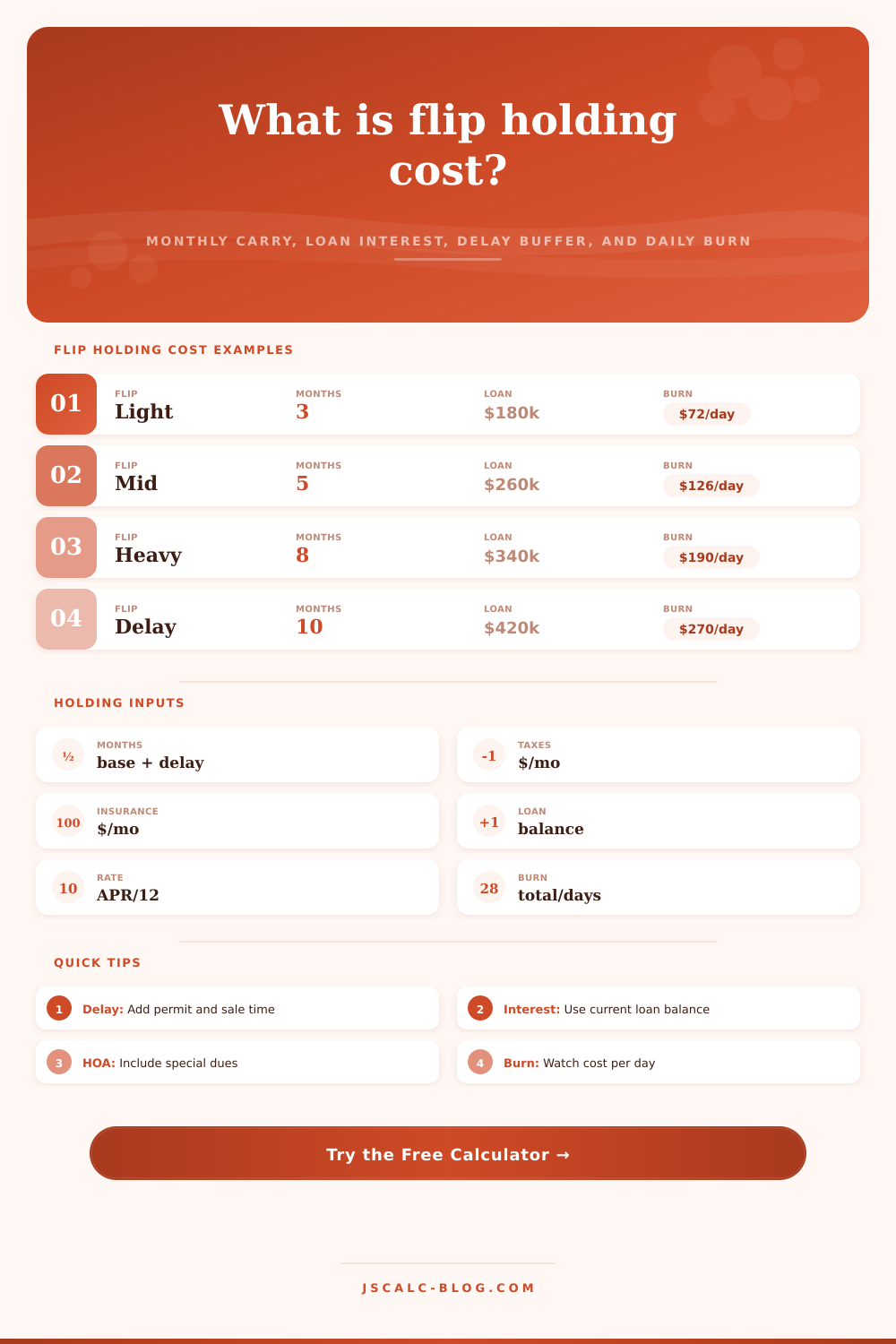
You begin with some base holding months and a delay buffer. Why? Because nothing ever goes according to plan. Exterior jobs get shut down by winter weather. Buyers require extended closing periods. Permits gets lost. Model the delay as its own variable so you know real cost of uncertainty. At a daily burn rate of one hundred eighty bucks, a slip of just twenty days will cost you three thousand six hundred dollars (before listing house). That’s money out of your pocket for sitting around and waiting.
So what’s it all mean? More than just feeding some numbers into a calculator, you need to know what those numbers represent. What are you carrying every month? Those are your property taxes, insurance, utilities, and (if applicable) HOA dues. Don’t skimp out on utilities when doing a rehab. They’re much higher then what you’d pay in a fully-occupied house. Contractors has multiple tools running and rooms needing to be heated. They are also dealing with waste water.
Next, consider the interest on your financing. This calculator assumes your loan interest is treated like a flat fee each month. It depends on how much you owe and your yearly interest rate. There’s no consideration for complex repayment schedules, which isn’t always true for hard money/bridge loans versus traditional mortgages. Bottom line: The interest keeps ticking upwards regardless of whether work is being done in site.
This tool provides a line item breakdown. Each of these fixed costs are listed individually and explains its contribution to the overall hold cost. Interest is scaled based off your loan size, and both insurance and taxes is considered flat monthly carries. The section on interpreting daily burn rate is worth reading through carefuly.
Under $75 per day? You probably have some margin. But over two-hundred? You’re dancing on thin ice. Every delay will weaken you. At this point, you might of have to accept worse deal terms or lower prices just to break even.
Many people neglect to factor in repair/maintenance/overhead costs when making calculations. You have to mow the lawn, shovel the snow, maybe install a monitoring system so someone doesn’t vandalize/squat in an empty home. Each one seem minor, yet they add up during a six month holding period. To account for this, there is fields on the calculator for recurring costs. Use them to get the complete picture.
Next time you calculate the results, take note of the “interest share” percentage. This represents how much of your monthly burn is spent on financing vs. This refers to operational overhead. If it’s too large, then you may be carrying excessive debt compared to the value of what you’re expecting to resell.
At the end of the day, it’s a wake-up call. It reminds you that time is money. If you don’t consider holding costs, a sweet-sounding deal will eventually turn bitter. Run those numbers upfront. Don’t stretch yourself too thin and get burned. Get an idea of where you need to move forward and where you should walk away. Your ultimate objective isn’t just completing the flip; it’s closing the deal while still having some wiggle room to enjoy the fruits of your labor.
Time doesn’t wait for anyone, including your loan officer.