After Repair Value Calculator
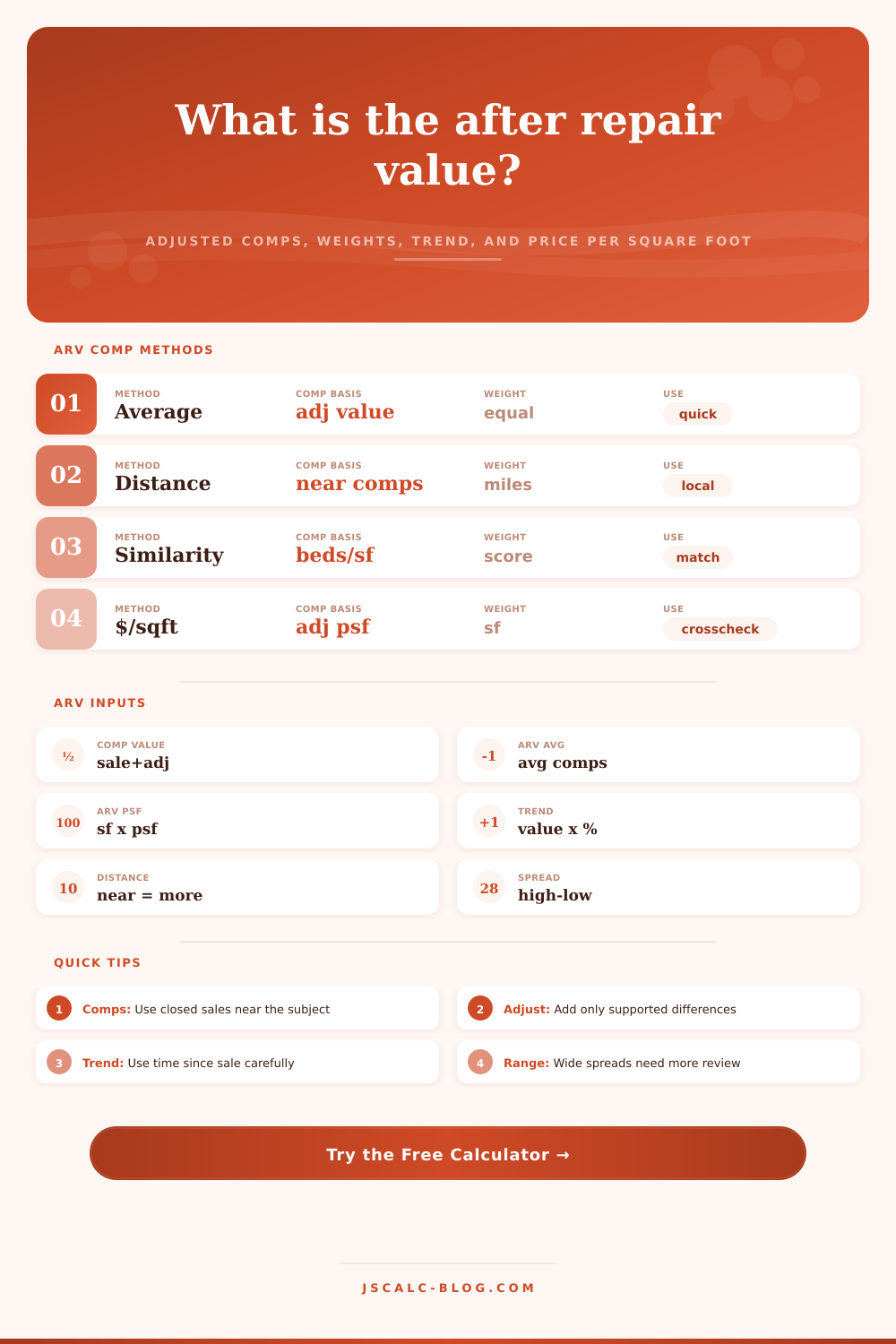
Estimate ARV from three adjusted comparable sales, weighted comp methods, market trend, condition adjustment, and a price-per-square-foot cross-check.
🎯ARV Presets
📝Subject and Method Inputs
Use the living area expected after repair.
Choose how the three adjusted comps are reconciled.
Applied to each adjusted comp after sale-price adjustments.
Use positive or negative dollars for post-repair condition difference.
🏡Comparable Sale Inputs
Comp 1
Comp 2
Comp 3
📊Current ARV Snapshot
🧮Formula Breakdown
🗂Comp Comparison Grid
| Comp | Sale price | Sq ft | Beds/baths | Distance | Net adj. | Trend adj. | Final adj. value | Adj. $/sqft | Weight | Weighted value |
|---|
⚖Weighting Method Reference
| Method | How it weights comps | Best use | Watch item | Output behavior |
|---|---|---|---|---|
| Equal average | One third each | Three very similar comps | Outliers count fully | Average adjusted value |
| Distance weighted | Closer sales get more weight | Subdivision or tight neighborhood | Nearest comp still must be similar | Weighted average adjusted value |
| Similarity weighted | Distance, sqft, bed, and bath match | Mixed comp set | Inputs need consistent living area | Weighted average adjusted value |
| Manual weights | User-entered percent weights | Broker or appraiser judgment | Weights should total near 100% | Weighted average adjusted value |
| Median adjusted comp | Middle final adjusted value | One high or low outlier | Ignores useful weighting detail | Median value as selected ARV |
| Price per square foot | Adjusted $/sqft applied to subject sqft | Size-sensitive properties | Square footage quality must match | Subject sqft x adjusted comp $/sqft |
| Conservative lower check | Lower of weighted value and psf ARV | Tight offer underwriting | Can understate strong comps | Lower reconciled ARV |
| Blended comp and sqft | 65% comp value, 35% psf ARV | General cross-check | Still depends on comp quality | Blended ARV |
📋Preset Benchmark Table
| Preset | Subject | Method | Trend | Comp 1 | Comp 2 | Comp 3 | Typical use |
|---|
📐Adjustment Reference Table
| Adjustment label | Common direction | Example driver | How to enter | Review cue |
|---|---|---|---|---|
| Square footage | Add to smaller comp | Comp has less living area | Positive dollar adjustment | Support with local $/sqft |
| Bedrooms | Add or subtract | Different functional bedroom count | Net into comp adjustment | Use paired sales when possible |
| Bathrooms | Add or subtract | Half bath or full bath difference | Net into comp adjustment | Watch layout utility |
| Garage and parking | Add to weaker comp | One-car vs two-car garage | Dollar adjustment | Neighborhood dependent |
| Lot and location | Add or subtract | Corner, road, view, school zone | Dollar adjustment | Do not double count distance |
| Finish level | Add to inferior comp | Renovated kitchen, baths, flooring | Condition or comp adjustment | Keep after-repair scope consistent |
| Sale date trend | Depends on market | Monthly appreciation or softening | Market trend percent | Use closed-sale timing |
💡ARV Calculation Tips
When analyzing an offer price, the first number to examine isn’t the offer price itself; it’s the after-repair value. If an offer price fall below the after-repair value, then your renovation project is financialy doable (assuming all costs are covered). If the offer price exceeds the after-repair value, then the renovation would of lose money before you even begin. Either way, misjudging the after-repair value mean either overpaying for asset or pricing yourself too low on the job.
Once you input comparable sales and adjustment factor, the calculator above figure out the math for you. It prevents those pesky mental errors from creeping in. These errors create flawed logic, it transforms spotty market data into a defensible estimate.
How to Calculate After-Repair Value
Next, locate three similar houses that sold within the last few months. Not houses as they are today, focus on what they’ll be like once they’re repaired! Not how they look now but how they will look when paint is dry and the floors is new. What about the paint job? You want to plug in the closed transaction numbers: Sale price = fact; Asking price = hope.
Plug in the comps’ sale prices (plus bedrooms, bathrooms, square footage) into the calculator. It adjust for any differences between your house and the comps. For example, if one of the comps include a half bath, the system will knock value off that home until it match your typical two-full-bath configuration. That’s fair; that makes sense; now we can compare apples to apples.
Neighborhoods change fast: Many people don’t realize how much it matter where a house is located. Just because two houses are both 3 miles away doesn’t mean they’re equal, one might be on a busier road or in a different school district. This make all the difference to a buyer. With weighting options, you can adjust your search so that nearby sales has more weight than those far away (because neighborhoods do shift rapidly). Use the option of ‘distance-weighted averaging’ to weight more heavily toward the property down the block versus the one across town. This small adjustment tend to match results with what local agent will tell you about individual streets.
Adjustments, Trends Trends need to be handled with care. You’ll want to add the trend adjustment if your data lag behind and prices are up 2 percent since the comparable sales closed. But if the market’s not truly hot (just historically noisy), don’t hide that fact. Adding a trend percentage to stale comps can drive your expectations beyond the price buyers will pay today. Before finalizing the average, you can adjust each of the comps by this percentage using the tool.
The next step is Condition adjustments: How close is the subject property to its repaired condition? In other words, how much it is worth once it’s fixed? Let’s say that you have an old kitchen, but the structure is solid. That’ll cost $5,000 in repairs. Add or subtract that number right into the comp values on the calculator, which simulate the value of the finished product. Why? Because most people make mistake of taking distressed sales as comps for their own renovated house. Don’t use the value of the starting block; use the value of the finish line.
An additional confidence boost comes from cross checking against price per square foot. It also takes the adjusted comps and compares the average price per square foot to your subject’s square footage. When there’s a big difference here, stop. Usually this mean one of the comps is an outlier or you took too large of an adjustment. There is a reference table on the page that describes how each method behaves different than others. This helps you determine whether you should be more conservative and go with the lower check based off your underwriting needs.
And walking around the neighborhood will never be replaced by any tool. Intuition is the ceiling, and data is the floor. The numbers don’t ensure your profit, they show your minimum risk. When the deal is right, the after-repair value estimate give you the discipline to walk away (when it’s not) and the courage to write that check. That’s what realy matters about doing the work upfront.