Fiscal Year Date Calculator
Find the fiscal year label, start date, end date, fiscal day number, percent elapsed, remaining days, fiscal quarter, and period tables for any fiscal start month and day.
Fiscal Year Results
| Fiscal Month | Calendar Window | Days | Cumulative End Day | Status |
|---|---|---|---|---|
| Month 1 | Jan 1-Jan 31 | 31 | 31 | Before selected date |
| Quarter | Start Date | End Date | Length | Selected Date Status |
|---|---|---|---|---|
| FQ1 | Jan 1, 2026 | Mar 31, 2026 | 90 days | Complete |
| Fiscal Day | Date | Fiscal Period | Percent Elapsed | Days Remaining |
|---|---|---|---|---|
| Day 1 | Jan 1, 2026 | FQ1 M1 | 0.3% | 364 |
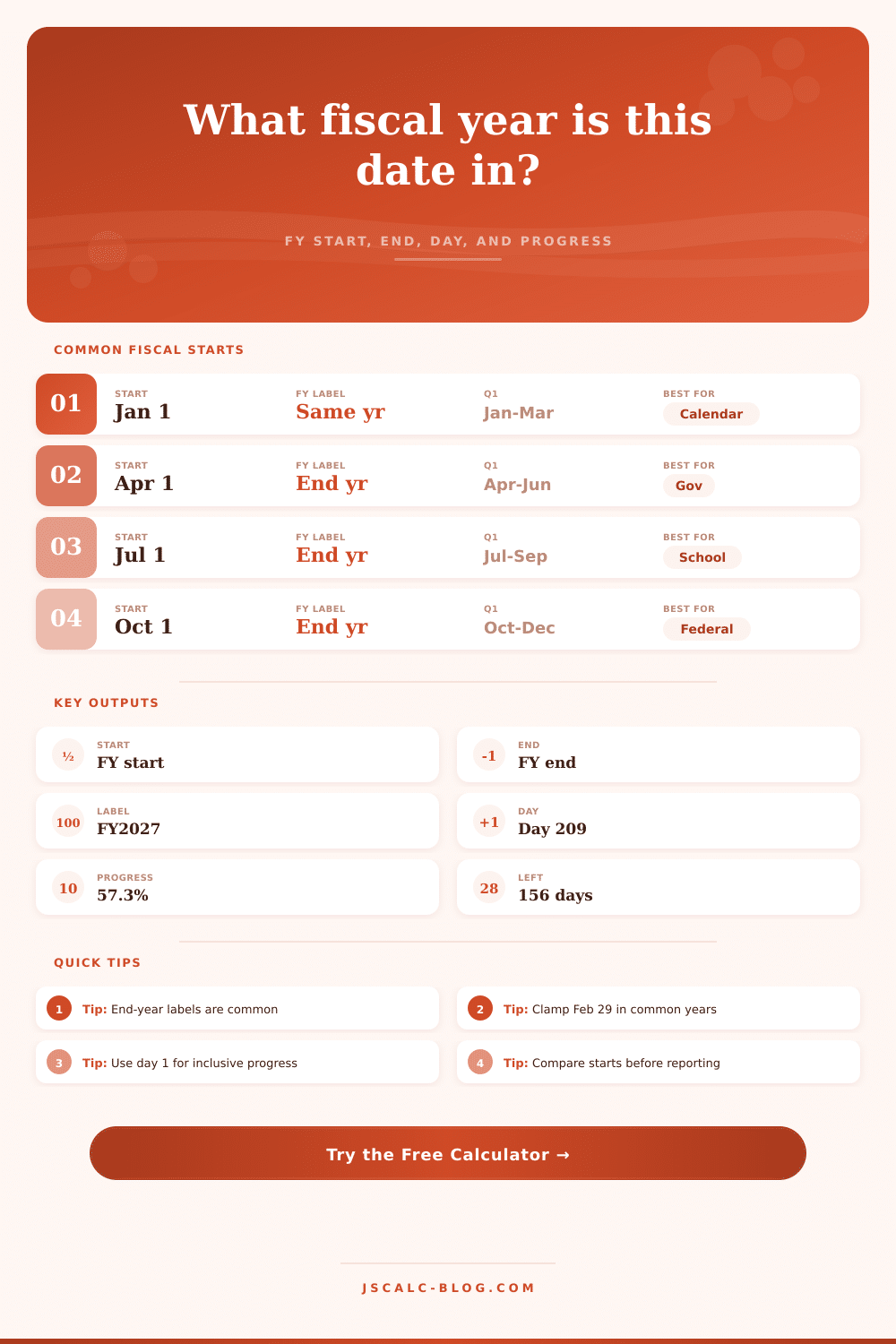
| Fiscal Start | Typical Label | Example FY Window | Fiscal Q1 | Common Use |
|---|---|---|---|---|
| January 1 | Starting or ending year | Jan 1-Dec 31 | Jan-Mar | Calendar-year reporting |
| February 1 | Ending year | Feb 1-Jan 31 | Feb-Apr | Retail planning calendar |
| April 1 | Ending year | Apr 1-Mar 31 | Apr-Jun | Government or nonprofit reporting |
| July 1 | Ending year | Jul 1-Jun 30 | Jul-Sep | Academic and school budgets |
| October 1 | Ending year | Oct 1-Sep 30 | Oct-Dec | Federal-style planning year |
| Custom day | Policy dependent | Any month/day boundary | Three-month blocks from start | Contracts and internal reporting |
The common wisdom say that the fiscal year starts on Jan 1 and ends on Dec 31. This makes sense: we have a wall-mounted calendar, so why shouldn’t our calendar-based fiscal year mirror that? But as any government budget officer (or savvy CFO) can explain, in real world things are much more messy.
A fiscal year isn’t an astronomical instrument; it’s a management instrument. We use it to match our financial reports to operational cycles, legislative sessions, or harvesting seasons.
Why You Need a Fiscal Year Calculator
If your fiscal year doesn’t align with the new year, then the arithmetic can get complex. And that’s where this calculator comes into play. It takes away all of complexity of years that overlap and provides you with a clear starting point for any given date.
And therein lies the problem. What if the company’s fiscal year is from July 1st, 2026, through June 30th, 2027? Is that FY2026 or FY2027? That’s completely dependent on whoever has the pen. For example, many companies will label their year based off the calendar year it ends within. In this case, it would be FY2027. Some others like the year they start with.
You get to choose how your year labels is formatted. The tool above makes it easy to toggle labeling convention, so you can show what your company calls FY when you present your report instead of a default internet standard. And while it’s a small thing, it avoids the embarrassment of walking into a board meeting with budget called FY2026 when everyone wants to call it FY2027.
Besides labels, it’s also important to know when each quarter begin. If you’re a summer retailer and want to plan inventory, knowing that your fiscal year begins in April doesn’t help much since the quarters don’t line up with the seasons. With the calculator, we break out the fiscal periods into nice start and end dates. For instance, it’ll tell you exactly which quarter any given date falls in. That way you can see where things lie and track their performance accordingly.
Maybe on calendar quarters, you wonder why your sales drop off in March? But then if you switch to fiscal quarters, maybe they actualy just dropped off at the tail end of Q1 in November. Context is everything.
The app will auto generate these period tables. This way, you don’t have to count days by hand through different month lengths and leap years.
The other thing that confuses manual calculations are leap years. Some budget years contains a February 29; some don’t. If you use a budget year starting on February 1, then whether or not that year contains a leap day will affect how long the year is. The calculator handles this by automatically clamping invalid dates. That means if your fiscal year begins with February 29 (common year), there’s no problem: it adjusts to maintain a steady flow, so your boundary becomes February 28. Attention to these kinds of details helps avoid sorts of errors where a budget model suddenly acquires an extra day of expenses and doesn’t fit anywhere in the month.
But what about progress? Sure, I know it’s going to be Q3. But do you know that it’s day 209 out of 365? It is 57 percent of the way through the year. That knowledge gives you some urgency.
The percentage elapsed lets you track how your actual spending compares to your planned budget as a ratio. And when you realize youve spent 70 percent of your budget, while only 40 percent of the fiscal year has occurred, well, then you’ve got a problem.
The system calculates that percentage according to actual length of the fiscal year. Or you could choose a standard 365-day denominator, should your planning models needs a fixed base. Either way, it closes the loop between theoretical planning and real-world accounting.
But overall, a fiscal year date calculator isn’t really a date finder, it’s a way to create a common vocabulary around time inside your company. It’s a way to have all parties agree on what quarter it is, when the year began, and how many days remain.
Communication will improve. Your meetings will be shorter. Your reports will be clearer.
With the tool above, you get math done for you, so you can concentrate on the dollars. It brings a confusing mess of policy and dates down to one clear timeline. You know whether it’s February and time to start thinking about next years retail inventory cycle, or October and it’s finally time to start applying for that government grant.
A clear answer to where you sit in the fiscal calendar is worth the couple of seconds it costs to press the calculate button. The key is knowing what you’re even measuring, and this tool makes it plain.