Days Left in the Year Calculator
Pick a date and count calendar days, business days, weeks, percent elapsed, and percent remaining through December 31 with inclusive or exclusive counting.
Days Left Results
| Month | Calendar Left | Business Left | Holiday Hits | Status |
|---|
| Date | Day Number | Calendar Left | Business Left | Year Progress |
|---|
| Date | Weekday | Status | Effect |
|---|
| Metric | Formula | Uses Basis? | Output |
|---|
Then one day you wake up and it’s suddenly just three months to go until end of the year. It’s not a future on a map anymore; it’s a series of checkboxes marking your way to Obligationtown. You look out at the calendar and take that quick gasp of air. It is the moment you know: time is passing more quicklier than you realized.
We all intuitively guess our remaining days, but intuition sucks at converting calendar days in business days. Enter the calculator above, which eliminates the guessing game by showing you exactly how many days you has left before you’re staring at December.
How to Count Your Days
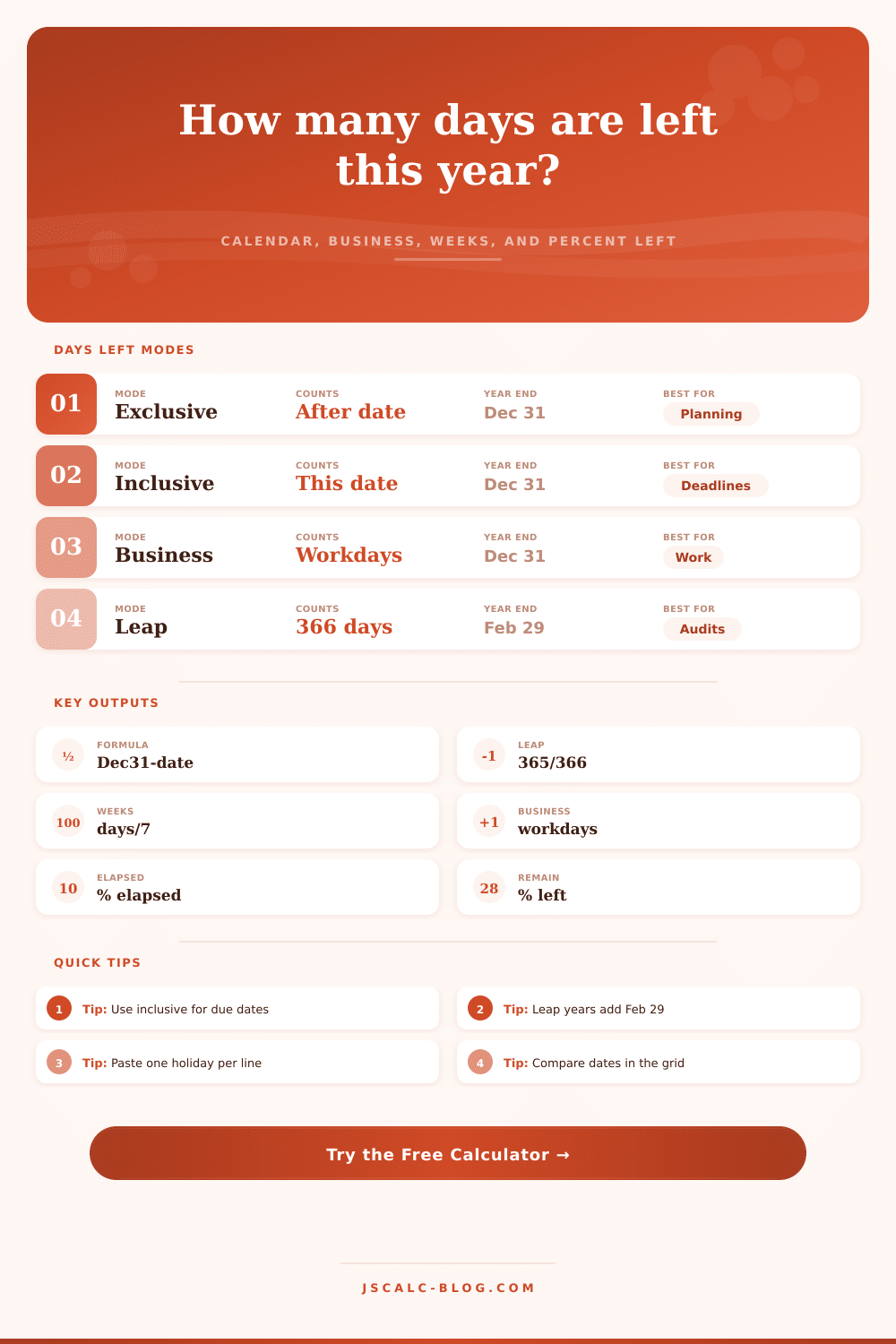
Before anything else, though, should we be counting days inclusively or exclusively? It seems like a small point of meaning, but it change our plan’s planning horizon by an entire day. Inclusive counting give us that day, and it’s relevant if you’re packing a project into a narrow time slot. You might have workday left on the chosen date, so you want to use inclusive counting.
On the other hand, exclusive counting lets you plan in clean terms for things that will occur only after this very instant. It treats now as having passed, which is nice when you’re doing something that happen after right now. This distinction feels trivial until you’re trying to wedge two weeks worth of work into a ten-day crack.
And then there’s the issue of business days. In the land of payroll and logistics, not every day are treated equally. For example, a traditional Monday-through-Friday schedule might work for a corporate office. However, it won’t work for hospitality and retail sectors that run six or seven days a week.
Being able to switch out workweek variations. Such as working Tues-Sat instead of M-F, is key to getting this right. It’s easy to get derailed here, as many folks mistakenly think that a regular ol’ business-day count take into account their highest-volume days of the week. They don’t. By inputting specific holidays as well, you can take those off the tally. This is why so many people miss the mark.
They forget that if a holiday falls on a non-working day, being closed won’t realy cost you anything. Double counting loss is what happens when you subtract a Sunday holiday during Christmas, knowing that you weren’t open anyway.
Another factor that doesn’t get mentioned much but does come into play is that every four years we tack on an extra day (February 29) to make up for Leap Years. In this case, both the portion of time that has passed and the portion of time remaining until the next date shift change by a significant amount; about one quarter of a percent, even though adding a single day might not sound like much.
If you’re measuring the financial success of something or auditing some contract, that little bit of time can change your denominator and thus your percentage of time left until the next milestone. You don’t have to keep the rules in mind for what leap years are, as the calculator handles the Gregorian rules automaticly. The calculator figures that out for you. It is a little thing, but it makes a difference when accuracy matters.
In addition to seeing where you stand compared to a future checkpoint (useful), you’ll be able to compare how your actual results stack up now versus then (also useful). Instead of looking blankly at a single number, you can visualize your progress. If you want to know if you’ve closed half the gap from today to the 1st of October, you’ll be able to see that, giving you a concrete understanding of how much more you have to go.
The monthly remainder table takes this even farther, it will show you exactly how many workdays is remaining until the end of each month. It makes something abstract (“the rest of the year”) into easy parts by the month.
Time, we like to imagine, is flowing through our fingers like an endless river. But, when it comes down to planning, it’s not. It’s made up of distinct chunks of day. These days are your money.
Once you can see them, the days on your calendar versus the days you get to use, you stop fretting over the rapidity with which they escape and begin working with whatever amount you have. Nothing changes in the numbers, but everything shifts in your thinking: It’s no longer just about time spent, but about time remaining. And that adjustment in mindset transforms a countdown into a plan.
You should of known this sooner.