FICA Tax Calculator
Estimate employee Social Security, Medicare, Additional Medicare tax, employer match, paycheck wage-base limits, and self-employment payroll tax equivalents.
The year controls the OASDI wage cap used for Social Security tax.
Paycheck mode uses prior year-to-date wages before this check.
Employer withholding still begins after $200,000 of Medicare wages.
Internal calculations keep cents before display rounding.
Usually gross wages subject to Social Security before the annual cap.
Medicare has no annual wage cap.
Used to calculate only the SS taxable part of the next paycheck.
Enter the gross wages on the paycheck that are subject to OASDI.
Used for the $200,000 employer Additional Medicare withholding trigger.
Usually the same as current Social Security wages unless payroll boxes differ.
Use 52 weekly, 26 biweekly, 24 semi-monthly, or 12 monthly.
Adds a forward-looking paycheck projection at current wages.
| Component | Employee Rate | Employer Rate | Wage Limit | Calculator Treatment |
|---|---|---|---|---|
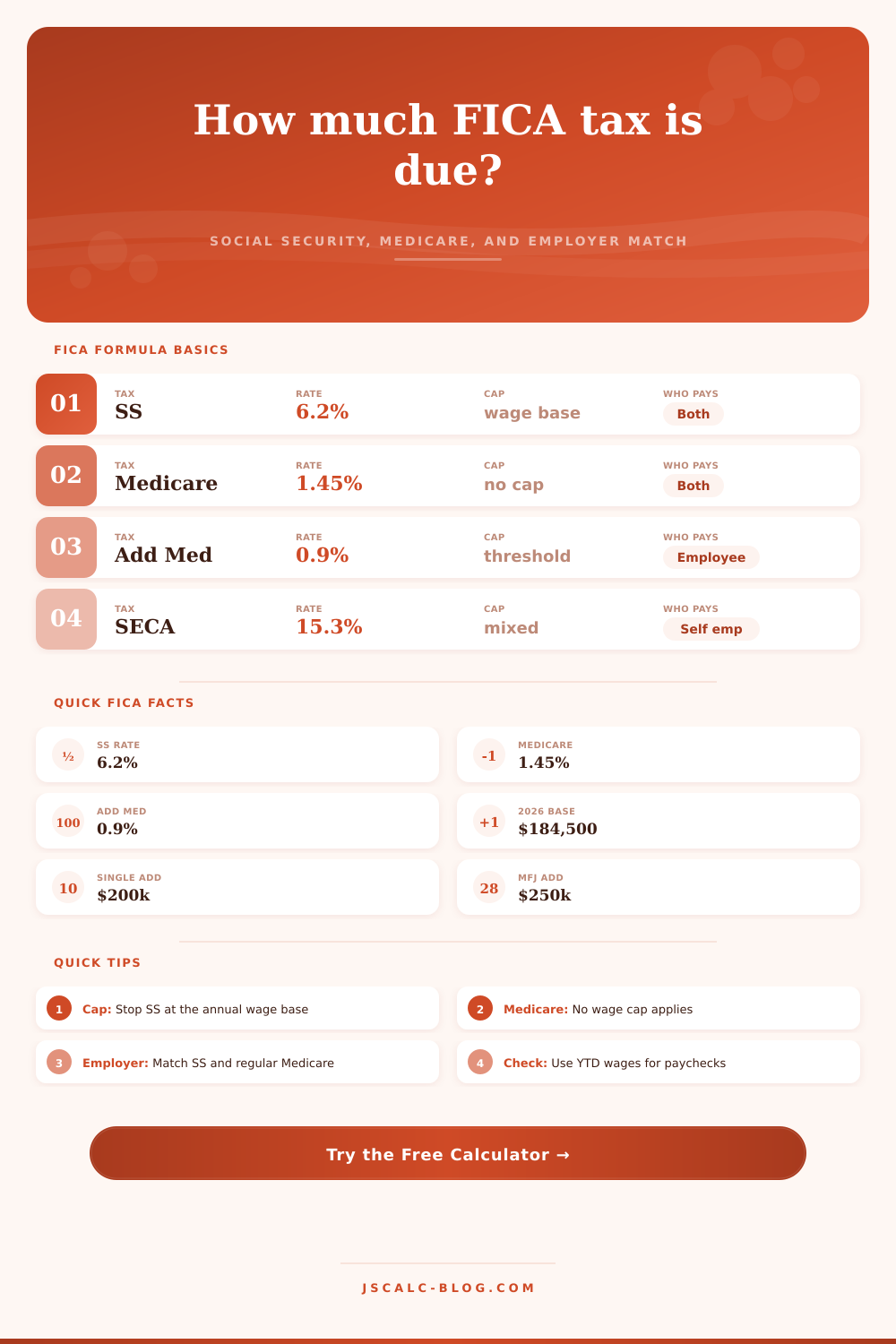
| Social Security OASDI | 6.2% | 6.2% | Annual wage base | Applies only to wages up to the selected year cap. |
| Regular Medicare HI | 1.45% | 1.45% | No cap | Applies to all Medicare wages entered. |
| Additional Medicare | 0.9% | 0% | Filing threshold | Employee-only tax on wages above the filing-status line. |
| Employer withholding trigger | 0.9% | 0% | $200,000 | Paycheck mode shows the employer trigger separately from final liability. |
| Self-employment estimate | 12.4% + 2.9% + 0.9% | N/A | 92.35% factor | Uses net earnings x 92.35% before SECA-style tax math. |
| Employer match | N/A | 6.2% + 1.45% | SS cap only | Does not include Additional Medicare tax. |
| Year | OASDI Wage Base | Employee Max SS | Employer Max SS | Combined SS Max |
|---|---|---|---|---|
| 2026 | $184,500 | $11,439.00 | $11,439.00 | $22,878.00 |
| 2025 | $176,100 | $10,918.20 | $10,918.20 | $21,836.40 |
| 2024 | $168,600 | $10,453.20 | $10,453.20 | $20,906.40 |
| 2023 | $160,200 | $9,932.40 | $9,932.40 | $19,864.80 |
| 2022 | $147,000 | $9,114.00 | $9,114.00 | $18,228.00 |
| Filing Status | Taxpayer Threshold | Additional Rate | Employer Withholding Trigger | Practical Check |
|---|---|---|---|---|
| Single | $200,000 | 0.9% | $200,000 wages | Employer trigger usually matches final threshold. |
| Head of household | $200,000 | 0.9% | $200,000 wages | Same threshold as single in this calculator. |
| Qualifying surviving spouse | $200,000 | 0.9% | $200,000 wages | Same threshold as single in this calculator. |
| Married filing jointly | $250,000 | 0.9% | $200,000 wages | Payroll may withhold before the joint return owes tax. |
| Married filing separately | $125,000 | 0.9% | $200,000 wages | Final tax can exceed paycheck withholding. |
| Employer match | Not applicable | 0% | Not matched | Employers do not match Additional Medicare tax. |
| Scenario | Year | Filing | OASDI Wages | Medicare Wages | Employee FICA | Employer Match | Combined Total |
|---|---|---|---|---|---|---|---|
| Current annual inputs | 2026 | Single | $95,000 | $95,000 | $7,267.50 | $7,267.50 | $14,535.00 |
| Prior YTD SS Wages | Current SS Wages | 2026 SS Subject | Employee SS Tax | Why It Matters |
|---|---|---|---|---|
| $0 | $4,000 | $4,000 | $248.00 | Full check is below the wage base. |
| $180,000 | $8,000 | $4,500 | $279.00 | Only the part up to $184,500 is taxed for SS. |
| $184,500 | $8,000 | $0 | $0.00 | Employee has already reached the 2026 cap. |
| $195,000 | $10,000 | $0 | $0.00 | Medicare still applies even when SS stops. |
| $199,000 Medicare | $4,000 Medicare | N/A | N/A | Additional Medicare withholding applies to $3,000. |
| $250,000 Medicare | $6,000 Medicare | N/A | N/A | Entire check is beyond the employer withholding trigger. |
JSCalc-Blog.com: This FICA tax calculator uses stated federal Social Security, Medicare, Additional Medicare, employer match, and self-employment formulas for planning. It is not payroll compliance, tax filing, or legal advice.
Do you look at your paycheck stub? You’ll notice a line for Social Security tax. Another one for Medicare. Maybe an even smaller line for Additional Medicare, if you’re earning enough to hit the threshold.
Payrolls just plucking numbers from thin air, right? Wrong. Your withholdings aren’t random; they’re a strict calculation based off the Federal Insurance Contributions Act. The FICA have set annual rates and caps for these withholdings. So, when you’re trying to guess your take-home pay, understanding the process behind it will help you gets more accurate predictions.
How FICA Taxes Work
On the FICA side, Social Security portion is the most constrained part of the equation: there’s an annual wage base limit, where you cease paying 6.2% of your salary after your total pay reaches a certain threshold. In 2026, that will occur at $184,500 in wages. After this point, you don’t pay any further Social Security tax; it doesn’t roll over. This is why if you have two job (or are a very high earner), you could find yourself getting over-withheld, each employer won’t know what the other one is doing! The calculator above incorporates all the math for you when you enter your year-to-date earnings, so you won’t need to calculate the leftover taxable income until you reach the cap.
Because Medicare lacks a cap, you will continue to pay 1.45% on each wage dollar forever. They fund it by keeping the rate in line with pay increases. But there’s another wrinkle. If you’re a high-earner, you’ll owe another 0.9% tax on income beyond specific thresholds. Your threshold depends on your filing status. The extra tax applies to single filers on income exceeding $200,000, different than $250,000 for married couples who file jointly. For everyone, the employer withholding amount trigger at $200,000 regardless of status. This could cause some joint-filing couple to end up getting money back at the end of the year because too much was withheld during the year. It is a little thing, but it affects your cash flow.
The total cost of regular Medicare and Social Security is doubled because employers matches what you put in. That’s a big cost for companies, but one that doesn’t hit them with the Additional Medicare tax. The additional 0.9% fall entirely on employees.
For the self-employed person, it gets trickier. He or she pays the employee portion plus the employer share. However, he or she also gets to deduct half of his or her self-employment tax as a business expense. The calculator takes that into account: It uses the 92.35% factor on net earnings to give you a look at how much you’d owe under that scenario.
That’s why many folks are thrown by when they’re paid. Your tax rate essentially drops for the rest of the year if you’re near the Social Security cap. So as the year winds down, your take home amount will be a bit higher, though no one has boosted your salary. A piece of the tax just dissapears. It’s actualy part of the design; it isn’t a bug. The page’s reference table explains that and shows how prior year-to-date earnings affect the tax amount from each paycheck.
One thing that people tend to overlook: These amounts fluctuate from one year to another. Inflation causes the wage base to adjust, meaning the cap increase each year. So if you’re basing your financial plans on last year’s wages, you’ll be operating under a false assumption. You should of see this year’s limits; and that’s what the tool does for you automatically. No more digging through old IRS publications.
Ultimately, your FICA taxes are automatic and they’re non-negotiable. You can’t alter the rate or choose to opt-out. However, you can predict those taxes. Once you understand when the additional Medicare tax applies and how the cap functions, you have a sense of control as to where that money goes. Maybe it doesn’t mean more in your pocket today, but at least you’ll know what it’s doing there. Once you put the puzzle pieces together, it’s simple math, even if the system itself is complicated.