Overtime Threshold Calculator
Estimate nonexempt overtime using FLSA weekly overtime after 40 hours, optional daily thresholds, weighted regular rates, and salary nonexempt premium math.
⚙ Workweek Presets
📝 Pay Inputs
Used for weighted regular-rate calculations.
Included in regular rate for the workweek.
⏱ Workweek Hours
📏 Threshold Rules
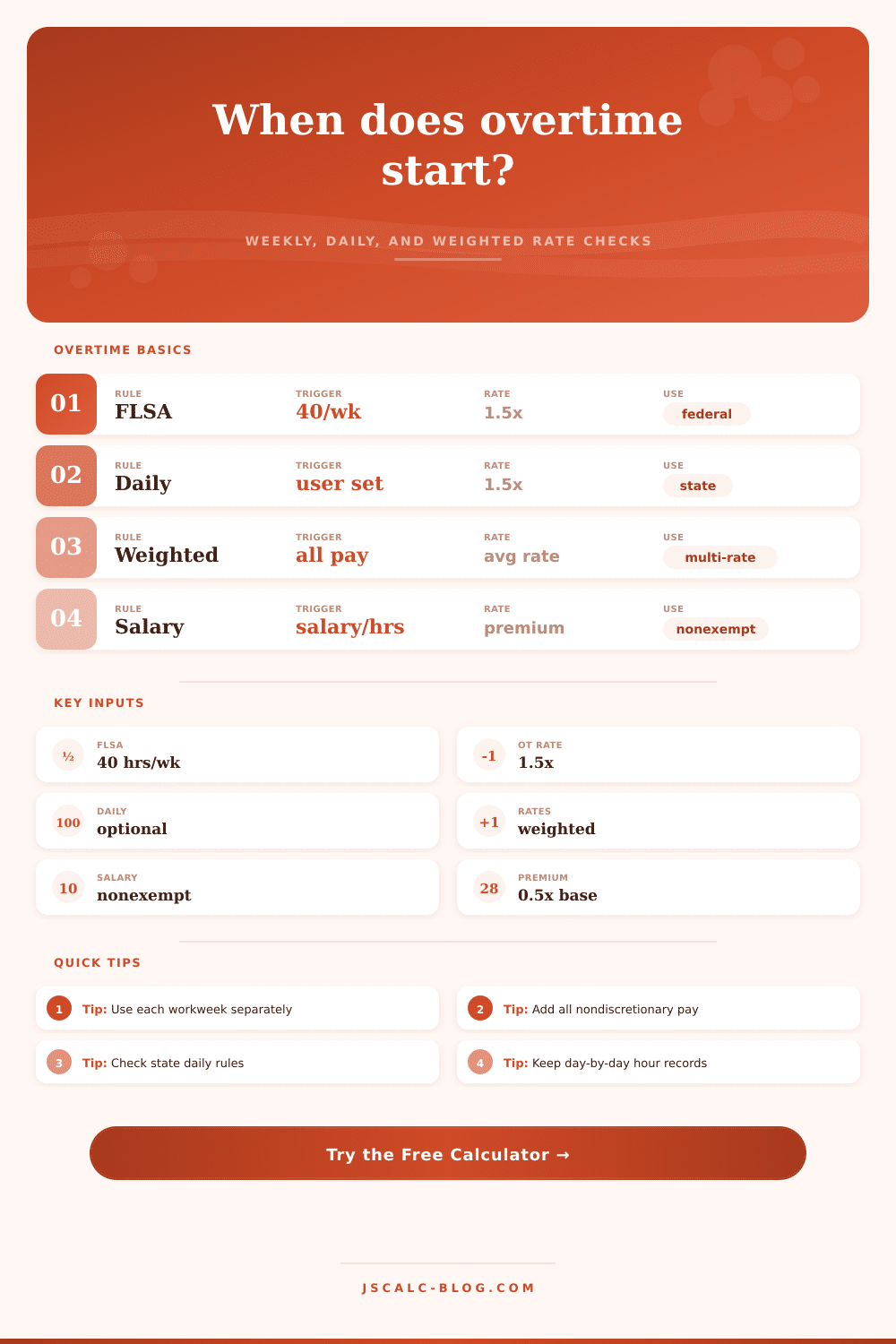
Federal FLSA overtime generally starts after 40 hours in a workweek for nonexempt employees at 1.5 times the regular rate. Daily thresholds vary by state, agreement, or policy, so enter the applicable daily rule when it applies.
Formula Breakdown
📊 Overtime Rule Snapshot
📘 Formula Reference
| Item | Formula | When It Applies | Calculator Treatment |
|---|---|---|---|
| Total hours | Mon through Sun hours added | Every nonexempt workweek | Uses day-by-day entries |
| FLSA weekly overtime | Max(0, total hours - weekly threshold) | Federal baseline, usually after 40 hours | Default threshold is 40 |
| Daily overtime | Sum of daily hours above daily threshold | Only where a daily rule applies | Disabled when daily threshold is 0 |
| Weekly-only overtime | Max(0, weekly overtime - daily overtime) | Prevents double counting the same hours | Adds after daily overtime is credited |
| Weighted regular rate | Straight earnings divided by total hours | Multiple hourly rates or bonus weeks | Includes nondiscretionary bonus amounts |
| Overtime premium | OT hours times regular rate times extra multiplier | When straight-time pay is already included | Uses multiplier minus 1 |
⏲ Weekly Hours Quick Lookup
| Total Hours | FLSA OT Hours | Straight-Time Hours | Premium at 1.5x |
|---|---|---|---|
| 38 | 0 | 38 | 0.0 regular-rate hrs |
| 40 | 0 | 40 | 0.0 regular-rate hrs |
| 42 | 2 | 42 paid straight | 1.0 regular-rate hrs |
| 45 | 5 | 45 paid straight | 2.5 regular-rate hrs |
| 50 | 10 | 50 paid straight | 5.0 regular-rate hrs |
| 60 | 20 | 60 paid straight | 10.0 regular-rate hrs |
⚖ Salary Nonexempt Reference
| Salary Arrangement | Regular Rate | Straight-Time Pay | Premium Logic |
|---|---|---|---|
| Salary covers fixed 40 hours | Weekly salary / 40 | Salary plus straight pay beyond 40 | Extra 0.5x on overtime hours |
| Salary covers fixed 37.5 hours | Weekly salary / 37.5 | Salary plus straight pay beyond 37.5 | Premium applies after OT threshold |
| Salary covers all hours worked | Weekly salary / total hours | Salary already covers straight time | Half-time premium at 1.5x |
| Salary plus nondiscretionary bonus | (Salary plus bonus) / covered hours | Bonus included in regular rate | Premium rises with bonus amount |
🗂 Scenario Comparison Grid
| Scenario | Basis | Total Hours | Threshold Used | Regular Rate Method | Premium Focus |
|---|---|---|---|---|---|
| Standard hourly overtime | One hourly rate | 45 | 40 weekly | Base hourly rate | 5 hours at extra 0.5x |
| Two-rate retail week | Two hourly rates | 48 | 40 weekly | Weighted average | 8 hours at weighted premium |
| Daily overtime state | One hourly rate | 38 | 8 daily | Base hourly rate | Daily hours can create OT under 40 |
| Long hospital shifts | One hourly rate | 48 | 12 daily and 40 weekly | Base hourly rate | Compare daily and weekly credits |
| Salary fixed 40 | Salary nonexempt | 50 | 40 weekly | Salary divided by 40 | Straight extra plus OT premium |
| Salary all hours | Salary nonexempt | 50 | 40 weekly | Salary divided by 50 | Half-time premium only |
| Bonus week | Hourly plus bonus | 46 | 40 weekly | Pay plus bonus over hours | Bonus increases regular rate |
| Weekend differential | Two hourly rates | 44 | 40 weekly | Weighted average | Differential included before premium |
📌 Actionable Checks
It does all that tricky math for you (and if it’s not working, let me know). Just plug in your rate and number of hours worked, and it spits out regular time, extra pay, and your total gross earnings from your paycheck, whether according to the federal law (which limits it by the week), state law (usually one day at a time) or your unique arrangement with your boss.
Most people believe overtime is just working more than 40 hours per week and getting paid for it. But life is messier, Overtime is more complicated. And that’s where things go wrong.
How to Calculate Your Overtime Pay
You flip a switch, choose your setup; either an hourly rate, a mix of wages and hourly pay, or if you are salaried and don’t fall into the exempt category, then select your particular workweek, and voila! Here’s how you’ll get paid.
The basic rule: Under federal law, if you work more than 40 hours in a workweek, you must be paid at one and a half times your regular rate of pay for all overtime. But what is your regular rate? Your regular rate isn’t necessarily simply your base hourly wage. Nondiscretionary bonuses, shift differentials, and night premiums, anything that isn’t decided by your boss, is included in the regular rate before overtime are calculated. To reflect this, the calculator above use a weighted average to calculate the overtime premium based off actual value of your work. It is not simply the bottom dollar per hour.
To further complicate matters, there’s also daily overtime. In some states, you’re paid time-and-a-half once you hit an eight- or ten-hour mark within one day (even if you don’t exceed forty hours during the week). This means that you could work just thirty-eight hours that week and still be forced into overtime pay on Monday. The table on that page make this pretty clear; it shows where the weekly and daily thresholds meet. Do you know whether your union contract or state requires daily limits? If so, enter that number for the “daily threshold.” That number have a big impact on the results. Those additional hours gets added in before the weekly sum is calculated. This means the employer can’t try to double-count those hours to dodge paying the premium.
Nonexempt salaried workers has other challenges. Being paid a salary does not mean you’re exempt from being paid overtime. For people who are covered by overtime (nonexempt), their salary need to be reduced to an hourly rate according to how many hours that salary is intended to cover. Does it cover a fixed 40 hour week? All the hours they’ve worked? The tool provides those options because they make a difference. A lower regular rate result in a smaller overtime check. With a salary covering all hours, the regular rate will be further diluted when you work more (which can seem counterintuitivly). But the law dictates that we use that diluted rate for calculating the premium, so the tool also shows precisely how that premium come out in practice.
Remember: This is an estimator to plan with and check, but it isn’t meant to replace a proper payroll audit completed by a certified payroll auditor. Different jurisdictions has different rules on labor, and your own company’s policy may provide even better benefits than the law requires.
You should of checked this. Double-check what those bonuses is classified as and what your local daily levels are. You want to know how a bonus builds into your regular rate and when your hours triggers overtime pay. When you get a handle on the math behind the inputs, the figures won’t be a mystery anymore, they’ll clearly reflect the value of your labor. That’s something the calculator above will show you, so long as you don’t lose yourself in the spreadsheet.