Payroll Tax Calculator
Estimate employee FICA, federal withholding, state and local withholding, employer FICA, and take-home pay from one paycheck setup.
Each preset loads a full paycheck pattern, then you can edit any field.
| Scenario | Gross | FIT wages | Employee FICA | Federal | Net pay | Employer FICA |
|---|---|---|---|---|---|---|
| Run the calculator to compare payroll changes. | ||||||
| Payroll item | Employee rate | Employer rate | Wage base | Formula note |
|---|---|---|---|---|
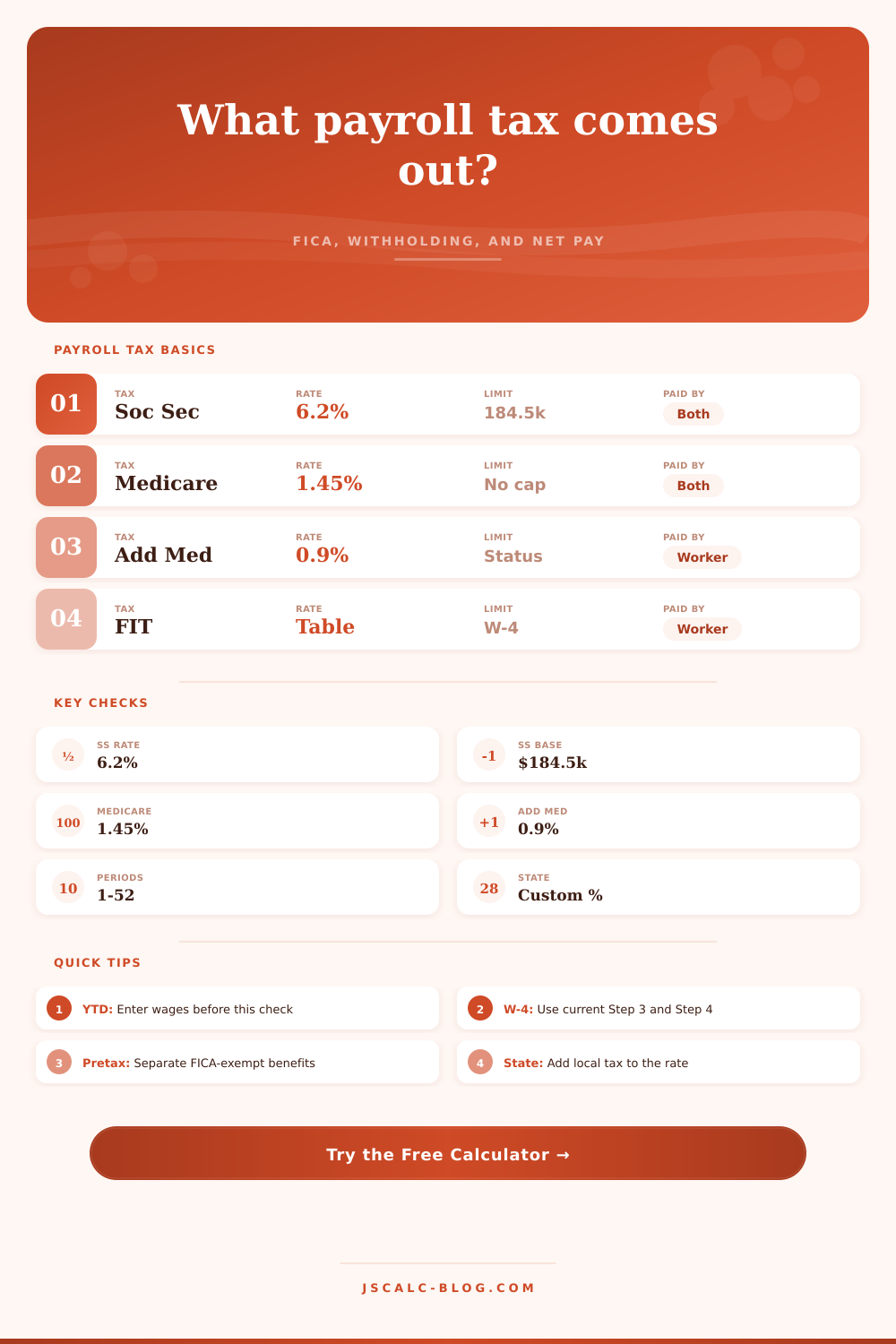
| Social Security OASDI | 6.2% | 6.2% | $184,500 | Applies until remaining wage base is used |
| Medicare HI | 1.45% | 1.45% | No cap | Applies to all Medicare wages |
| Additional Medicare | 0.9% | 0% | Status threshold | Applies only above selected threshold |
| Employer FICA match | None | 7.65% base | SS cap applies | Employer does not match Additional Medicare |
| 401(k)-style deduction here | FIT reduction | No FICA reduction | Plan rules | Modeled as income-tax pre-tax only |
| Cafeteria benefits here | FIT and FICA reduction | FIT and FICA reduction | Plan rules | Modeled as FICA-exempt benefits |
| Threshold basis | Annual threshold | Who pays | Rate | Calculator use |
|---|---|---|---|---|
| Single | $200,000 | Employee | 0.9% | Used when filing status is single |
| Head of household | $200,000 | Employee | 0.9% | Same threshold as single |
| Married filing jointly | $250,000 | Employee | 0.9% | Used for married joint setting |
| Married filing separately | $125,000 | Employee | 0.9% | Available as manual threshold basis |
| Employer withholding rule | $200,000 | Employee withheld | 0.9% | Payroll systems begin withholding above this wage level |
| Employer share | Not applicable | Employer | 0% | No employer match for Additional Medicare |
| Frequency | Periods | Common use | Annualized wage formula | Check timing note |
|---|---|---|---|---|
| Weekly | 52 | Hourly payroll | Taxable check x 52 | Small check, fast YTD movement |
| Biweekly | 26 | Salary and hourly | Taxable check x 26 | Two months can have three checks |
| Semimonthly | 24 | Salaried payroll | Taxable check x 24 | Usually twice per calendar month |
| Monthly | 12 | Executives or small teams | Taxable check x 12 | Larger per-check withholding |
| Quarterly | 4 | Owner or bonus cycle | Taxable check x 4 | Useful for large irregular payroll |
| Annual | 1 | One-time annual payroll | Taxable check x 1 | Rare for normal wages |
| Filing status | First taxable range | Middle range example | Top range starts | W-4 Step 2 effect |
|---|---|---|---|---|
| Married filing jointly | 0% under $19,300 | 22% over $120,100 | $788,000 | Uses narrower checkbox schedule |
| Single or MFS | 0% under $7,500 | 22% over $57,900 | $648,100 | Uses narrower checkbox schedule |
| Head of household | 0% under $15,550 | 22% over $83,000 | $656,150 | Uses narrower checkbox schedule |
| Standard deduction addback | $12,900 MFJ | $8,600 otherwise | Not used if Step 2 checked | Built into adjusted annual wage |
| W-4 credits | Subtract yearly credits | Then divide by periods | Floor at zero | Step 3 input controls this |
| Extra withholding | Per-check amount | Added after credits | No annualization | Step 4(c) input controls this |
gross pay is salary per period, hourly regular plus overtime, or manual gross, plus supplemental wages.
Social Security uses 6.2% x the smaller of current FICA wages or remaining 2026 wage base. Medicare uses 1.45% x Medicare wages. Additional Medicare uses 0.9% x current wages above the chosen YTD threshold.
federal withholding estimate annualizes FIT wages, applies W-4 Step 4(a), Step 4(b), the 2026 percentage schedule, Step 3 credits, and extra per-check withholding. The supplemental option taxes regular wages with the annual method and supplemental wages at 22%.
net pay = gross pay - retirement deduction - FICA-exempt benefits - employee FICA - federal withholding - state/local withholding - post-tax deductions.
When you get your first paycheck of the year, it’s not as large as you’d imagined. Remember: you committed to an annual salary. However, the amount that reaches your bank account are less then that. Why? Because your employer has subtracted payroll taxes from your gross income. These deductions is important to understand so that you can budget accordingly.
Your paycheck contains several line that appear random. They’re not; there’s a logical structure to them. The calculator up top do this work for you. It lets you see how these figures impact your month-to-month cash flow.
Understanding Your Paycheck Deductions
FICA: The amount withheld isn’t uniform because Social Security has a wage cap; it’s Social Security and Medicare taxes, which go toward our nation’s safety net. The rate hasn’t changed. Your employer will deduct a percentage of your gross income through Social Security (up to a certain wage cap) and then take a flat portion of your gross from there for Medicare.
If you’re at a high-earning level, this can results in a big bump up in your net paycheck further into the year. Keep an eye on your year-to-date earnings so you’ll know when you max out; the withholding won’t magically cease until the system knows you’ve hit the ceiling.
Your federal income tax withholding will vary based off your circumstances. This is where many gets confused. The amount of money that gets withheld from your paycheck are determined by your W-4 form. It is determined by your other income. It is also determined by your number of dependents and your filing status.
Unfortunately, many view their W-4 as a set-and-forget piece of paper. Fill it out when you begin working for someone new; and don’t touch it ever again. The reality is life changes. You could have a baby, you could get married. All these things impacts your taxes and therefore what you owe.
Withholding too much is like giving the government an interest-free loan. Too little means a big surprise bill once it’s time to file.
Pre-tax deductions offer a powerful lever for managing your effective tax rate. Health insurance and contributions into a 401(k) will decreases your taxable income. Certain deductions lower FICA taxes. Others lower only income taxes. If you know which deductions do what, it save you money.
That’s where this tool (on this page) comes into play. It splits up your benefits into separate pieces. It reveals the true cost of every option. Run the numbers at various levels of contributions. See how much an extra five percent in retirement savings actualy costs you in take-home pay.
Your paycheck is complicated by State & Local Taxes Where you work determines your rate; Where you live determines your rate. And your rate depends on the bracket (some states don’t have an income tax; other states has high brackets). City taxes, often overlooked locally, can really add up.
The calculator has a set of tables that shows current rates and thresholds. Think of these tables as a guide to the rules. Because some states don’t follow the federal deductions, you need to check your state’s rules specifically. For example, your taxable income at the state level may differ than your taxable income at the federal level.
Deductions mean control. Payroll deductions are the breakdown of where every dollar gets spent. Taxes? Insurance? Retirement? That’s right, a deduction means something was taken from that dollar.
You can’t have control over what you don’t know, so let’s get familiar with where your paycheck goes. Look through your upcoming paystub, and follow each line item back to its origin. You make the decisions, and the calculator does the math. Want to change? Change your withholdings. Want to adjust? Adjust your contributions. Run the numbers, because knowing your withholding helps you understand whether your paycheck covers your life today.
Gross vs. Net pays looks like a big difference, but there’s plenty of room to play in the middle. You should of looked at this earlier.