50% Rule Expense Calculator
Estimate rental operating expenses with the 50% rule, compare the result to known expense overrides, then calculate NOI and cash flow after monthly debt service.
🏘Rental 50% Rule Presets
📝50% Rule Inputs
Use scheduled rent before vacancy for one unit.
Units, suites, doors, or leasable rental spaces.
The common first-pass setting is 50% of effective gross rent.
Applied before the rule estimate so gross rent becomes effective rent.
Set to 0 for self-management, or keep it to value your time.
Routine turns, service calls, supplies, landscaping, and small repairs.
Utilities, HOA, admin, licenses, trash, pest control, or common area service.
Shown below NOI so roof, HVAC, appliance, and major system reserves stay visible.
Use principal and interest or the full lender payment you want to stress-test.
📊Five-Column Rental Snapshot
⚙Formula Breakdown
📋Expense Rule Reference Table
| Property type | Rule range | Vacancy check | Management range | Use the rule when |
|---|---|---|---|---|
| Single-family rental | 35% to 50% | 3% to 6% | 7% to 10% | Screening before full line-item review |
| Townhome or condo | 35% to 52% | 3% to 6% | 7% to 10% | HOA and exterior duties are known |
| Duplex or triplex | 40% to 55% | 4% to 8% | 6% to 9% | One vacancy can move the result |
| Fourplex | 45% to 58% | 4% to 8% | 6% to 9% | Small multifamily underwriting screen |
| Small apartment | 48% to 60% | 5% to 9% | 5% to 8% | Payroll and utilities are not fully known |
| Student housing | 50% to 65% | 7% to 12% | 7% to 10% | Turnover and make-ready risk is high |
| Small retail property | 35% to 55% | 5% to 12% | 4% to 7% | Reimbursements are still being verified |
| Mixed-use building | 45% to 60% | 4% to 9% | 5% to 8% | Residential and commercial expenses mix |
📑Preset Comparison Table
| Preset | Type | Units | Gross rent | Rule | Rule OpEx | Known OpEx | NOI | Cash flow |
|---|
🔍Override Method Table
| Method | Operating expense used | Best use | Capex treatment | Output affected |
|---|---|---|---|---|
| Use rule estimate | Effective rent x rule % | Fast screening | Shown below NOI | NOI and cash flow |
| Use higher of rule or known | More conservative of two estimates | Early diligence | Shown below NOI | NOI and cash flow |
| Use known expenses | Known tax, insurance, management, repairs, other | Verified operating history | Shown below NOI | NOI and cash flow |
| Blend rule and known 50/50 | Average of rule and known expenses | Partial operating data | Shown below NOI | NOI and cash flow |
| Known OpEx plus capex | Known operating expenses + capex reserve | Cash-focused reserve view | Included in estimate | NOI-like screen and cash flow |
| Rule estimate plus capex | Rule operating expenses + capex reserve | Conservative quick screen | Included in estimate | NOI-like screen and cash flow |
📈Vacancy and Rule Sensitivity Table
| Scenario | Vacancy | Rule % | Effective rent | NOI | Cash after debt |
|---|
💡Two Practical Tips
When you began investing in real estate, I’m sure somebody said to “look for positive cash flow“. That’s good advice, but it sounds easy, and it isn’t! Most novice investors is surprised by just how much it costs to have the roof not leak and lights stay on. If you’re underestimating those expenses, you’ll bleed red ink.
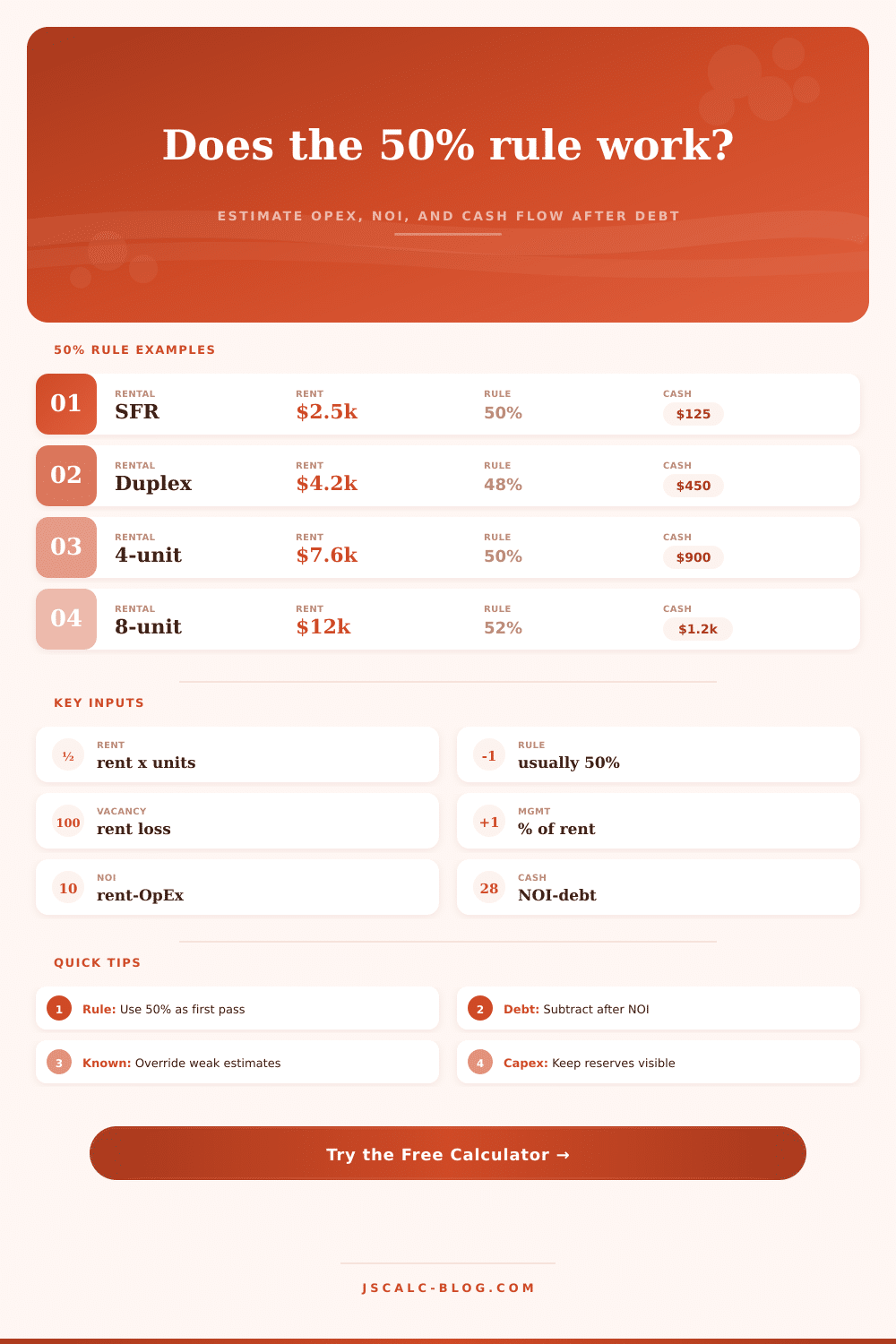
To fill the void between gross rent and net profit, the fifty percent rule provide a fast-and-dirty rule of thumb: half of your rental income will vanish as operating expenses. Use the calculator above to compare this approximation different than the particulars of your property.
Why You Should Use the 50% Rule for Real Estate Costs
If the house generate $2k per month, then you think that half, a grand, dissapears into management fees, vacancy, maintenance, insurance and taxes. That leaves another grand which is your pre-debt-service operating profit. Without having to spend hours auditing past expenses, this gives you a quick-and-dirty pass/fail test: does this deal make sense?
In most markets and across most expense categories, rent and the size or value of property predictably scale. But then again, life isn’t as pretty than a nice round percent. In practice, this rule understates costs when the turnover rate are high, like with an older property that needs lots of maintenance work. For example, a 19 eighty five single-family house will probably cost more than half its rent to maintain compared to a newer townhome built last year.
That’s why property type make such a huge difference when you adjust your percentage. Properties with heavy wear-and-tear (student housing) tend to skew higher; properties with low-turnover (stable family rentals) can tendency to skew lower since tenants stick around longer. You need to consider both the physical age of structure AND the quality of its systems.
Another variable that skews results in unexpected ways is vacancy. The calculator apply vacancy loss before calculating the expense estimate, which is a subtle but important distinction. You might assume a five percent vacancy rate on a fourplex. However, one empty unit will hit you much harder then one empty unit in an eight-unit building. Having more unit helps soften the impact of vacancy or turnover. Model this lost income realisticly, don’t hope for full occupancy throughout the entire year.
Once you account for debt service, everything changes. Cash flow let you know whether you can turn on the lights; Net operating income lets you know how well this property would perform as an independent asset. While it may seem great to have control over more units through high use of debt, there isn’t much wiggle room if repairs pile up or if expenses spike. Make sure your debt payment is comfortabley below your net operating income. Test with conservative vacancy assumptions and/or higher interest rates. This will help avoid any painful surprises down the line.
These are capital expenses. This is something many investor forget to include in their month-to-month estimates. Your roof won’t be replaced every year; neither will your HVAC or appliances. They’ll break down at random intervals … and each one will set you back some serious coin. A reserve account for large purchases shields you from raiding your own bank accounts during an emergency. More importantly, it forces honesty upon your cash flow analysis: all physical property decay over time, and deserves real reinvestments.
In the end, I find this type of tool to be most useful if you use it more for benchmarking purposes (against typical industry standards) instead of treating it as a definitive answer. You can adjust the inputs to test various “what-if” scenarios; how will the numbers change if repairs cost 10% more? What if vacancies increases by 2%? Doing so helps develop an understanding of where the money flows (and where the risks lie).
Many details matter in real estate and these little things can be the difference between success and failure. Some people do really well with houses. Others don’t. Some learn the real cost of owning an investment property while others cross their fingers and hope for the best. You should of looked closer at the numbers.
The 50% rule is a fast screening tool. But you should go further and learn what it will cost YOU. Make informed choices instead of hoping for the best. You’re not guessing when you’re doing the math right; you’ve got a plan.