70% Rule Flip Calculator
Estimate a flip's max allowable offer, deal spread, projected profit, and financing drag from ARV, repairs, holding time, selling costs, and your chosen rule percentage.
Use supported sold comps after the planned scope is complete.
Standard is 70%, but hotter or slower markets may shift.
Labor, materials, permits, utilities during work, and cleanup.
Applied to repair costs before profit math.
Title, escrow, transfer, buyer fees, and due diligence.
Agent commissions, seller credits, transfer fees, and closing.
Purchase to resale close, including listing and escrow.
Taxes, insurance, utilities, lawn, HOA, security, and debt service not entered below.
Percent of purchase price funded by a loan.
Points charged on the loan amount at purchase.
Interest-only estimate across the hold period.
Your required profit after all entered costs.
| Rule | MAO before buffer | MAO after buffer | Projected profit | Target gap |
|---|
The offer ladder keeps the same ARV, repairs, carrying costs, selling percentage, and financing assumptions while shifting only the rule percentage.
| Cost line | Formula | Input | Amount | Share of ARV |
|---|
The profit formula used here is profit = ARV - purchase - repairs - holding - selling - financing. Purchase closing costs are shown as a separate acquisition cost.
| Deal type | Typical rule | Repair buffer | Hold stress | Use when |
|---|---|---|---|---|
| Cosmetic refresh | 72% to 75% | 5% to 8% | 1 extra month | Paint, fixtures, flooring |
| Standard rehab | 68% to 72% | 8% to 12% | 2 extra months | Kitchen, bath, systems |
| Heavy rehab | 62% to 68% | 12% to 20% | 3 extra months | Layout, roof, major trades |
| High-end resale | 65% to 70% | 10% to 15% | 2 extra months | Premium finishes and longer buyer pool |
| Slow rural exit | 60% to 66% | 12% to 18% | 3 to 5 months | Thin comps or long listing time |
| Fast wholesale | 75% to 82% | 5% to 10% | 0 to 1 month | Assignment spread, not full rehab |
| Preset | ARV | Repairs | Rule | Hold | Selling |
|---|---|---|---|---|---|
| Starter Cosmetic Flip | $185,000 | $28,000 | 72% | 4 months | 6.5% |
| Suburban Rehab | $260,000 | $55,000 | 70% | 6 months | 7.0% |
| Heavy Rehab Bungalow | $315,000 | $92,000 | 65% | 8 months | 7.5% |
| Condo Refresh | $225,000 | $24,000 | 74% | 3 months | 6.0% |
| Small Multiunit | $410,000 | $82,000 | 70% | 7 months | 7.2% |
| Luxury Margin Check | $650,000 | $140,000 | 68% | 9 months | 6.8% |
| Tight-Margin Offer | $300,000 | $52,000 | 73% | 5 months | 6.5% |
| Fast Wholesale Exit | $190,000 | $35,000 | 80% | 1 month | 1.5% |
| Rural Slow Hold | $240,000 | $62,000 | 64% | 10 months | 8.0% |
MAO
ARV x rule percentage minus adjusted repairs gives the classic offer ceiling.
Repairs
Repair cost plus contingency keeps unknown scope visible before bidding.
Selling
ARV x selling percentage estimates commission, credits, and exit fees.
Financing
Loan points plus interest estimates borrowed-fund drag across the hold.
Profit
ARV minus purchase, repairs, closing, holding, selling, and financing.
With real estate, you can’t just rely on a house’s physical appearance to know its worth; you have to do the math and check comps. The kitchen is outdated. The carpet are worn. The siding is rotting. Maybe you want to purchase this home, fix it up, and flip it for profit. But you also need to weigh the risk to your finances.
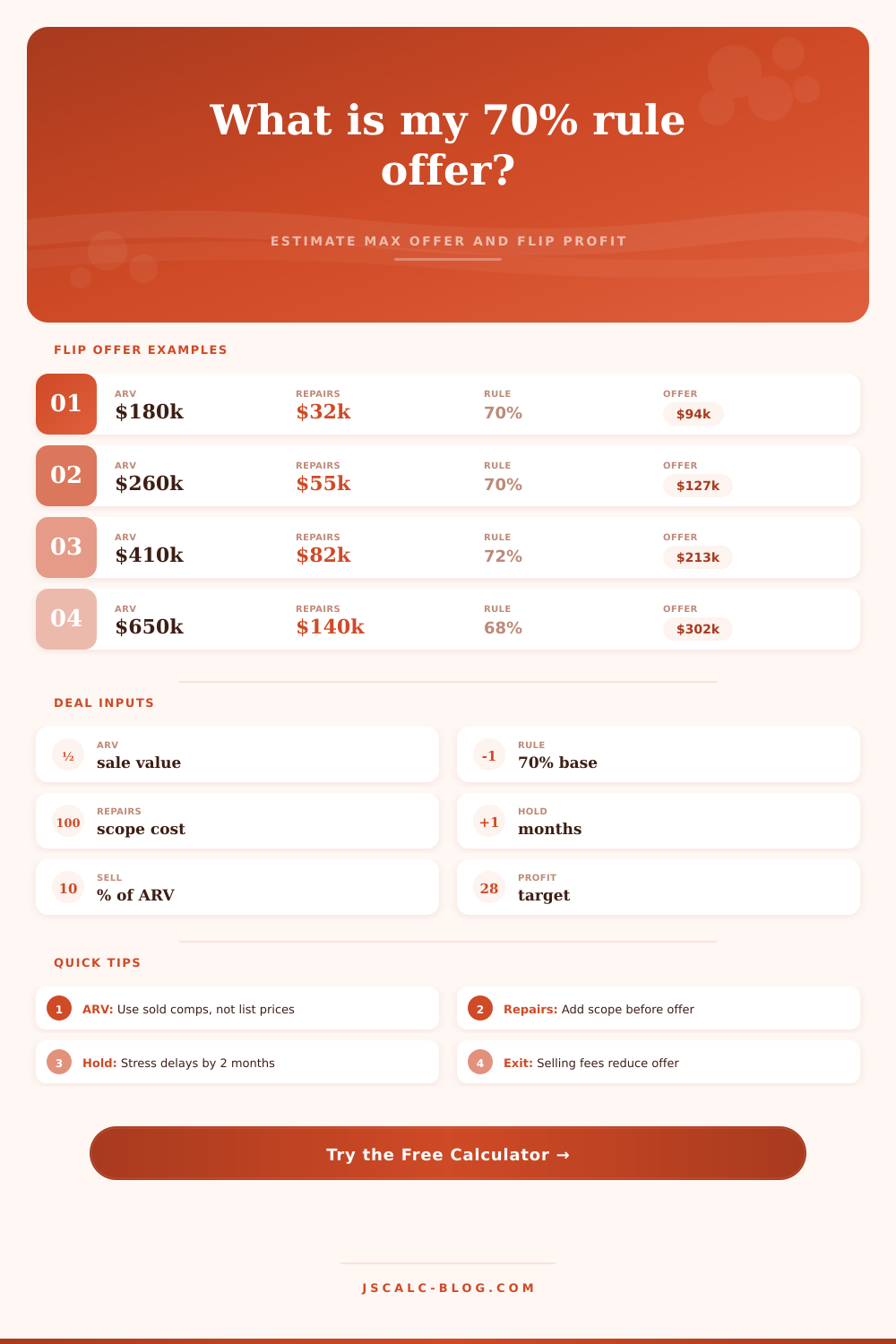
That’s where 70% rule comes into play. Think of it like a safety net. It prevents you from buying an investment that looks profitable on paper but ignores hidden costs. It’s a basic idea: 70% of After Repair Value (ARV). Subtract the cost of repairs. That’s how much you should of offer. Anything above that, and profit vanishes rapidy.
Why You Should Use the 70% Rule in Real Estate
This sounds so straightforward, yet it trips up so many investor. They’ll overlook condition of their comparisons when calculating ARV. They might use list price different than sales price. Suddenly, they’re looking at an apparently good investment, but when it comes time to buy, there’s no way to get out of bed. Once you plug in the numbers, all math happens automatically. It spits out an answer. No guesswork required. You can spend your time strategizing.
Failing to account for cost of capital and time kills new investors’ returns. Time isn’t free, if your property sits for six or nine months, that’s when it gets expensive. But if you’re lucky (or unlucky), it could take six to nine month. Every day that your house is vacant means losing money. The mortgage will continue accruing interest, not to mention utility bills, taxes and insurance. These holding costs lowers your potential profit before you even bring in a contractor.
Financing adds more costs. Interest and points mount up fast. That two point fee on an 80% loan may not sound like much now. Add six months plus a 10% annual interest rate and it represent a large chunk of what you expect to earn. And don’t forget to include your exit strategy costs. Yes, selling isn’t free. You have transfer taxes, closing fees on both sides (purchase/sale), and a realtor who take a commission.
If you’re flipping a cosmetic, that may work on 72% rule due to fast sales. But you might have a massive rehab in a slow neighborhood. That’s where you’ll need a 65% rule (or less) to cushion your profits. The lower cushion is due to greater risk of structural problems PLUS longer hold time.
Finally, there is one thing that investors forget about until it’s too late: contingency. Permits aren’t as cheap as you thought, the roof leaks, there’s mold behind the wall. I’d recommend adding 10 to 15 percent buffer to the estimated cost of repairs. Why? Because if things don’t go according to plan (and they never do), that buffer shields you from scope creep. What could be a financial disaster becomes simply an expense against your budget. And when everything goes right, hooray! You win some money.
You need profit goals. When you’re flipping houses, it’s about making money. Not fun. If you set a specific profit goal, that will force you to calculate backwards from the result you want. That will change how you think. It’ll prevent you from purchasing an investment just because “you can.” It’ll cause you to purchase only if numbers make sense financially.
Your margin for error is the distance between your projected profit and your target profit. The greater this gap, the more you can handle unexpected costs. The smaller this gap, then any delay (e.g., a missed permit) can wipe out your profit.
The 70% rule isn’t a perfect solution. It’s a filter. And it filters out a LOT of crappy deals early in the game, which will save you time on properties that don’t fit your business moddern. So while investors use it as a jumping-off point for success, they then take into account local market dynamics and their own level of operating efficiency.
Run the numbers. The numbers talk, but only when you examine them in detail. Maintain accurate comps. Be realistic with your repair estimates. Know what your exit costs are. Do those things, and that ugly house might seem less risky and a little bit more like a good deal.