2% Rule Rental Calculator
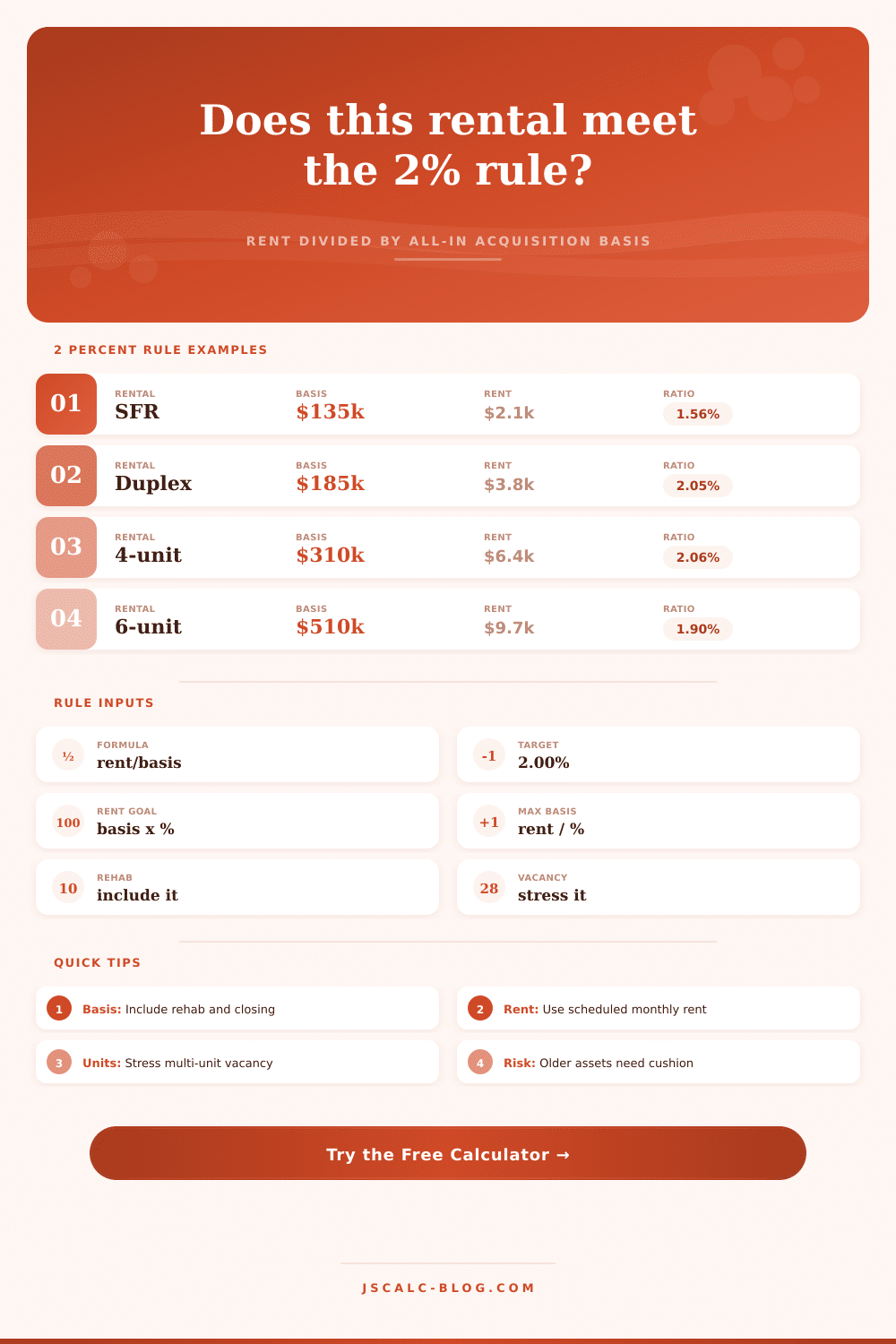
Screen a rental by dividing total monthly rent by all-in acquisition basis, including purchase price, rehab, closing costs, vacancy stress, unit count, and property risk class.
📌2% Rule Presets
📝Acquisition and Rent Inputs
Contract price or expected offer amount.
Include repairs needed before stable rent.
Lender fees, title, inspection, legal, and transfer items.
Use scheduled monthly rent for one unit.
Duplex and small multifamily stress views use this count.
Laundry, storage, parking, pet rent, or utility recovery.
Shown as a stress view; core 2% rule uses scheduled rent.
2.00% is the classic screen; adjust for your own target.
Adds a cushion target and stress comment.
Highlights how unit loss can change the monthly ratio.
📊Current 2% Rule Snapshot
⚙Formula Breakdown
🏘Preset Benchmark Table
| Preset | Purchase | Rehab | Closing | Units | Rent/unit | Other | All-in basis | Ratio | Result |
|---|
📉Duplex and Small Multifamily Stress View
| Stress scenario | Monthly rent used | Rent lost | Rule ratio | Gap to target | Best use |
|---|
🔧Rehab Inclusion Table
| Rehab added | All-in basis | Needed rent at target | Current ratio | Basis left before target |
|---|
📋Rule Interpretation Table
| Monthly ratio | Screen result | What it means | What to check next | Risk note |
|---|---|---|---|---|
| Below 1.00% | Weak for 2% rule | Rent is far below this high-cash-flow screen. | Check market rent, expenses, and strategy. | May still work for appreciation or low leverage. |
| 1.00% to 1.49% | Below target | Closer to a 1% style screen than a 2% rule screen. | Verify taxes, insurance, and repairs. | Thin margin if operating costs are high. |
| 1.50% to 1.99% | Near miss | Useful watchlist range when rents can stabilize higher. | Confirm rehab scope and rent comps. | Small errors can erase the cushion. |
| 2.00% to 2.49% | Meets classic rule | Scheduled monthly rent clears the traditional 2% screen. | Run NOI, debt, and capex analysis. | High ratio can signal rougher asset quality. |
| 2.50% or more | Very high screen | Rent is unusually high versus basis. | Inspect condition, collections, and legality. | Confirm no hidden vacancy or deferred work. |
🛡Risk Class Reference
| Risk class | Added target cushion | Typical issue | Stress to review | Use in calculator |
|---|---|---|---|---|
| Newer / renovated | 0.00% | Lower immediate repair risk | Normal vacancy | Classic 2% target can be enough for screening. |
| Standard rental | 0.10% | Routine turnover and systems | Vacancy plus light repairs | Default cushion for common rental stock. |
| Older systems | 0.25% | Roof, HVAC, plumbing, electrical | Capex and make-ready | Raises the target screen above 2%. |
| Heavy rehab | 0.50% | Scope drift and delayed rent | Higher rehab basis | Demands a larger rent-to-basis cushion. |
| Small multifamily | 0.20% | Turnover, utilities, collections | Lost unit and vacancy stacking | Use the multifamily stress options. |
| Student / rooming | 0.40% | Seasonality and higher turnover | Rent cut and vacancy jump | Review leases and local rules carefully. |
💡Practical 2% Rule Tips
When most novice landlords begin learning about investing, they asks a seemingly harmless question which turns out to be much more complicated then it appears. How do I know if an investment property will pay for itself? Before you sign a lease, you want to know whether or not it’s worth it. Most people use the “two percent rule,” and it quickly turns into an all-or-nothing filter … but many plugs in incorrect numbers.
Don’t focus solely on Multiple Listing Service sticker price; instead, evaluate the real dollars flowing out of your pocket. You plug all of that into the calculator above, which does the heavy lifting. It also calculates closing fees and rehab costs as part of total basis.
Why the Two Percent Rule Is Not Enough
You see? Most amateur analysis stop here. “Okay,” you say, “the property rents for three grand per month and lists for one hundred fifty thousand dollars. Nice! It yields a twenty percent monthly return. That is clearly ridiculous. Except now it’s not: now we’re talking about an investment of two hundred thousand dollars after spending ten grand on acquisition fees and another forty grand on getting the plumbing up to code. Suddenly, it’s a lot tougher math. Remember that basis is not simply price paid at time of purchase; it’s the real price of entry. Always factor in title insurance, inspections, and whatever urgent repairs is necessary to get the place livable. Otherwise, you’ll over-estimate your potential returns until you’ve moved in. This all-in figure serves as basis for the tool, which then uses that number to adjust your target rent, helping you set a realistic standard for how much cash flow should actualy look like.
The other variable that distinguishes rookie investors from seasoned ones are vacancy stress. Your duplex may look great with both sides rented, yet one vacancy annihilates half of your base revenue right there. It’s not a prediction of doom, just a test for resilience. If a property barely passes the two percent threshold at 100% occupancy, then expect to fail the screen when reality hits.
This tool also lets you tweak your expectations based off an asset’s physical condition, which should be different for a newly renovated property compared to it is an older one. An older one. For instance, if you’re investing in a turnkey condo with new systems and predictable performance, you may want to set a lower target. But if you invest in an older six-unit building with aging roofs and outdated wiring, you’ll want more of a cushion for deferred maintenance. In other words, it doesn’t force you to treat all rental as a standard cookie-cutter investment.
Also, running after high ratios alone can be a psychological trap. Often the reason property passes the two percent screen with flying colors is because there’s something wrong underneath it. Perhaps the neighborhood is on the decline. Or perhaps the units are tiny and need constant management as they turn over. High yield is sometimes correlated with high hassle. How do you balance the numbers against the operational reality of dealing with troublesome tenants or frequent repairs?
Don’t treat this as a test, a means of passing or failing. Instead, view it as a portfolio built to withstand changes in the market. Run the scenarios under stress conditions (e.g., what happens during increased vacancy rates, softened rents?) What’s your range? It is not a single point estimate of optimism. Now determine whether reward is worth the operational friction. This is merely the beginning of a much longer process.
If a property makes it through your screen, then you’ll want to look further into its cap ex reserves, insurance expenses, and tax considerations. You should of looked closer. The 2% rule is like a flashlight; it won’t illuminate the contents of the room. But it prevents you from walking into obvious pitfalls, while still allowing time for more thorough checking of potential opportunites.
In the end, having good judgment when you’re initially screening protects you from making expensive errors down the road. You’ll screen out vanity metrics, and hone in on what realy matters, real cash flow potential divided by true acquisition cost. At times it may seem restrictive, but these numbers establishes a safety net for your money. By respecting total cost rather than just the purchase price, you make much more realistic investment decisions.